
Question 892 marksEasy
What is the significance of atomic number in the modern periodic table ?
Confirming your payment
Sign up now and get 250 free tokens.
Periodic Table, Periodic Properties and Variations of Properties · Question 89 of 99
What is the significance of atomic number in the modern periodic table ?
Solution:
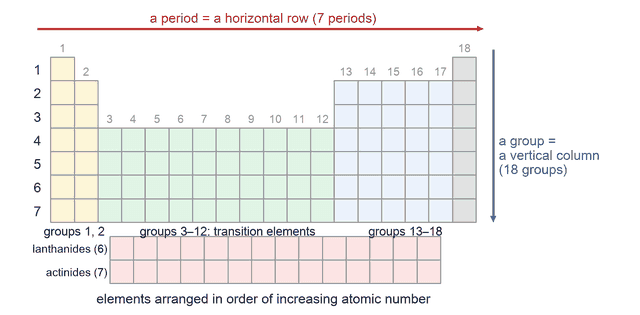
Concept: The modern periodic law says that the physical and chemical properties of the elements are periodic functions of their atomic numbers. The modern periodic table arranges the elements in order of increasing atomic number in 18 vertical groups and 7 horizontal periods.
Step 1 — It fixes the order of the elements.
The elements are arranged in order of increasing atomic number, as the modern periodic law requires.
Step 2 — It fixes the position of each element.
The atomic number decides the electronic configuration, and so the number of shells (the period) and the number of valence electrons (the group) of each element.
Step 3 — It explains periodicity.
Properties depend on the valence electrons, so elements with similar properties fall in the same group, and properties recur at regular intervals of atomic number.
Step 4 — It removes the anomalies of Mendeleev's table.
Isotopes, with the same atomic number, take a single place. Pairs such as argon and potassium fall in their correct order: argon, atomic number 18, comes before potassium, atomic number 19, although its atomic mass (39.9) is greater than that of potassium (39.1).
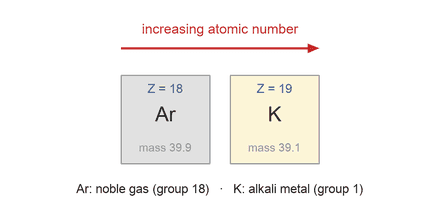
Watch out: The modern table is ordered by atomic number, not atomic mass; Ar and K would be swapped by mass.
Therefore, the atomic number is the basis of the modern periodic table: it decides the order, the period and group of each element, and removes Mendeleev's anomalies.