
Question 904 marksMedium
Arrange the following in order of :
(i) increasing radii.
(a) , Cl (b) , Mg, (c) N, O, P
(ii) increasing ionisation energy.
(a) P, Na, Cl (b) F, O, Ne (c) Ne, He, Ar
Explain your choice.
Confirming your payment
Sign up now and get 250 free tokens.
Periodic Table, Periodic Properties and Variations of Properties · Question 90 of 99
Arrange the following in order of :
(i) increasing radii.
(a) , Cl (b) , Mg, (c) N, O, P
(ii) increasing ionisation energy.
(a) P, Na, Cl (b) F, O, Ne (c) Ne, He, Ar
Explain your choice.
Solution:
Concept: An ion has the same number of protons as its atom. A cation has lost electrons, so the same nuclear pull acts on fewer electrons and the particle is smaller than its atom; an anion has gained electrons, so the repulsion between electrons grows and the particle is larger than its atom. Atomic size (atomic radius) depends on the number of shells and on the nuclear charge. Down a group a new shell is added at each step, so atoms get bigger; across a period the shells stay the same while the nuclear charge rises, so atoms get smaller. Ionisation energy follows the opposite trend to size.
Step 1 — Part (i)(a): Cl and Cl⁻.
has 18 electrons and 17 protons. The extra electron increases the repulsion and reduces the pull on each electron, so the ion expands.
Cl <
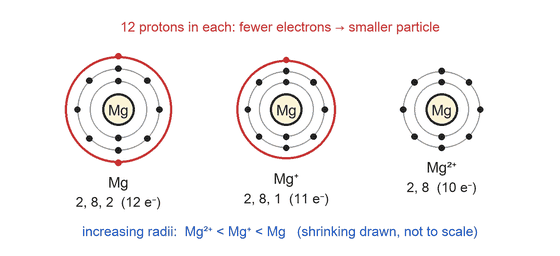
Step 2 — Part (i)(b): Mg²⁺, Mg and Mg⁺.
Every electron lost leaves the same 12 protons pulling on fewer electrons, so the particle shrinks; (2, 8) has also lost its third shell.
< < Mg
Step 3 — Part (i)(c): N, O and P.
O is to the right of N in period 2, with a greater nuclear charge, so it is smaller (66 against 70 pm). P is in period 3 and has an extra shell (110 pm).
O < N < P
Step 4 — Part (ii)(a) and (b): P, Na, Cl and F, O, Ne.
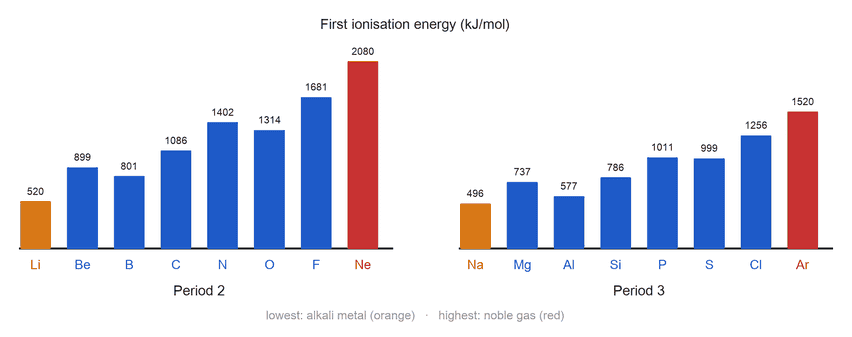
Within a period, ionisation energy rises from left to right as the size falls and the nuclear charge rises.
Na < P < Cl (496 < 1011 < 1256 kJ mol⁻¹)
O < F < Ne (1314 < 1681 < 2080 kJ mol⁻¹; neon's stable octet gives the highest value)
Step 5 — Part (ii)(c): Ne, He and Ar.
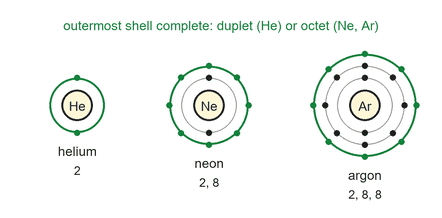
In group 18 ionisation energy falls down the group as the atoms get bigger (one more shell at each step), so helium has the highest value.
Ar < Ne < He (1520 < 2080 < 2372 kJ mol⁻¹)
Watch out: In (i)(c) compare O and N first (same period, O smaller); P, below N in group 15, has an extra shell and is the largest.
Therefore, (i) (a) Cl < Cl⁻, (b) Mg²⁺ < Mg⁺ < Mg, (c) O < N < P; (ii) (a) Na < P < Cl, (b) O < F < Ne, (c) Ar < Ne < He.