
Question 912 marksEasy
Atomic numbers of elements A, B, C, D, E, F are 8, 7, 11, 12, 13 and 9 respectively. State the type of ions they form.
Confirming your payment
Sign up now and get 250 free tokens.
Periodic Table, Periodic Properties and Variations of Properties · Question 91 of 99
Atomic numbers of elements A, B, C, D, E, F are 8, 7, 11, 12, 13 and 9 respectively. State the type of ions they form.
Solution:
Concept: Metals (1 to 3 valence electrons) lose electrons to form cations; non-metals (5 to 7 valence electrons) gain electrons to form anions. The charge equals the number of electrons lost or gained.
Step 1 — Write each configuration and read off the ion.
Each atomic number gives the configuration, and the valence electrons tell whether electrons are lost or gained.
| Element | Configuration | Ion formed |
|---|---|---|
| A (8) | 2, 6 | anion (gains 2) |
| B (7) | 2, 5 | anion (gains 3) |
| C (11) | 2, 8, 1 | cation (loses 1) |
| D (12) | 2, 8, 2 | cation (loses 2) |
| E (13) | 2, 8, 3 | cation (loses 3) |
| F (9) | 2, 7 | anion (gains 1) |
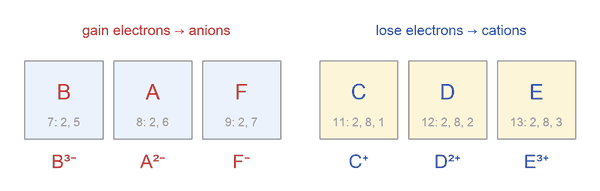
Step 2 — Group the answers.
A, B and F have 6, 5 and 7 valence electrons, so they gain electrons; C, D and E have 1, 2 and 3, so they lose them.
Watch out: For a non-metal the charge is 8 minus the valence electrons (B with 5 forms B³⁻), not the valence electrons themselves.
Therefore, A, B and F form anions (A²⁻, B³⁻, F⁻), and C, D and E form cations (C⁺, D²⁺, E³⁺).