
Question 925 marksMedium
Give reasons :
(a) The oxidising power of elements increases from left to right along a period.
(b) Ionisation potential of elements increases across a period from left to right.
(c) Alkali metals are good reducing agents.
Confirming your payment
Sign up now and get 250 free tokens.
Periodic Table, Periodic Properties and Variations of Properties · Question 92 of 99
Give reasons :
(a) The oxidising power of elements increases from left to right along a period.
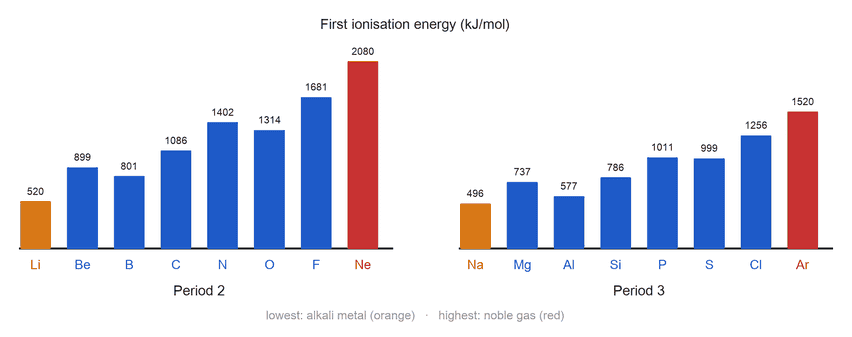
(b) Ionisation potential of elements increases across a period from left to right.
(c) Alkali metals are good reducing agents.
Solution:
Concept: Across a period the nuclear charge increases and the atomic size decreases. Alkali metals have the largest atoms and the lowest ionisation potentials of their periods. A reducing agent is an electron donor (it loses electrons and is itself oxidised); an oxidising agent is an electron acceptor (it gains electrons and is itself reduced).
Step 1 — Part (a): oxidising power across a period.
Oxidising power is the tendency to gain electrons. As the atoms get smaller and the nuclear charge increases from left to right, an incoming electron is attracted more strongly, so the oxidising power increases; chlorine is the strongest oxidising agent of period 3.
Step 2 — Part (b): ionisation potential across a period.
From left to right the nuclear charge increases while the number of shells stays the same, so the atomic size decreases. The valence electrons are held more firmly, so more energy is needed to remove one (Na 496 to Ar 1520 kJ mol⁻¹).
Step 3 — Part (c): alkali metals are good reducing agents.
Alkali metals have only one valence electron, a large atomic size and a low ionisation potential, so they lose that electron very easily.
A substance that donates electrons is a reducing agent, so alkali metals are good reducing agents.
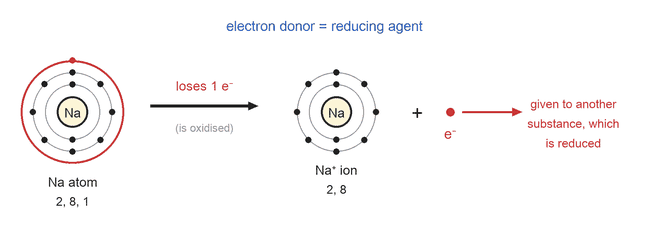
Watch out: A reducing agent is itself oxidised: sodium is oxidised to Na⁺ while it reduces something else.
Therefore, (a) smaller atoms with more nuclear charge gain electrons more readily; (b) electrons are held more firmly across a period; (c) alkali metals lose their single valence electron very easily.