
Question 463 marksMedium
(a) Arrange the elements of second and third periods in increasing order of their ionisation energy.
(b) The element with the highest ionisation potential is :
A. Hydrogen B. Caesium
C. Radon D. Helium (2020)
Confirming your payment
Sign up now and get 250 free tokens.
Periodic Table, Periodic Properties and Variations of Properties · Question 46 of 99
(a) Arrange the elements of second and third periods in increasing order of their ionisation energy.
(b) The element with the highest ionisation potential is :
A. Hydrogen B. Caesium
C. Radon D. Helium (2020)
Solution:
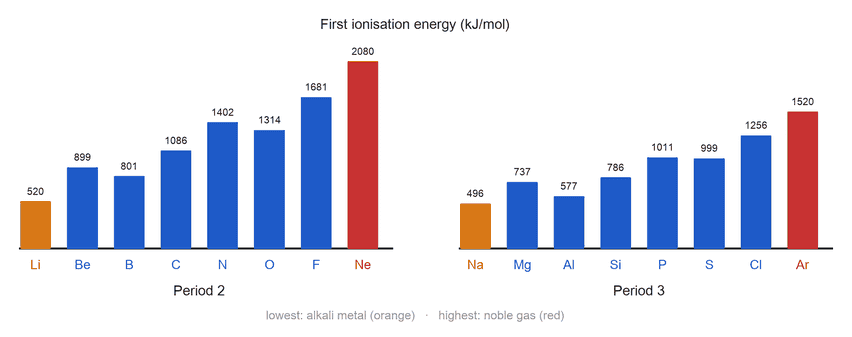
Concept: Ionisation energy (ionisation potential) is the energy needed to remove an electron from a neutral isolated gaseous atom. It is higher when the atom is small and the nuclear charge is large, so it increases across a period and decreases down a group. The book's first ionisation energies (kJ mol⁻¹) give the exact order.
Step 1 — Part (a): arrange period 2.
Li < B < Be < C < O < N < F < Ne
(520 < 801 < 899 < 1086 < 1314 < 1402 < 1681 < 2080)
Step 2 — Part (a): arrange period 3.
Na < Al < Mg < Si < S < P < Cl < Ar
(496 < 577 < 737 < 786 < 999 < 1011 < 1256 < 1520)
Step 3 — Part (a): explain the exceptions.
The general trend is a rise from left to right. Be and N have higher values than B and O, and Mg and P higher than Al and S, because their configurations are extra stable (fully filled or half-filled sub-shells), so their electrons are harder to remove.
Step 4 — Part (b): choose the highest ionisation potential.
Helium is the smallest noble gas, with a stable duplet held close to the nucleus, so it has the highest ionisation potential of all elements (2372 kJ mol⁻¹). Hydrogen has a single electron in an incomplete shell (1312 kJ mol⁻¹), and caesium and radon are much larger atoms.
Watch out: Do not simply list the elements in table order; Be/B, N/O, Mg/Al and P/S are swapped in the true order.
Therefore, (a) period 2: Li < B < Be < C < O < N < F < Ne; period 3: Na < Al < Mg < Si < S < P < Cl < Ar; (b) D. Helium.