Solution:
Concept: Electron affinity is the energy released when a neutral isolated gaseous atom accepts an electron to form an anion. A small atom with a large nuclear charge attracts the extra electron strongly, so electron affinity increases across a period and decreases down a group.
Step 1 — Part (a): define the term and give the unit.
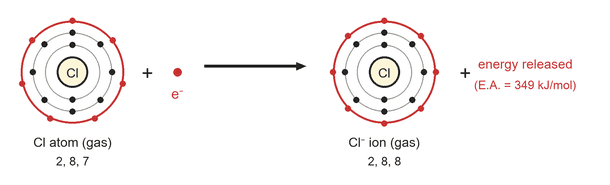
Electron affinity is the amount of energy released when a neutral isolated gaseous atom accepts an electron to form a gaseous anion.
Cl(g)+e−→Cl−(g)+energy
It is measured in eV/atom or kJ mol⁻¹; for chlorine 349 kJ mol⁻¹ is released.
Step 2 — Part (b): arrange period 2.
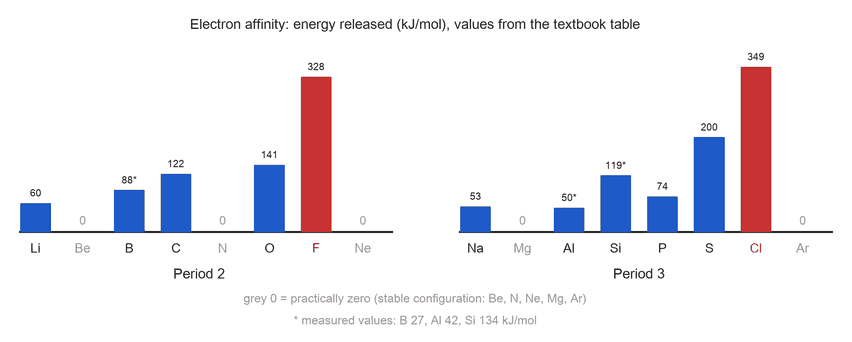
Using the book's table (energy released, kJ mol⁻¹), the elements that accept an electron, in increasing order, are:
Li < B < C < O < F
(60 < 88 < 122 < 141 < 328)
Step 3 — Part (b): name the exceptions.
Beryllium, nitrogen and neon do not follow the trend. Their configurations are stable (Be 2, 2; N 2, 5 with a half-filled sub-shell; Ne 2, 8 with a full octet), so they have practically zero electron affinity and come first in any increasing order.
Step 4 — Part (c): fluorine or neon.
Neon already has a complete octet and no tendency to accept an electron, so its electron affinity is zero. Fluorine needs just one electron to complete its octet, so fluorine has the higher E.A.
Watch out: Electron affinity is energy released; do not confuse it with ionisation energy, which is energy absorbed.
Note: the order Li < B uses the book's value for boron (88 kJ mol⁻¹). Measured data give boron only about 27 kJ mol⁻¹, which would put B before Li; the book's order is the one expected in the exam.
Therefore, (a) E.A. is the energy released when a gaseous atom gains an electron (kJ mol⁻¹); (b) Be, N, Ne (≈ 0) < Li < B < C < O < F, with Be, N and Ne as the exceptions; (c) fluorine.
