
Question 144 marksEasy
How do the following vary on moving from left to right in the third period of the periodic table ?
(i) valence electrons and
(ii) valency
Confirming your payment
Sign up now and get 250 free tokens.
Periodic Table, Periodic Properties and Variations of Properties · Question 14 of 99
How do the following vary on moving from left to right in the third period of the periodic table ?
(i) valence electrons and
(ii) valency
Solution:
Concept: Period 3 runs Na, Mg, Al, Si, P, S, Cl, Ar. All eight have three shells, and one more electron is added to the outer shell at each step. Valency is the number of electrons an atom loses, gains or shares to reach a stable octet (a duplet for the first shell). Atoms with 1, 2 or 3 valence electrons lose them, so their valency equals the number of valence electrons; atoms with 5, 6 or 7 gain electrons, so their valency is 8 minus that number.
Step 1 — Part (i): count the valence electrons.
The valence electrons increase from 1 to 8: Na 1, Mg 2, Al 3, Si 4, P 5, S 6, Cl 7, Ar 8.
Step 2 — Part (ii): find the valency of the first four.
Na, Mg, Al and Si lose (or share) all their valence electrons, so their valency equals the number of valence electrons: Na 1, Mg 2, Al 3, Si 4.
Step 3 — Part (ii): find the valency of the rest.
P, S and Cl gain (or share) electrons to complete the octet, so their valency is 8 minus the valence electrons: P 3, S 2, Cl 1. Argon already has a complete octet, so its valency is 0.
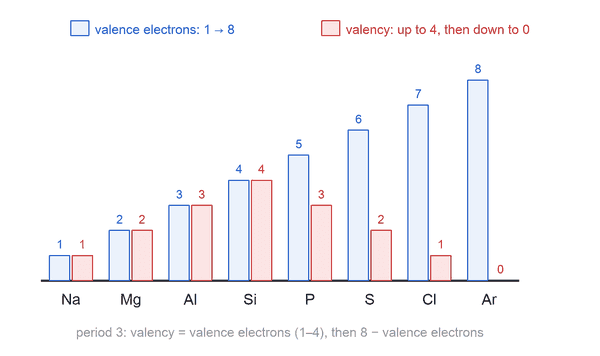
Watch out: Valency does not keep rising with the valence electrons; it rises to 4 and then falls.
Therefore, (i) valence electrons increase from 1 to 8; (ii) valency increases from 1 to 4 and then decreases to 0.