Solution:
Concept: Size and reactivity depend on how strongly the nucleus pulls on the outer electrons, against the repulsion between the electrons themselves.
Step 1 — Part (i): Cl⁻ ion is bigger than the Cl atom.
Cl− has 18 electrons but still only 17 protons. The extra electron increases the repulsion between electrons, and the pull of the nucleus on each electron falls, so the ion expands.
Cl+e−→Cl−
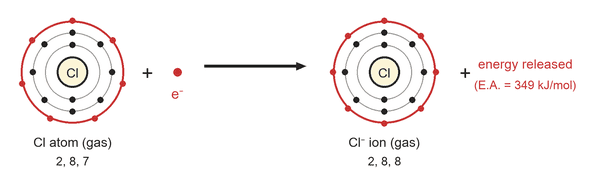
Step 2 — Part (ii): argon atom is bigger than chlorine atom.
Argon (2, 8, 8) has a complete octet. With its outer shell full, the repulsion between the electrons is at its greatest and the shell expands, so argon is bigger than chlorine (2, 8, 7) even though it lies to its right.
Step 3 — Part (iii): chlorine is less reactive than fluorine.
Chlorine has three shells and fluorine only two. Chlorine's outer shell is farther from the nucleus, so it attracts an extra electron less strongly, and its tendency to gain an electron (its reactivity) is smaller.
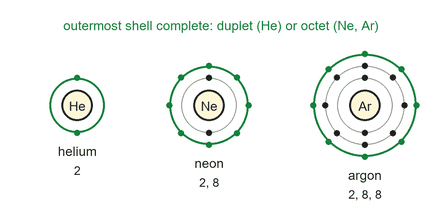
Step 4 — Part (iv): inert gases do not form ions.
Their outer shell is stable and completely filled (a duplet for helium, an octet for the rest). They have very high ionisation energies and practically zero electron affinity, so they neither lose nor gain electrons.
Watch out: In (iii), fluorine is more reactive even though chlorine releases slightly more energy on gaining an electron (349 against 328 kJ mol⁻¹); reactivity is judged by the small size and strong pull of fluorine.
Therefore, (i) the extra electron in Cl⁻ increases repulsion; (ii) argon's full octet expands its shell; (iii) chlorine's larger atom attracts electrons less strongly; (iv) inert gases have a stable full outer shell.
