
Question 424 marksEasy
(a) Define the term 'ionisation potential'. (2010)
(b) Represent it in the form of an equation. In which unit is it measured?
Confirming your payment
Sign up now and get 250 free tokens.
Periodic Table, Periodic Properties and Variations of Properties · Question 42 of 99
(a) Define the term 'ionisation potential'. (2010)
(b) Represent it in the form of an equation. In which unit is it measured?
Solution:
Concept: An electron is held in an atom by the attraction of the nucleus, so energy must be supplied to pull it out.
Step 1 — Part (a): define the term.
Ionisation potential is the energy required to remove an electron from a neutral isolated gaseous atom and convert it into a positively charged gaseous ion. It is also called ionisation energy (I.E.) or first ionisation energy.
Step 2 — Part (b): write it as an equation.
For any element M, the energy is taken in on the left and the electron leaves on the right.
For sodium, for example:
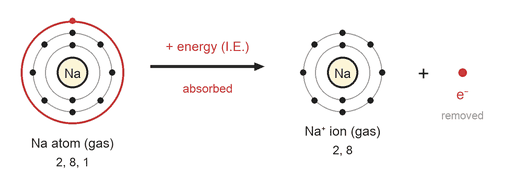
Step 3 — Part (b): state the unit.
It is measured in electron volts per atom (eV/atom); its S.I. unit is kilojoule per mole (kJ mol⁻¹). Sodium's value is 496 kJ mol⁻¹.
Watch out: The atom must be isolated and gaseous; energy for removing an electron from a solid metal is a different quantity.
Therefore, ionisation potential is the energy needed to remove an electron from a neutral isolated gaseous atom, M(g) + I.E. → M⁺(g) + e⁻, measured in eV/atom or kJ mol⁻¹.