
Question 434 marksEasy
Ionisation Potential values depend on (a) atomic size (b) nuclear pull. Explain.
Confirming your payment
Sign up now and get 250 free tokens.
Periodic Table, Periodic Properties and Variations of Properties · Question 43 of 99
Ionisation Potential values depend on (a) atomic size (b) nuclear pull. Explain.
Solution:
Concept: The more firmly an outer electron is held, the more energy is needed to remove it. Two things decide how firmly it is held: the distance from the nucleus (atomic size) and the charge of the nucleus.
Step 1 — Part (a): atomic size.
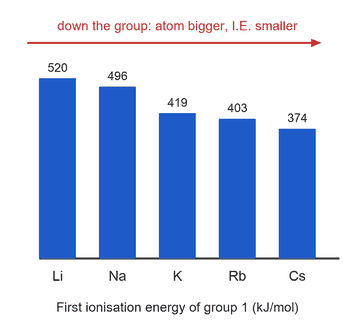
The larger the atom, the farther its outer electrons are from the nucleus and the weaker the attraction on them. So they are removed more easily: a larger atom has a lower ionisation potential.
Down group 1 the atoms grow and the ionisation energy falls: Li 520, Na 496, K 419 kJ mol⁻¹.
Step 2 — Part (b): nuclear pull (nuclear charge).
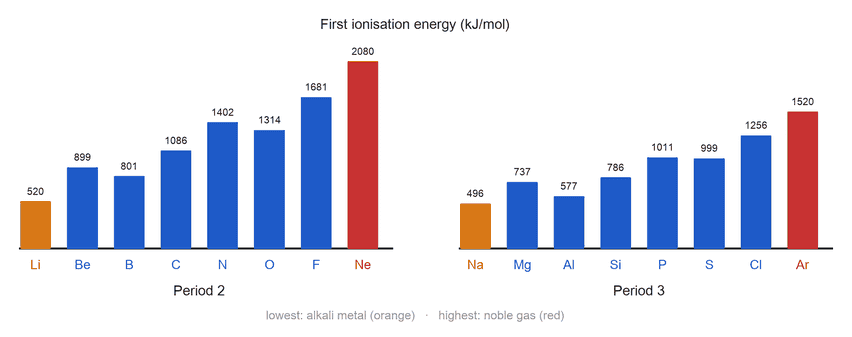
The greater the nuclear charge, the more strongly the outer electrons are attracted, so more energy is needed to remove one: a greater nuclear pull gives a higher ionisation potential.
Across period 3 the nuclear charge rises from +11 to +18 and the ionisation energy rises from Na 496 to Ar 1520 kJ mol⁻¹.
Watch out: The two effects act in opposite directions: size lowers the ionisation potential, nuclear charge raises it.
Therefore, ionisation potential decreases as atomic size increases, and increases as the nuclear pull increases.