
Opening your dashboard
Class 10 Chemistry Chapter 1 Periodic Table, Periodic Properties and Variations of Properties: Competency-Based Questions (CBQ)
40 questions on Chapter 1, each worked through on its own page with the AI tutor. Class 10 Chemistry, ICSE 2026-27.
40 questions
1–5 marks · Mixed difficulty
- 11 mark
Question 1
Cognitive domain: Understanding · CISCE Competency-Focused Practice Questions 2024, Q7
Group Numbers IA 1 IIA 2 IIIA 13 IVA 14 VA 15 VIA 16 VIIA 17 VIIIA 18 Li D O J Ne A Mg E Si H K B C F G L With reference to the portion of the periodic table given above, identify the element having the largest atomic size:
- 21 mark
Question 2
Cognitive domain: Analysis & Application · CISCE Competency-Focused Practice Questions 2024, Q31
Which of the following arrangements is INCORRECT as per the property stated against it?
- 31 mark
Question 3
Cognitive domain: Application · CISCE Competency-Focused Practice Questions 2024, Q46
The atomic size of Boron is 0.88 Å, and that of nitrogen is 0.70 Å. Nitrogen lies to the ________ (left/ right) of Boron.
- 45 marks
Question 4
Cognitive domain: Recall · CISCE Competency-Focused Practice Questions 2024, Q50
Match the items in Column A with the correct set of elements in Column B.
Column A Column B (a) Alkali metals (i) Be, C, O, F (b) Alkaline earth metals (ii) F, Cl, Br, I (c) Atomic radius decreases (iii) P, Al, Na, S (d) Non-metallic character decreases (iv) K, Na, Li, Rb (e) Period 3 elements (v) Ba, Ca, Sr, Ra - 55 marks
Question 5
Cognitive domain: Analysis · CISCE Competency-Focused Practice Questions 2024, Q55
Match the descriptions in Column A with a corresponding left-to-right order of arrangement of elements in Column B.
Column A Column B (a) Increasing number of shells (i) F > Cl > Br (b) Increasing reactivity (ii) Cl > F > Br (c) Decreasing electron affinity (iii) Ca > Mg > Be (d) Decreasing electronegativity (iv) F < Cl < Br (e) Decreasing metallic character (v) Br < Cl < F - 61 mark
Question 6
Cognitive domain: Understanding & Application · CISCE Competency-Focused Practice Questions 2024, Q63
Element X belongs to period 2 and group 1 of the periodic table. State the formula of the chloride of the element X.
- 71 mark
Question 7
Cognitive domain: Understanding & Application · CISCE Competency-Focused Practice Questions 2024, Q90
Ionisation energies of 4 elements A, B, C and D are 496, 403, 520 and 419 kJ/mol, respectively. If these elements belong to the same group in the Periodic Table, which element will occupy the top position in the group? Justify your answer.
- 83 marks
Question 8
Cognitive domain: Analysis & Application · CISCE Competency-Focused Practice Questions 2024, Q115
Study the information given in the table below and answer the questions that follow. (Note - the letters do not represent the actual symbols of the elements)
Element Electronic configuration Ionisation energy () X 2, 2 900 Y 2, 8, 2 738 Z 2, 8, 8, 2 590 (a) Explain why element X has highest ionisation energy.
(b) To which period does Z belong?
(c) Draw the electron dot structure of the compound formed between Z and oxygen.
- 91 mark
Question 9
Cognitive domain: Analysis
The stock register of a school chemistry store lists three coloured non-metallic elements of the same group under the code letters P, Q and R (not their symbols). The store room is at 30 °C.
Element Melting point (°C) Boiling point (°C) P −101.5 −34.0 Q −7.2 58.8 R 113.7 184.3 Which statement about these elements is correct?
- 101 mark
Question 10
Cognitive domain: Application
While revising, Riya writes the formulae of the hydrides of the first four elements of period 3 in order: , , , . She sees that the number of hydrogen atoms rises by one each time, so she continues the pattern and writes for phosphorus and for sulphur.
Which option gives the correct formulae of the two hydrides and the correct reason?
- 111 mark
Question 11
Cognitive domain: Understanding
Assertion (A): The third period of the modern periodic table contains 18 elements.
Reason (R): The third shell (M shell) of an atom can hold a maximum of 18 electrons.
- 121 mark
Question 12
Cognitive domain: Understanding
Assertion (A): Sodium metal acts as a strong reducing agent when it reacts with chlorine.
Reason (R): Sodium metal is a good conductor of electricity.
- 132 marks
Question 13
Cognitive domain: Application
The seventh period of the modern periodic table is now complete. Its last element, a noble gas, has atomic number 118. Research laboratories are trying to make the element with atomic number 119, which has not been made so far.
(a) In which period and group of the periodic table should element 119 be placed? Give a reason.
(b) Predict its valency and state whether it should be a metal or a non-metal. Name one known element that it should resemble closely.
- 144 marks
Question 14
Cognitive domain: Analysis
At the annual science exhibition of a school in Pune, Aditi's team displayed the oxides of three elements of the third period, coded W, X and Y (these are not their symbols). They shook a little of each oxide with water and tested the liquid with litmus paper. One oxide did not dissolve, so they warmed fresh samples of it separately with dilute hydrochloric acid and with sodium hydroxide solution. An oxide that reacts with both an acid and an alkali is called an amphoteric oxide. Their observations are given below.
Oxide of With water and litmus With dilute acid With alkali W dissolves; the solution turns red litmus blue not tested not tested X does not dissolve; litmus does not change reacts and dissolves reacts and dissolves Y dissolves; the solution turns blue litmus red not tested not tested (a) Classify the oxide of each of W, X and Y as acidic, basic or amphoteric.
(b) Arrange W, X and Y in the order in which they occur from left to right in the period, and give the reason. Which of them has the largest atom, and which has the highest electronegativity?
(c) The team wants to add the oxide of the element that lies just below W in the same group. Should its solution in water be more strongly or less strongly alkaline than that of the oxide of W? Explain in terms of metallic character.
- 154 marks
Question 15
Cognitive domain: Evaluation
In the chemistry store of a school in Kochi, the laboratory attendant keeps small pieces of three alkali metals in separate bottles of kerosene (density about 0.80 g/cm³). New students notice that the pieces of sodium and potassium lie at the bottom of their bottles, but the pieces of lithium float at the top. The attendant tells them his rule of thumb: "The lower an alkali metal is in its group, the denser it is and the more easily it melts." The students look up the data in their textbook.
Metal Atomic number Density (g/cm³) Melting point (°C) Lithium 3 0.54 180.5 Sodium 11 0.97 98 Potassium 19 0.86 63.5 (a) Use the data to explain why lithium floats on kerosene while sodium and potassium sink in it.
(b) Judge each half of the attendant's rule against the data. Which half holds for all three metals, and where does the other half fail?
(c) Rubidium lies just below potassium in the group. State whether its melting point should be above or below 63.5 °C. Explain why a freshly cut surface of rubidium should lose its shine in air faster than a freshly cut surface of potassium.
- 165 marks
Question 16
Cognitive domain: Creativity
For Science Day, Kabir's group has to design one chart that lets a visitor see periodicity instead of only reading its definition. They collect the atomic radii of some elements from their textbook. The noble gases are left out.
Element Li Be B C N O F Atomic number 3 4 5 6 7 8 9 Atomic radius (pm) 152 112 88 77 70 66 64 Element Na Mg Al Si P S Cl K Atomic number 11 12 13 14 15 16 17 19 Atomic radius (pm) 186 160 143 117 110 104 99 231 (a) Describe the chart you would draw for them: what goes on each axis, and what pattern a visitor will see in it.
(b) At which atomic numbers in the chart does a new period begin? Explain, in terms of shells and nuclear charge, the shape of the chart at these points and between them.
(c) Calcium (atomic number 20) is not in their data. Use the pattern to propose a range within which its atomic radius should lie, and justify both limits.
(d) Suggest one more quantity that the group could plot against atomic number on the same chart to show the visitor the cause of the repeating pattern. Say what its plot would look like.
- 171 mark
Question 17
Cognitive domain: Understanding
The chart in the school corridor lists the elements with atomic numbers 3 to 18, in order, with the number of electrons in the outermost shell of each atom.
Atomic number 3 4 5 6 7 8 9 10 Electrons in the outermost shell 1 2 3 4 5 6 7 8 Atomic number 11 12 13 14 15 16 17 18 Electrons in the outermost shell 1 2 3 4 5 6 7 8 Which of the following is not a periodic property of these elements?
- 181 mark
Question 18
Cognitive domain: Application
In a chemistry quiz, a team is told only this about an element X: an ion of X carries a charge of and has the electronic configuration 2, 8, 8. The letter X is not the chemical symbol of the element.
Which statement about the element X is correct?
- 191 mark
Question 19
Cognitive domain: Analysis
The figure shows the arrangement of electrons in the shells of three atoms P, Q and R. The letters are not chemical symbols.
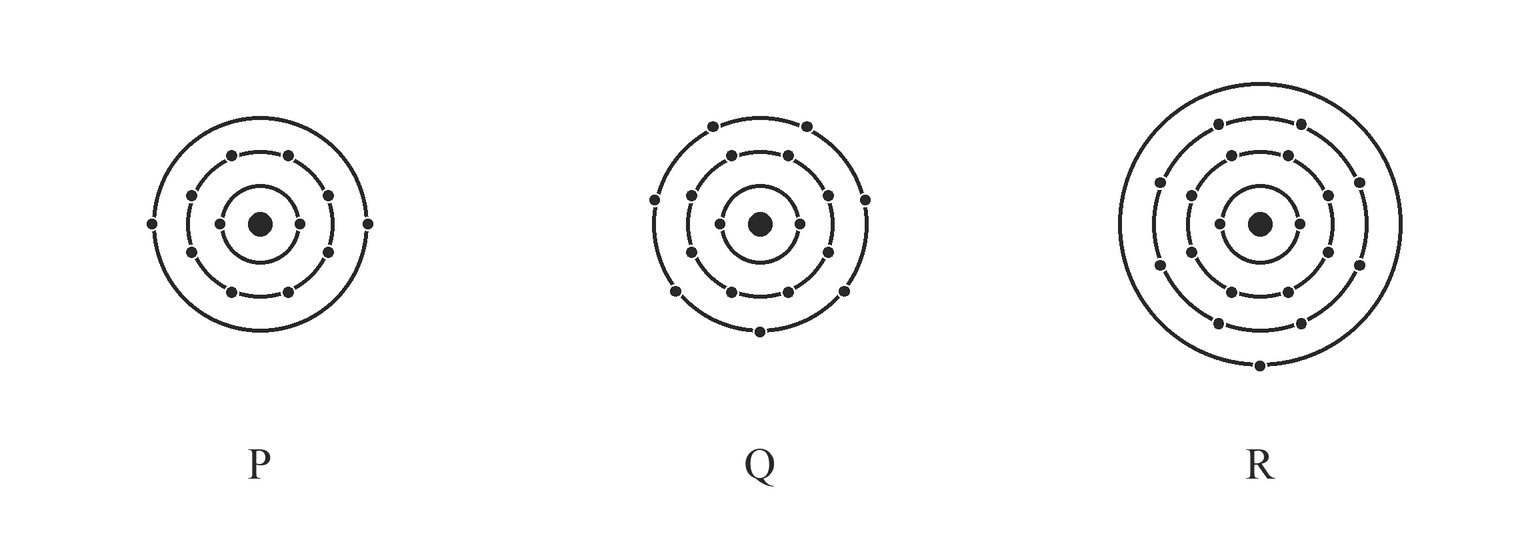
Which statement about P, Q and R is correct?
- 201 mark
Question 20
Cognitive domain: Analysis
Three elements P, Q and R belong to the third period, and they are not named. Their electronegativity values on the Pauling scale are 0.9, 1.5 and 3.0 respectively. Which statement about these elements is correct?
- 211 mark
Question 21
Cognitive domain: Understanding
Assertion (A): The lanthanides and the actinides are shown in two separate rows below the main body of the modern periodic table.
Reason (R): The properties of these elements are so different from those of every other element that they cannot be placed in any group.
- 221 mark
Question 22
Cognitive domain: Analysis
For a class quiz, Kunal compares the first member of group 1 with the first member of group 17.
Assertion (A): Lithium is the least reactive of the alkali metals, whereas fluorine is the most reactive of the halogens.
Reason (R): Lithium and fluorine both lie in period 2 of the modern periodic table.
- 231 mark
Question 23
Cognitive domain: Evaluation
Astatine (atomic number 85) lies just below iodine in group 17. It is radioactive and only tiny amounts of it exist, so its properties are predicted from the trends of the group. The table gives the data for the halogens, and the values for astatine are estimates.
Element Atomic number Atomic radius (pm) Electronegativity State at room temperature Fluorine 9 64 4.0 gas Chlorine 17 99 3.0 gas Bromine 35 114 2.8 liquid Iodine 53 133 2.5 solid Astatine 85 150 2.2 ? Which prediction about astatine, made from the group trends, is best?
- 241 mark
Question 24
Cognitive domain: Evaluation
Carbon, silicon, germanium, tin and lead all lie in group 14, and every atom of them has four electrons in its outermost shell. Yet carbon is a non-metal, silicon and germanium are metalloids, and tin and lead are metals.
Which explanation of this change in character down the group is correct?
- 251 mark
Question 25
Cognitive domain: Application
A chemist is given the data on an unknown element X, which has a large atomic radius, a low ionisation energy, a low electronegativity and an oxide that is strongly basic. In which part of the periodic table should the chemist look for X?
- 261 mark
Question 26
Cognitive domain: Analysis
A lab assistant copies the densities of the solid elements of the third period into a table.
Element Na Mg Al Si P S Density () 1.0 1.7 2.7 2.3 1.8 2.1 Which statement about the density across this period is correct?
- 272 marks
Question 27
Cognitive domain: Evaluation
While revising, Arjun writes in his notebook: "Periodicity means that the properties of the elements repeat, because the elements are arranged in the order of increasing atomic mass, and so the properties repeat after every eight elements."
Find the two mistakes in his sentence and write the correct statement.
- 282 marks
Question 28
Cognitive domain: Application
In a revision game, Kiran must pick out every element from atomic number 1 to 20 whose atom has exactly two electrons in its outermost shell.
(a) Name the elements Kiran should pick, and write the electronic configuration of each.
(b) One of these elements is not placed in group 2 with the others. Name it, state its group, and explain the reason using the cause of periodicity.
- 292 marks
Question 29
Cognitive domain: Application
The first ionisation energies of gaseous sodium and potassium are 496 and 419 kJ per mole respectively.
(a) How much energy is needed to remove one electron from each atom in 0.25 mol of gaseous sodium atoms?
(b) Would 0.25 mol of potassium atoms need more or less energy? Find the energy and explain the difference in terms of atomic size.
- 302 marks
Question 30
Cognitive domain: Understanding
Argon (atomic number 18) and calcium (atomic number 20) are both listed with the mass number 40, yet they lie in different periods and different groups of the modern periodic table.
(a) Find the number of neutrons in an atom of each element, and write its electronic configuration.
(b) State the period and the group of each element, and explain why the mass number cannot be used to decide the position of an element.
- 312 marks
Question 31
Cognitive domain: Application
A quiz card reads: "An alkali metal A and a halogen B lie in the same period. One atom of A and one atom of B together contain 90 electrons." The letters are not chemical symbols. The card also gives the atomic numbers of the alkali metals of periods 2 to 6 as 3, 11, 19, 37 and 55, and those of the halogens of periods 2 to 6 as 9, 17, 35, 53 and 85.
(a) Identify A and B, and write the electronic configuration of A.
(b) Write the formula of the compound formed between A and B. Which of the two elements acts as the reducing agent when they combine? Give the reason.
- 322 marks
Question 32
Cognitive domain: Analysis
Look at the elements of the third period: sodium, magnesium, aluminium, silicon, phosphorus, sulphur and chlorine. Name the element in which
(a) the number of electrons in the outermost shell is equal to the number of shells;
(b) the valency is equal to the number of shells, but the number of outermost electrons is not;
(c) the number of outermost electrons is 6 and the valency is 2.
- 333 marks
Question 33
Cognitive domain: Analysis
A student writes the melting points of the first six elements of the third period on a card.
Element Na Mg Al Si P S Melting point (°C) 98 650 660 1410 44.2 115.2 (a) Which element has the highest melting point, and in which group does it lie?
(b) State how the melting point changes along the period from sodium to sulphur.
(c) Using the data, which of the six elements would melt if a sample of each were heated in a sealed tube placed in a boiling-water bath at 100 °C?
- 343 marks
Question 34
Cognitive domain: Creativity
Dev's group is preparing three "Who am I?" cards for a periodic-table quiz. Each card must carry three clues that together point to only one element of the period named on the card, and no clue may name the element or give its symbol. Write one card for each of the following.
(a) The alkali metal of period 3.
(b) The halogen of period 2.
(c) The element of period 3 that has a valency of 4.
- 353 marks
Question 35
Cognitive domain: Analysis
A teacher rates the chemical reactivity of the elements of the third period on a scale of 0 to 10. (Hypothetical data.)
Element Na Mg Al Si P S Cl Reactivity score 10 7 4 1 3 5 9 (a) Describe how the reactivity changes along the period, and name the least reactive element.
(b) Explain the fall from sodium to silicon and the rise from phosphorus to chlorine in terms of the tendency to lose or gain electrons.
(c) Argon (atomic number 18) follows chlorine. What score would you give argon, and why?
- 363 marks
Question 36
Cognitive domain: Application
In her notebook Sana writes: "The valency of oxygen is −2, because an oxygen atom gains two electrons, and the valency of magnesium is +2, because a magnesium atom loses two electrons."
(a) Correct Sana's statement about the signs, and give the reason.
(b) Write the electronic configurations of the magnesium atom and its ion, and of the oxygen atom and its ion.
(c) State the formula of magnesium oxide, with the reason in terms of valency.
- 374 marks
Question 37
Cognitive domain: Analysis
In a school laboratory in Pune, the teacher carries out two demonstrations with metals of group 2. A strip of clean magnesium ribbon placed in a beaker of cold water shows almost no change for several minutes. A small granule of calcium dropped into cold water sinks, fizzes steadily as bubbles of hydrogen rise, and the water slowly turns milky. The students then copy the data for the whole group from their textbook.
Element Be Mg Ca Sr Ba Atomic number 4 12 20 38 56 Atomic radius (pm) 112 160 197 215 222 First ionisation energy (kJ/mol) 900 738 590 550 503 (a) Describe how the atomic radius and the first ionisation energy change down the group, and give the one reason that explains both changes.
(b) Use the ionisation energies to explain why calcium reacts readily with cold water while magnesium hardly reacts. Write the balanced equation for the reaction of calcium with water.
(c) Strontium lies just below calcium. Predict how a granule of strontium would behave in cold water compared with calcium, and state the trend in metallic character down the group.
- 384 marks
Question 38
Cognitive domain: Analysis
At a salt works near the Kutch coast, a guide tells a group of students that common salt is made of sodium and chlorine. Sodium (atomic number 11) is a soft, silvery metal, and chlorine (atomic number 17) is a poisonous, greenish-yellow gas, yet together they form harmless table salt. The students copy some data of the two elements into a table.
Property Sodium Chlorine Atomic radius (pm) 186 99 First ionisation energy (kJ/mol) 496 1251 Electron affinity (kJ/mol) −53 −349 Electronegativity 0.9 3.0 (a) Write the electronic configuration of each atom, and state its period and group.
(b) Use two rows of the table to explain why a sodium atom gives an electron to a chlorine atom, and not the other way round.
(c) Write the balanced equation for the formation of sodium chloride from its elements, and the electronic configurations of the two ions formed.
- 395 marks
Question 39
Cognitive domain: Evaluation
At an inter-school quiz in Chennai, two teams argue about where hydrogen belongs in the periodic table. Team A says it belongs with the alkali metals of group 1, and Team B says it belongs with the halogens of group 17. The quizmaster gives both teams the data in the table.
Element Electronic configuration First ionisation energy (kJ/mol) Electronegativity State at room temperature Hydrogen 1 1312 2.1 gas () Lithium 2, 1 520 1.0 solid Sodium 2, 8, 1 496 0.9 solid Fluorine 2, 7 1681 4.0 gas () Chlorine 2, 8, 7 1251 3.0 gas () (a) Using the electronic configurations, give one argument for Team A and one argument for Team B.
(b) Compare the ionisation energy of hydrogen with those of the two alkali metals and the two halogens. Which family is hydrogen closer to in this property? Show the differences.
(c) The captain of Team A says: "Hydrogen must be an alkali metal, because it forms a positive ion, just as sodium forms Na⁺." Evaluate this claim using the electronegativity and state data, and say where hydrogen is placed in the modern periodic table.
- 404 marks
Question 40
Cognitive domain: Analysis
A student plots the electronegativity values of the elements of two groups against the period number, using a table in her textbook. The elements of the alkali metals and of the halogens are drawn as Series X and Series Y, but she has forgotten to write which series is which. She remembers only that period 2 holds lithium and fluorine, and that the last point of each series belongs to the sixth period. The figure shows her graph.
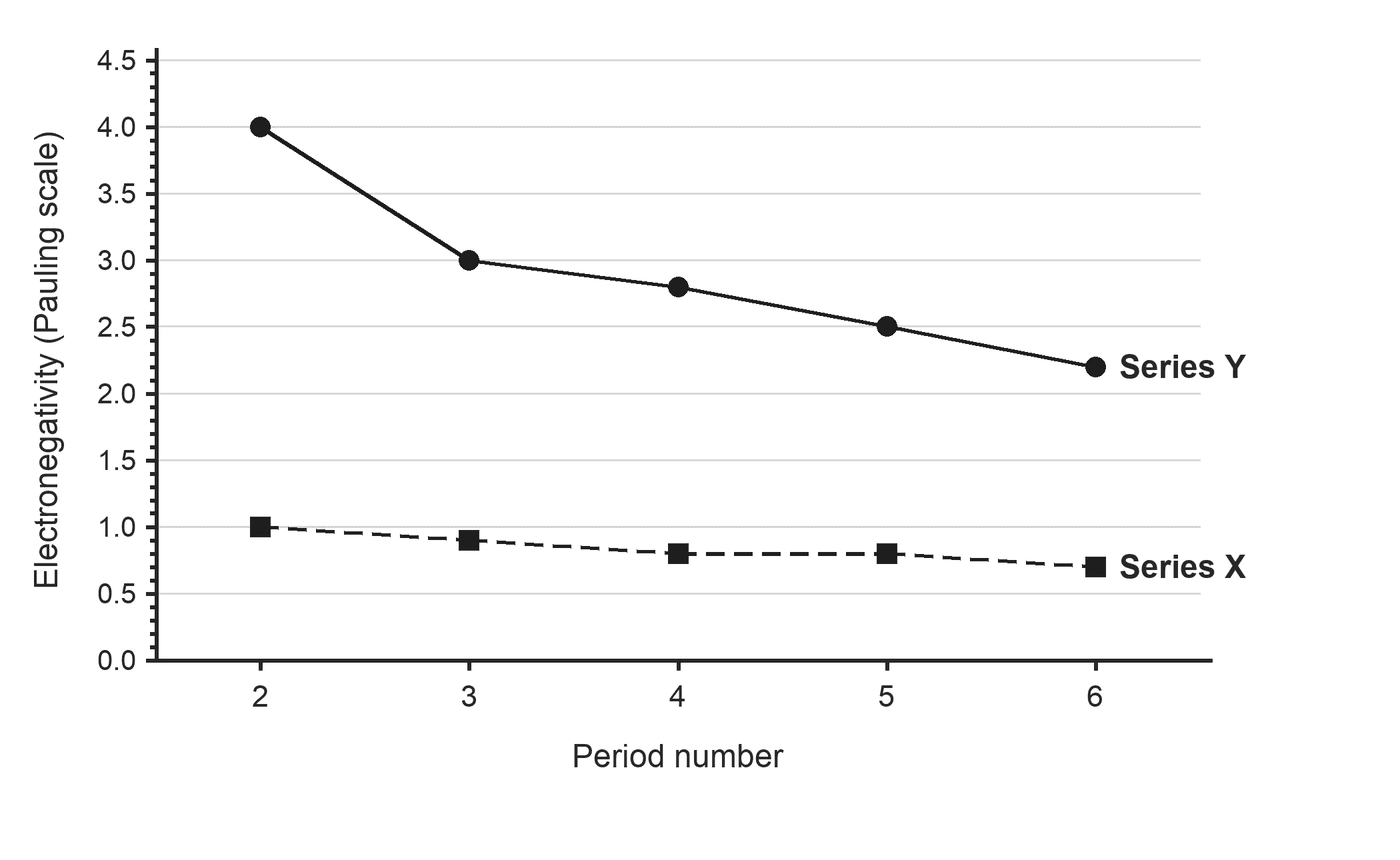
(a) Which series is the halogens and which is the alkali metals? Give a reason from the graph.
(b) Read from the graph the electronegativity of each series in period 2 and in period 6, and find the difference between the two series in each period. How does the gap change?
(c) Explain why the electronegativity of both series falls as the period number increases.