
Question 244 marksEasy
Why is the size of (i) neon greater than fluorine? (ii) sodium greater than magnesium ?
Confirming your payment
Sign up now and get 250 free tokens.
Periodic Table, Periodic Properties and Variations of Properties · Question 24 of 99
Why is the size of (i) neon greater than fluorine? (ii) sodium greater than magnesium ?
Solution:
Concept: Atomic size depends on the number of shells, the nuclear charge, and the repulsion between the electrons in the outer shell.
Step 1 — Part (i): compare neon and fluorine.
Neon (2, 8) has a completely filled octet, while fluorine (2, 7) has one electron less. With the outer shell full, the repulsion between its electrons is at its greatest, which outweighs the pull of the nucleus, so the outer shell spreads out.
So the neon atom (112 pm) is bigger than the fluorine atom (64 pm), even though neon has the greater nuclear charge.
Step 2 — Part (ii): compare sodium and magnesium.
Both have three shells (Na 2, 8, 1; Mg 2, 8, 2). Magnesium has the greater nuclear charge (+12 against +11), so its electrons are pulled closer to the nucleus.
So magnesium is smaller (160 pm) and sodium is larger (186 pm).
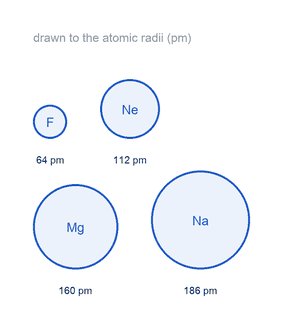
Watch out: A noble gas is bigger than the halogen just before it, but it is still smaller than the alkali metal at the start of its period.
Therefore, (i) neon's full octet has maximum electron repulsion, so it is bigger than fluorine; (ii) sodium has a smaller nuclear charge on the same three shells, so it is bigger than magnesium.