
Question 255 marksEasy
(i) Which is greater in size ?
(a) an atom or a cation
(b) an atom or an anion
(c) or
(d) Fluorine or oxygen
(ii) Which has the maximum metallic character – Na, Li or K ?
Confirming your payment
Sign up now and get 250 free tokens.
Periodic Table, Periodic Properties and Variations of Properties · Question 25 of 99
(i) Which is greater in size ?
(a) an atom or a cation
(b) an atom or an anion
(c) or
(d) Fluorine or oxygen
(ii) Which has the maximum metallic character – Na, Li or K ?
Solution:
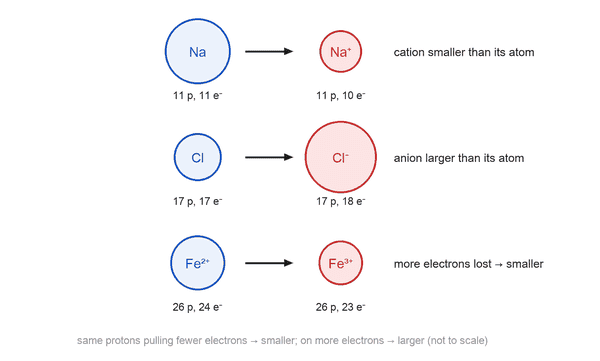
Concept: An ion has the same number of protons as its atom. A cation has lost electrons, so the same nuclear pull acts on fewer electrons and the particle is smaller than its atom; an anion has gained electrons, so the repulsion between electrons grows and the particle is larger than its atom.
Step 1 — Part (i)(a): atom or cation.
Sodium (11 protons, 11 electrons) loses one electron to form (11 protons, 10 electrons). The same nuclear charge now pulls on fewer electrons, and here a whole shell is lost, so the atom is bigger.
Step 2 — Part (i)(b): atom or anion.
Chlorine (17 electrons) gains one electron to form (18 electrons) with the same 17 protons. The extra electron increases the repulsion and the pull per electron falls, so the anion is bigger.
Step 3 — Part (i)(c): Fe²⁺ or Fe³⁺.
Both ions have 26 protons, but has 24 electrons and only 23. The ion with fewer electrons is pulled in more tightly, so is bigger.
Step 4 — Part (i)(d): fluorine or oxygen.
O and F are both in period 2, with two shells. Oxygen has the smaller nuclear charge (+8 against +9), so oxygen is bigger (O 66 pm, F 64 pm).
Step 5 — Part (ii): maximum metallic character among Na, Li and K.
Li, Na and K are all in group 1, and metallic character increases down a group. K is the lowest of the three, so it has the largest atom and loses its valence electron most easily: potassium.
Watch out: The number of protons does not change when an ion forms; only the number of electrons changes.
Therefore, (i) (a) the atom, (b) the anion, (c) Fe²⁺, (d) oxygen; (ii) potassium.