
Question 631 markMCQEasy
An element with atomic number 19 will most likely combine chemically with the elements whose atomic number is :
Confirming your payment
Sign up now and get 250 free tokens.
Periodic Table, Periodic Properties and Variations of Properties · Question 63 of 99
An element with atomic number 19 will most likely combine chemically with the elements whose atomic number is :
(A) 17
(B) 11
(C) 28
(D) 20
Answer: (A) 17
Concept: Valency is the number of electrons an atom loses, gains or shares to reach a stable octet (a duplet for the first shell). Atoms with 1, 2 or 3 valence electrons lose them, so their valency equals the number of valence electrons; atoms with 5, 6 or 7 gain electrons, so their valency is 8 minus that number.
Step 1 — Identify the element with atomic number 19.
Atomic number 19 is potassium (2, 8, 8, 1), a reactive metal that loses one electron.
Step 2 — Find the partner that needs one electron.
Atomic number 17 is chlorine (2, 8, 7), a non-metal that needs one electron. Potassium gives its electron to chlorine and both reach 2, 8, 8, forming potassium chloride.
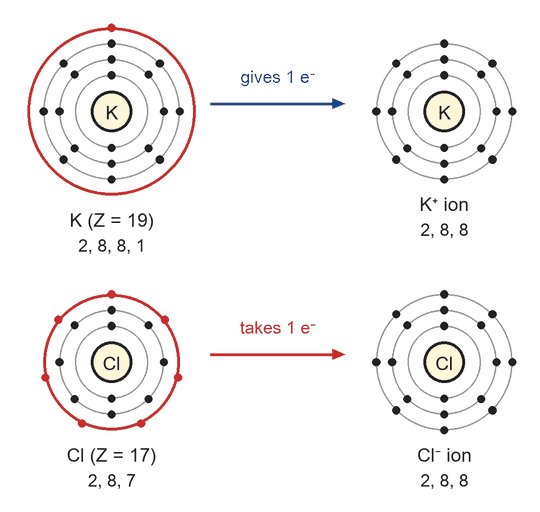
Watch out: Elements combine most readily when one loses exactly the number of electrons the other needs.
Why the other options are wrong:
Therefore, the element with atomic number 19 combines most readily with the element of atomic number 17, option (A).