Solution:
Concept: Read each letter's period (row) and group (column) to identify it; then use the trends: electronegativity highest at the top right, reactivity of metals highest at the bottom left, size smallest at the right of a period, ionisation potential highest for the small noble gases.
Step 1 — Identify the letters.
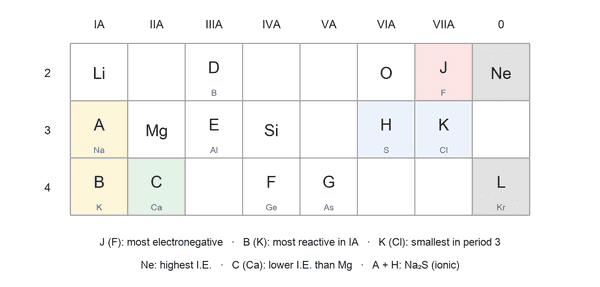
Each letter's row gives its period and its column gives its group, which names the element.
| Period | Letters and the elements they stand for |
|---|
| 2 | D: boron; J: fluorine |
| 3 | A: sodium; E: aluminium; H: sulphur; K: chlorine |
| 4 | B: potassium; C: calcium; F: germanium; G: arsenic; L: krypton |
Step 2 — Parts (i) and (ii).
(i) J (fluorine) is the most electronegative: top right, noble gases left out. (ii) B (potassium) is the most reactive element of group 1 shown: it is the lowest, so it loses its electron most easily.
Step 3 — Parts (iii) and (iv).
(iii) K (chlorine) has the smallest atomic size in period 3, because size falls across the period and chlorine is the last element before the noble gas. (iv) Ne (neon) has the highest ionization potential: noble gases have the highest values, and neon, higher up than L (krypton), has the greater value.
Step 4 — Parts (v), (vi) and (vii).
(v) O is oxygen (2, 6), so it has 6 valence electrons. (vi) Of Mg and C in group 2, C (calcium) is lower down, so it has the larger atom and the lower ionization energy. (vii) L is krypton (Kr).
Step 5 — Part (viii).
A (sodium, 2, 8, 1) loses one electron and H (sulphur, 2, 8, 6) gains two, so an ionic (electrovalent) bond is formed. Two A atoms are needed for each H atom, so the formula is A2H; with the real symbols this is Na2S.
2Na+S→Na2S
Watch out: The letters are not symbols: H here is sulphur and B is potassium, not hydrogen and boron.
Therefore, (i) J; (ii) B; (iii) K; (iv) Ne; (v) 6; (vi) C; (vii) krypton; (viii) ionic bond, A₂H (Na₂S).
