Solution:
Concept: For the first 20 elements, the number of shells in an atom gives its period, and the number of electrons in its outermost (valence) shell gives its group: 1 or 2 valence electrons → group 1 or 2; 3 to 8 valence electrons → group 13 to 18 (add 10). Valency is the number of electrons an atom loses, gains or shares to reach a stable octet (a duplet for the first shell). Atoms with 1, 2 or 3 valence electrons lose them, so their valency equals the number of valence electrons; atoms with 5, 6 or 7 gain electrons, so their valency is 8 minus that number.
Step 1 — Parts (i) and (ii): identify X.
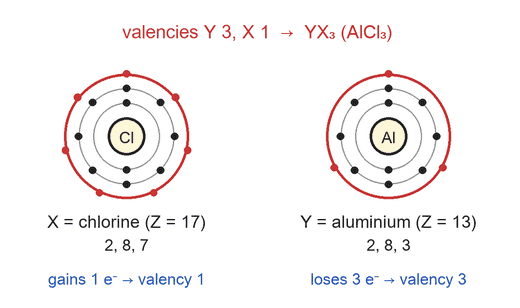
Period 3 means three shells, and group 17 means 7 valence electrons. So X is 2, 8, 7: it has 7 valence electrons, and with 17 electrons it is chlorine.
Step 2 — Part (iii): name the family.
Group 17 is the halogen family.
Step 3 — Part (iv): identify Y.
In 1327Y the atomic number is 13, so Y is 2, 8, 3, which is aluminium. It loses 3 electrons, so its valency is 3.
Step 4 — Part (iv): write the formula.
X gains 1 electron (valency 1). One Y atom gives away 3 electrons, so it needs three X atoms to take them. The formula is YX3. With the real symbols this is AlCl3 (aluminium chloride).
Watch out: Use the atomic number 13 (lower number) for Y's configuration, not the mass number 27.
Therefore, (i) 7 valence electrons; (ii) chlorine; (iii) halogens; (iv) YX₃ (AlCl₃).
