Solution:
Concept: Valency depends on the number of valence electrons, which is the same within a group but changes along a period. Transition elements (groups 3 to 12) fill the middle of the table; representative elements are in groups 1, 2 and 13 to 17.
Step 1 — Correct statement (i).
Across a period the valence electrons change from 1 to 8, so the valency changes too (period 3: 1, 2, 3, 4, 3, 2, 1, 0). It is the elements of one group that share a valency.
Correct: elements in the same group have the same valency.
Step 2 — Correct statement (ii).
The number of shells only tells the period: sodium (3 shells) and potassium (4 shells) both have valency 1. What decides valency is the outer shell.
Correct: valency depends upon the number of valence electrons (electrons in the outermost shell) of an atom.
Step 3 — Correct statement (iii).
Copper and zinc lie in groups 11 and 12, inside the block of groups 3 to 12, and their two outermost shells are incomplete.
Correct: copper and zinc are transition elements.
Step 4 — Correct statement (iv).
The extreme right of the table holds the noble gases of group 18, not the transition elements.
Correct: transition elements are placed in the middle of the periodic table (groups 3 to 12).
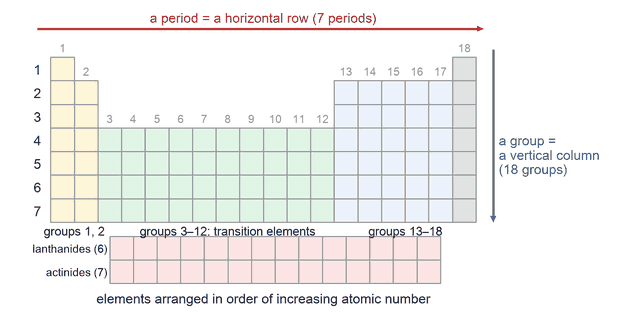
Watch out: The word 'period' and the word 'group' are easy to swap; elements of the same group, not period, share a valency.
Therefore, (i) same group, same valency; (ii) valency depends on the valence electrons; (iii) copper and zinc are transition elements; (iv) transition elements are in the middle (groups 3 to 12).
