
Question 274 marksEasy
State the trend in chemical reactivity :
(i) across the third period from left to right,
(ii) down the group.
a. in group IA (1) b. in group VIIA (17)
Confirming your payment
Sign up now and get 250 free tokens.
Periodic Table, Periodic Properties and Variations of Properties · Question 27 of 99
State the trend in chemical reactivity :
(i) across the third period from left to right,
(ii) down the group.
a. in group IA (1) b. in group VIIA (17)
Solution:
Concept: Metals react by losing electrons and non-metals by gaining them, so the reactivity of an element follows how easily it does this.
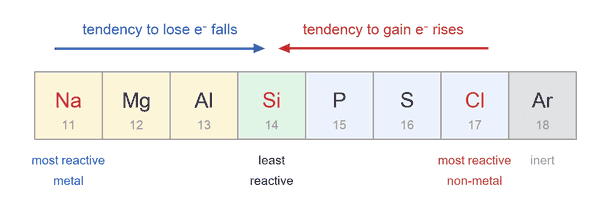
Step 1 — Part (i): Na to Si across period 3.
From sodium to silicon the nuclear charge rises and the atoms get smaller, so the tendency to lose electrons falls. Reactivity decreases: sodium is the most reactive metal and silicon the least reactive element of the period.
Step 2 — Part (i): P to Cl, and argon.
From phosphorus to chlorine the tendency to gain electrons rises, so reactivity increases again; chlorine is the most reactive non-metal of the period. Argon, with a complete octet, is unreactive.
Step 3 — Part (ii)(a): down group IA (1).
The atoms get bigger down the group, so the single valence electron is lost more easily. Reactivity increases: Li < Na < K < Rb < Cs.
Step 4 — Part (ii)(b): down group VIIA (17).
The atoms get bigger down the group, so an extra electron is attracted less strongly. Reactivity decreases: F > Cl > Br > I.
Watch out: The two groups go opposite ways: metals get more reactive down a group, non-metals less reactive.
Therefore, (i) across period 3 reactivity first decreases (Na to Si) and then increases (P to Cl); (ii) (a) it increases down group 1, (b) it decreases down group 17.