
Question 601 markMCQEasy
Ionisation potential increases over a period from left to right because :
Confirming your payment
Sign up now and get 250 free tokens.
Periodic Table, Periodic Properties and Variations of Properties · Question 60 of 99
Ionisation potential increases over a period from left to right because :
(A) Atomic radius and nuclear charge increase
(B) Atomic radius and nuclear charge decrease
(C) Atomic radius increases and nuclear charge decreases
(D) Atomic radius decreases and nuclear charge increases
Answer: (D) Atomic radius decreases and nuclear charge increases
Concept: Ionisation energy (ionisation potential) is the energy needed to remove an electron from a neutral isolated gaseous atom. It is higher when the atom is small and the nuclear charge is large, so it increases across a period and decreases down a group.
Step 1 — See what changes across a period.
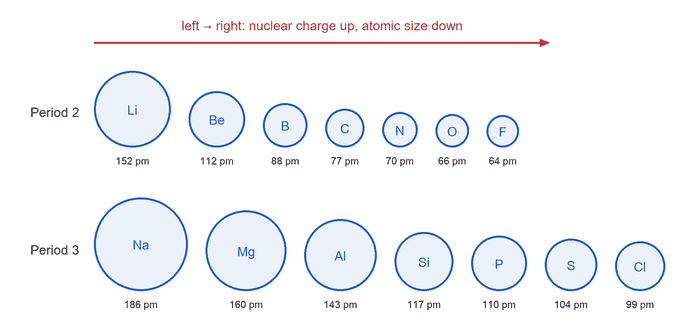
Across a period the nuclear charge rises by one at each step while the shells stay the same, so the atom shrinks.
Step 2 — Link both changes to the ionisation potential.
A smaller radius puts the outer electrons nearer the nucleus, and a larger charge pulls on them harder. Both make an electron harder to remove, so the ionisation potential rises.
Watch out: The nuclear charge does increase across a period; it is the radius that decreases.
Why the other options are wrong:
Therefore, the ionisation potential increases because the atomic radius decreases and the nuclear charge increases, option (D).