
Question 721 markMCQEasy
An element combines with to form a compound. Which of the following is true ?
P X is a metal, Y is a metal.
Q X is a metal, Y is a non metal.
R X looses electron(s), Y gains electron(s).
Confirming your payment
Sign up now and get 250 free tokens.
Periodic Table, Periodic Properties and Variations of Properties · Question 72 of 99
An element combines with to form a compound. Which of the following is true ?
P X is a metal, Y is a metal.
Q X is a metal, Y is a non metal.
R X looses electron(s), Y gains electron(s).
(A) Only P
(B) Only Q
(C) Both P and Q
(D) Both Q and R
Answer: (D) Both Q and R
Concept: Valency is the number of electrons an atom loses, gains or shares to reach a stable octet (a duplet for the first shell). Atoms with 1, 2 or 3 valence electrons lose them, so their valency equals the number of valence electrons; atoms with 5, 6 or 7 gain electrons, so their valency is 8 minus that number.
Step 1 — Identify X and Y.
X (Z = 13) is 2, 8, 3, aluminium, a metal that loses 3 electrons. Y (Z = 17) is 2, 8, 7, chlorine, a non-metal that gains 1 electron.
Step 2 — Test each statement.
P says both are metals, which is false. Q says X is a metal and Y a non-metal, which is true. R says X loses and Y gains electrons, which is true.
Step 3 — Show the compound.
Three Y atoms take the three electrons of one X atom, giving .
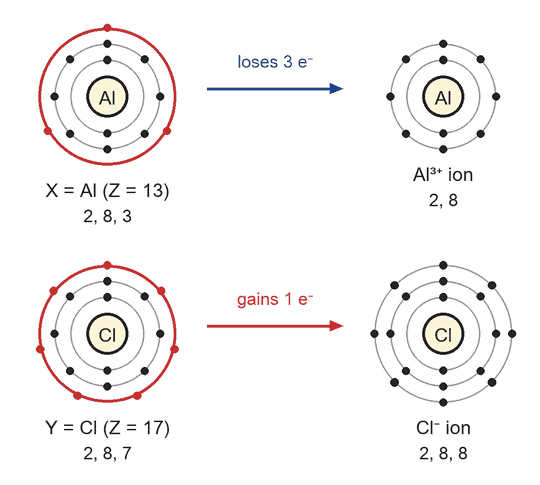
Watch out: A metal and a non-metal combine by transferring electrons; the metal loses them and the non-metal gains them.
Why the other options are wrong:
Therefore, both Q and R are true, option (D).