
Question 44 marksEasy
How does the electronic configuration in atoms change
(i) in a period from left to right ?
(ii) in a group from top to bottom ?
Confirming your payment
Sign up now and get 250 free tokens.
Periodic Table, Periodic Properties and Variations of Properties · Question 4 of 99
How does the electronic configuration in atoms change
(i) in a period from left to right ?
(ii) in a group from top to bottom ?
Solution:
Concept: For the first 20 elements, the number of shells in an atom gives its period, and the number of electrons in its outermost (valence) shell gives its group: 1 or 2 valence electrons → group 1 or 2; 3 to 8 valence electrons → group 13 to 18 (add 10).
Step 1 — Part (i): move across a period from left to right.
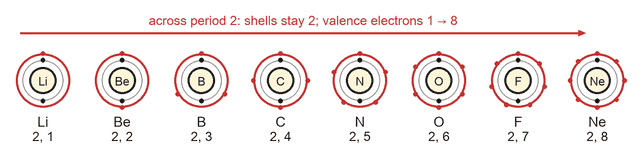
In one period every element has the same number of shells (equal to the period number). At each step one more electron is added to that outer shell, so the number of valence electrons increases by one, from 1 to 8 (from 1 to 2 in period 1).
Period 2 shows this: Li (2, 1), Be (2, 2), B (2, 3), C (2, 4), N (2, 5), O (2, 6), F (2, 7), Ne (2, 8).
Step 2 — Part (ii): move down a group from top to bottom.
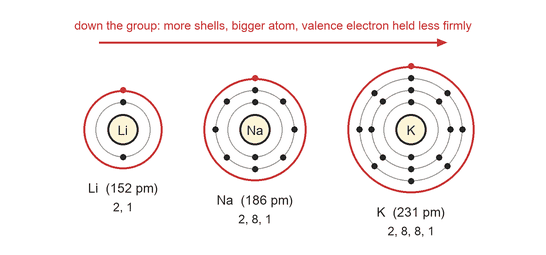
Going down a group, one new shell is added at each step, while the number of valence electrons stays the same.
Group 1 shows this: Li (2, 1), Na (2, 8, 1) and K (2, 8, 8, 1) have two, three and four shells, but always one valence electron.
Watch out: Across a period the number of shells does not change; only the valence electrons change.
Therefore, (i) across a period the shells stay the same and the valence electrons increase from 1 to 8; (ii) down a group a shell is added at each step and the valence electrons stay the same.