Solution:
Concept: Atomic numbers 3 to 10 are period 2 (lithium to neon) and 11 to 18 are period 3 (sodium to argon). Decoding the letters first makes every part a question about known elements.
Step 1 — Decode the letters.
Place each atomic number in its period and write the real element under each letter.
| Letter | A | B | C | D | E | F | G | H |
|---|
| Element (period 2) | Li | Be | B | C | N | O | F | Ne |
| Letter | I | J | K | L | M | N | O | P |
|---|
| Element (period 3) | Na | Mg | Al | Si | P | S | Cl | Ar |
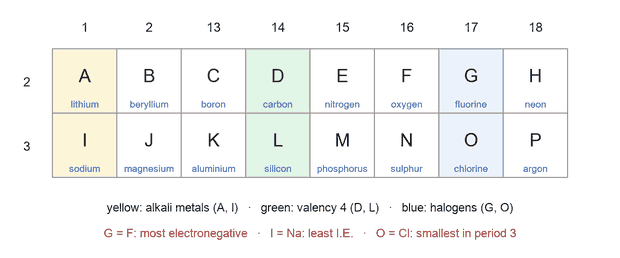
Step 2 — Parts (a) and (b): most electronegative, and the halogens.
Electronegativity is highest at the top right (noble gases left out), so the most electronegative is G (fluorine). The halogens have 7 valence electrons: G and O (fluorine and chlorine).
Step 3 — Parts (c) and (d): alkali metals, and valency 4.
The alkali metals have 1 valence electron: A and I (lithium and sodium). The elements with valency 4 have 4 valence electrons: D and L (carbon and silicon).
Step 4 — Parts (e) and (f): least ionisation energy, least size in period 3.
The least ionisation energy belongs to the lowest, left-most alkali metal: I (sodium, 496 kJ mol⁻¹). Size falls across period 3, so the smallest atom (noble gas left out) is O (chlorine, 99 pm).
Watch out: The letters are not chemical symbols: 'O' here is chlorine, not oxygen, and 'F' is oxygen.
Therefore, (a) G; (b) G and O; (c) A and I; (d) D and L; (e) I; (f) O.
