
Question 14 marksEasy
(i) State modern periodic law.
(ii) Name the scientist who stated the law.
(iii) How many groups and periods does modern periodic table have?
Confirming your payment
Sign up now and get 250 free tokens.
Periodic Table, Periodic Properties and Variations of Properties · Question 1 of 99
(i) State modern periodic law.
(ii) Name the scientist who stated the law.
(iii) How many groups and periods does modern periodic table have?
Solution:
Concept: The modern periodic law says that the physical and chemical properties of the elements are periodic functions of their atomic numbers. The modern periodic table arranges the elements in order of increasing atomic number in 18 vertical groups and 7 horizontal periods.
Step 1 — Part (i): state the modern periodic law.
The law links the properties of an element to its atomic number (the number of protons in its nucleus).
Modern periodic law: the physical and chemical properties of the elements are periodic functions of their atomic numbers.
This means that when the elements are arranged in order of increasing atomic number, elements with similar properties recur at regular intervals.
Step 2 — Part (ii): name the scientist.
The law was stated by Henry Moseley (1913). His X-ray experiments showed that the atomic number, not the atomic mass used by Mendeleev, is the fundamental property of an element.
Step 3 — Part (iii): count the groups and periods.
The vertical columns of the modern (long form) table are the groups and the horizontal rows are the periods. There are 18 groups and 7 periods.
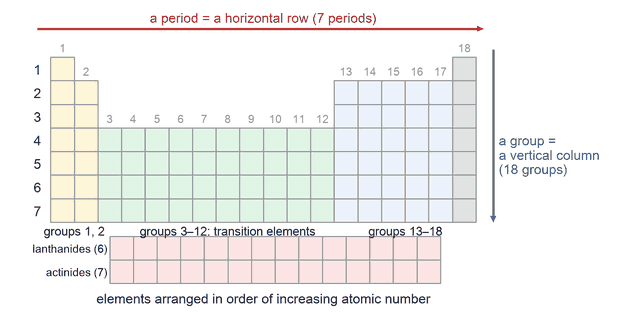
The seven periods hold 2, 8, 8, 18, 18, 32 and 32 elements. The lanthanides and actinides are written in two rows below the table so that it does not become too wide.
Watch out: Mendeleev's law was based on atomic mass; the modern law is based on atomic number. Do not mix the two.
Therefore, (i) properties are periodic functions of atomic number; (ii) Henry Moseley; (iii) 18 groups and 7 periods.