
Opening your dashboard
Class 10 Physics Chapter 4: Refraction of Light at Plane Surfaces Solutions
139 textbook questions with step-by-step answers, free to read, for ICSE 2026-27.
Get talked through Ch 4, not just shown the answer
Reading a finished solution is not the same as being able to do it. The AI tutor takes one question at a time and works it with you, in your own words, until you can.
- Ask it out loud, in your own words
- It gives you the next step, not the answer
- Stuck on part (ii)? Start there
139 questions with solutions
1–5 marks · Mixed difficulty
- 11 mark
Question 1
In the diagram shown below, which one of the following statements is true ?
 Solve with AI
Answer
(A) C is incident ray and A is reflected ray
(B) A is incident ray and D is refracted ray
- Correct
(C) A is incident ray and B is refracted ray
(D) B is incident ray and C is refracted ray
Answer: (C) A is incident ray and B is refracted ray
Concept: Refraction is the change in direction of light when it passes obliquely from one transparent medium into another. It happens because light travels at different speeds in different media. Light bends towards the normal when it enters an optically denser medium (it slows down) and away from the normal when it enters an optically rarer medium (it speeds up). All angles are measured from the normal, the line at 90° to the surface at the point of incidence. At a boundary part of the light is also reflected, making the same angle with the normal as the incident ray.
Step 1 — Find the incident ray.
The incident ray is the one travelling towards the surface. The arrow on A points towards the point where all the rays meet, so A is the incident ray.
Step 2 — Find the reflected ray.
C goes back into the air on the other side of the normal, making the same angle with the normal as A. A ray that stays in the first medium at an equal angle is the reflected ray, so C is the reflected ray.
Step 3 — Find the refracted ray.
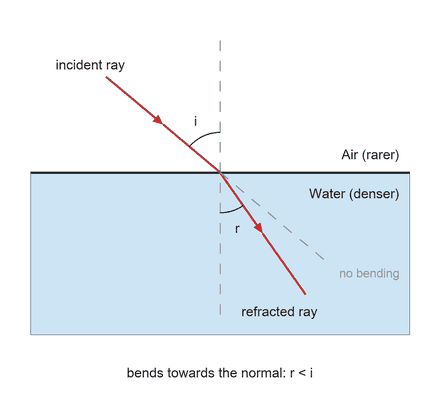
Water is optically denser than air, so the refracted ray must bend towards the normal (r < i). B goes into the water and lies closer to the normal than the straight-on line, so B is the refracted ray.
Step 4 — See why D is not possible.
D carries on in the same straight line as A. An oblique ray entering water must bend, so no ray can go along D.
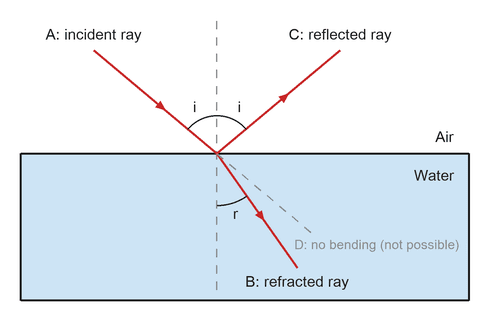
Watch out: The straight-on line D looks natural, but a ray that falls obliquely on water always bends; only a ray along the normal goes straight on.
Why the other options are wrong:
- (A) C is incident ray and A is reflected ray: C travels away from the surface, so it cannot be the incident ray, and A is the incident ray, not a reflected one.
- (B) A is incident ray and D is refracted ray: D is the straight-on line; an obliquely incident ray entering water must bend towards the normal, so D is not the refracted ray.
- (D) B is incident ray and C is refracted ray: B travels away from the surface into the water, so it is not an incident ray, and C stays in the air, so it is the reflected ray, not a refracted one.
Therefore, A is the incident ray and B is the refracted ray, option (C).
- 21 mark
Question 2
When a ray of light from air enters a denser medium, it :
Solve with AIAnswer
(A) bends away from the normal
- Correct
(B) bends towards the normal
(C) goes undeviated
(D) is reflected back
Answer: (B) bends towards the normal
Concept: Refraction is the change in direction of light when it passes obliquely from one transparent medium into another. It happens because light travels at different speeds in different media. Light bends towards the normal when it enters an optically denser medium (it slows down) and away from the normal when it enters an optically rarer medium (it speeds up). All angles are measured from the normal, the line at 90° to the surface at the point of incidence.
Step 1 — See what happens to the speed.
An optically denser medium (such as glass) has a larger refractive index, so light travels slower in it: from 3 × 10⁸ m s⁻¹ in air to 2 × 10⁸ m s⁻¹ in glass.
Step 2 — Decide the direction of bending.
When light slows down on crossing a surface obliquely, it bends towards the normal, so the angle of refraction is smaller than the angle of incidence (r < i).

Watch out: Towards the normal means r < i; away from the normal (r > i) is the case for light leaving the denser medium.
Why the other options are wrong:
- (A) bends away from the normal: a ray bends away from the normal when it goes from a denser medium into a rarer one, the opposite of this case.
- (C) goes undeviated: a ray goes undeviated only when it falls along the normal (i = 0°); an oblique ray entering a denser medium always bends.
- (D) is reflected back: only a small part of the light is reflected at the surface; most of it enters the denser medium and is refracted.
Therefore, a ray entering a denser medium from air bends towards the normal, option (B).
- 31 mark
Question 3
A light ray does not bend at the boundary while passing from one medium to the other medium if the angle of incidence is :
Solve with AIAnswer
- Correct
(A)
(B)
(C)
(D)
Answer: (A)
Concept: Snell's law: for light going from medium 1 into medium 2, sin i ÷ sin r = ₁μ₂, a constant called the refractive index of medium 2 with respect to medium 1. Here i is the angle of incidence and r the angle of refraction, both measured from the normal.
Step 1 — Put i = 0° into Snell's law.
A ray with i = 0° falls along the normal. Snell's law gives the sine of the angle of refraction.
Step 2 — Read off the angle of refraction.
Since sin r is 0, the angle r is 0°, so the refracted ray also travels along the normal: the ray goes into the second medium without bending. Its speed still changes.

Watch out: The ray does not bend at i = 0°, but it still changes speed (and wavelength).
Why the other options are wrong:
- (B) : at i = 45°, sin r = sin 45° ÷ μ is smaller than sin 45° (for μ > 1), so r is less than 45° and the ray bends.
- (C) : at i = 60° the same happens: r is less than 60°, so the ray bends.
- (D) : at i = 90° the ray only skims along the surface; any light that enters goes in at r less than 90°, which is a change of direction.
Therefore, a ray does not bend when its angle of incidence is 0°, option (A).
- 41 mark
Question 4
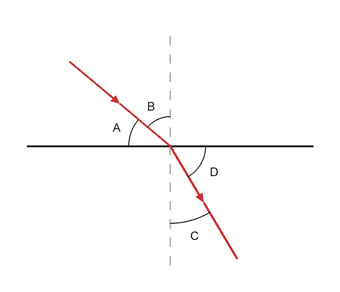
The diagram given below shows light travelling from air into glass. Four angles A, B, C and D are shown. Which of the following formulae is used to calculate the refractive index of the glass ?
 Solve with AI
Answer
(A)
(B)
- Correct
(C)
(D)
Answer: (C)
Concept: Snell's law: for light going from medium 1 into medium 2, sin i ÷ sin r = ₁μ₂, a constant called the refractive index of medium 2 with respect to medium 1. Here i is the angle of incidence and r the angle of refraction, both measured from the normal. Angles of incidence and refraction are measured from the normal, never from the surface.
Step 1 — Pick the angle of incidence.
B lies between the incident ray and the normal, so B is the angle of incidence i. (A lies between the incident ray and the surface.)
Step 2 — Pick the angle of refraction.
C lies between the refracted ray and the normal, so C is the angle of refraction r. (D lies between the refracted ray and the surface.)
Step 3 — Write Snell's law with these angles.
We replace i by B and r by C in Snell's law.
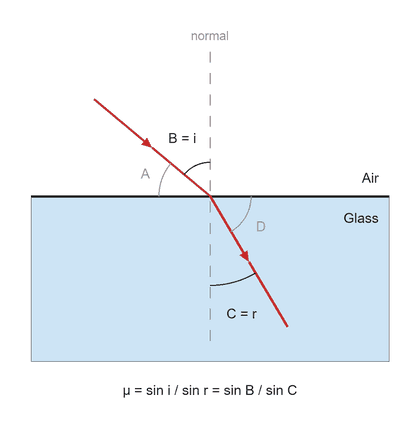
Watch out: Angles of incidence and refraction are measured from the normal, never from the surface.
Why the other options are wrong:
- (A) : A is measured from the surface (it is 90° minus i), so sin A is not sin i; the formula needs the angle B on top.
- (B) : it is upside down and uses A, which is measured from the surface.
- (D) : B and A are both on the incident side; neither of them is the angle of refraction.
Therefore, μ = sin B ÷ sin C, option (C).
- 51 mark
Question 5
The incorrect statement among the following is :
Solve with AIAnswer
- Correct
(A) When a ray of light gets refracted from a denser to a rarer medium, the speed of light decreases.
(B) The frequency of light does not change on refraction
(C) The speed of light V in a medium is related to its wavelength and frequecy as
(D) The incident ray, the refracted ray and the normal at the point of incidence all lie in one plane.
Answer: (A) When a ray of light gets refracted from a denser to a rarer medium, the speed of light decreases.
Concept: The refractive index of a medium is μ = c ÷ V, the speed of light in vacuum (or air), c = 3 × 10⁸ m s⁻¹, divided by the speed of light V in the medium. A larger μ means light is slower there; for example μ is 1.5 for glass and 4/3 for water. So light speeds up when it goes from a denser into a rarer medium.
Step 1 — Test statement (A).
Going from a denser to a rarer medium, μ falls, so the speed V = c/μ rises. For example, light going from water (2.25 × 10⁸ m s⁻¹) into air (3 × 10⁸ m s⁻¹) speeds up. Statement (A) says the speed decreases, so (A) is incorrect.

Step 2 — Check the other statements.
The frequency is fixed by the source, so (B) is correct. V = fλ holds for light in any medium, so (C) is correct. The incident ray, the refracted ray and the normal lie in one plane (the first law of refraction), so (D) is correct.
Watch out: The question asks for the incorrect statement, so the answer is the one false statement.
Why the other options are wrong:
- (B) The frequency of light does not change on refraction: it is a correct statement: the frequency of light does not change on refraction, so it is not the answer.
- (C) The speed of light V in a medium is related to its wavelength and frequecy as : it is a correct statement: the relation between speed, frequency and wavelength holds in every medium, so it is not the answer.
- (D) The incident ray, the refracted ray and the normal at the point of incidence all lie in one plane: it is a correct statement (the first law of refraction), so it is not the answer.
Therefore, the incorrect statement is (A): light speeds up, not slows down, from a denser to a rarer medium, option (A).
- 61 mark
Question 6
In refraction of light, the relation between incident angle and refracted angle is :
Solve with AIAnswer
(A)
(B)
(C)
- Correct
(D) there is no fixed relation
Answer: (D) there is no fixed relation
Concept: Refraction is the change in direction of light when it passes obliquely from one transparent medium into another. It happens because light travels at different speeds in different media. Light bends towards the normal when it enters an optically denser medium (it slows down) and away from the normal when it enters an optically rarer medium (it speeds up). All angles are measured from the normal, the line at 90° to the surface at the point of incidence.
Step 1 — Light going from rarer to denser.
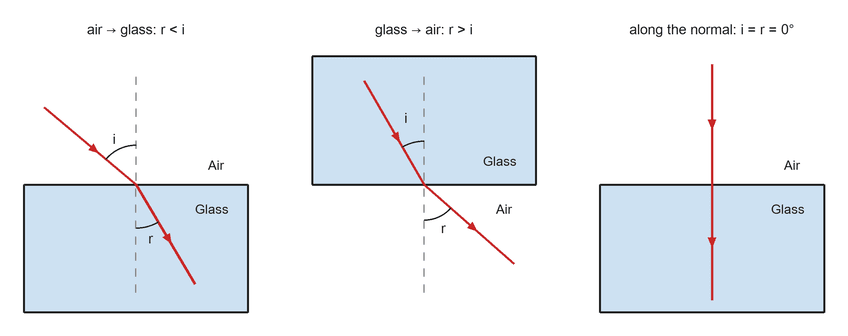
From air into glass the ray bends towards the normal, so i > r. For example, i = 50° gives r ≈ 30.7°.
Step 2 — Light going from denser to rarer.
From glass into air the ray bends away from the normal, so r > i. For example, i = 30° gives r ≈ 48.6°.
Step 3 — Light along the normal.
At normal incidence both angles are 0°, so neither is bigger.
Step 4 — Conclude.
Which angle is bigger depends on the direction of travel, so there is no single fixed relation between i and r.
Watch out: Do not learn "i > r" as a rule; it holds only when light enters a denser medium.
Why the other options are wrong:
- (A) : i > r holds only when light goes from a rarer to a denser medium.
- (B) : r > i holds only when light goes from a denser to a rarer medium.
- (C) : i and r are equal only at normal incidence (both 0°) or when both media have the same refractive index.
Therefore, there is no fixed relation between i and r, option (D).
- 71 mark
Question 7
The intensity of the refracted light is always .......... the intensity of incident light :
Solve with AIAnswer
(A) greater than
(B) equal to
- Correct
(C) less than
(D) none of the above
Answer: (C) less than
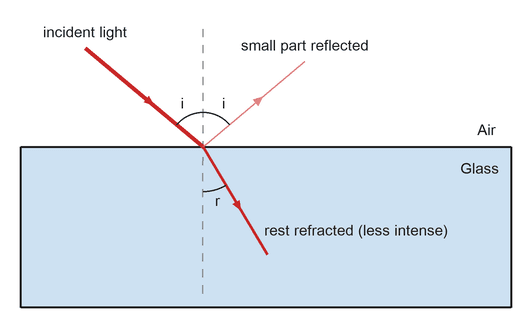
Concept: At a boundary between two media the incident light is partly reflected and partly refracted. The incident energy is shared between the reflected and refracted light (and a little is absorbed).
Step 1 — Follow the light energy.
A small part of the incident light is reflected back into the first medium, and the medium absorbs a little.
Step 2 — Compare the intensities.
Only what is left goes into the second medium, so the refracted light is always less intense than the incident light.
Why the other options are wrong:
- (A) greater than: more light coming out than going in would mean energy is created, which cannot happen.
- (B) equal to: equal intensity would need no reflection and no absorption at the boundary, but some light is always reflected.
- (D) none of the above: option (C) is correct, so "none of the above" is wrong.
Therefore, the refracted light is always less intense than the incident light, option (C).
- 81 mark
Question 8
The ray AO is shown in the figure given below. The path of refracted ray and emergent ray will be:
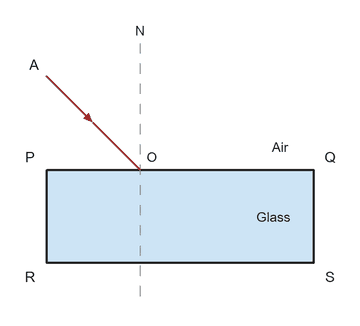
(1) the refracted ray will bend towards normal
(2) the refracted ray will bend away from normal
(3) the emergent ray will bend towards normal
(4) the emergent ray will bend away from normal
Solve with AIAnswer
(A) (1) and (3)
- Correct
(B) (1) and (4)
(C) (2) and (3)
(D) (2) and (4)
Answer: (B) (1) and (4)
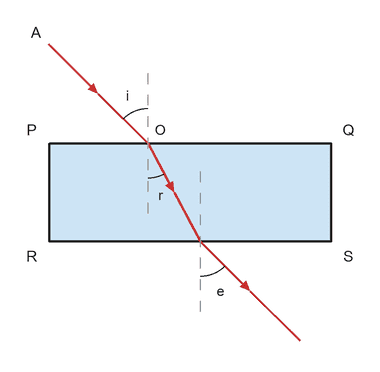
Concept: A ray crossing a parallel-sided glass slab is refracted twice: towards the normal on entering (air to glass) and away from the normal on leaving (glass to air). Because the two faces are parallel, the angle of emergence e equals the angle of incidence i, so the emergent ray is parallel to the incident ray, only shifted sideways (lateral displacement).
Step 1 — At the top face (air to glass).
Light slows down on entering glass, so the refracted ray bends towards the normal. Statement 1 is correct and statement 2 is wrong.
Step 2 — At the bottom face (glass to air).
Light speeds up on leaving glass, so the emergent ray bends away from the normal. Statement 4 is correct and statement 3 is wrong.
Step 3 — See the result.
Since the faces are parallel, the emergent ray comes out parallel to AO, shifted sideways.
Watch out: The two bends are opposite: towards the normal going in, away from the normal coming out.
Why the other options are wrong:
- (A) (1) and (3): statement 3 is wrong: a ray going from glass into air bends away from the normal, not towards it.
- (C) (2) and (3): statement 2 is wrong (entering glass the ray bends towards the normal), and statement 3 is wrong too.
- (D) (2) and (4): statement 2 is wrong: entering glass from air, the ray bends towards the normal.
Therefore, statements 1 and 4 are correct, option (B).
- 91 mark
Question 9
What is the deviation of a ray of light which is incident normally on the surface of two separating media :
Solve with AIAnswer
- Correct
(A)
(B)
(C)
(D)
Answer: (A)
Concept: The angle of deviation is the angle between the direction of the incident ray and the direction of the refracted ray: how much the ray has turned. Snell's law: for light going from medium 1 into medium 2, sin i ÷ sin r = ₁μ₂, a constant called the refractive index of medium 2 with respect to medium 1. Here i is the angle of incidence and r the angle of refraction, both measured from the normal.
Step 1 — Find the angle of refraction.
For normal incidence i = 0°, and Snell's law gives sin r = 0, so r = 0°.
Step 2 — Find the deviation.
The ray keeps its direction, so the angle between the old and new directions is zero.
Why the other options are wrong:
- (B) : a deviation of 45° would need the ray to bend, which it does not at normal incidence.
- (C) : a deviation of 90° would also need bending; at normal incidence the ray goes straight on.
- (D) : 180° would mean the light turns straight back, which is reflection along the normal, not refraction.
Therefore, a ray incident normally is not deviated: the deviation is 0°, option (A).
- 101 mark
Question 10
If refractive indices of medium 1 and medium 2 are the same, the speed of light will :
Solve with AIAnswer
(A) increase
(B) decrease
- Correct
(C) remain the same
(D) none of the above
Answer: (C) remain the same
Concept: The refractive index of a medium is μ = c ÷ V, the speed of light in vacuum (or air), c = 3 × 10⁸ m s⁻¹, divided by the speed of light V in the medium. A larger μ means light is slower there; for example μ is 1.5 for glass and 4/3 for water.
Step 1 — Write the speed in each medium.
The speed in a medium depends only on its refractive index.
Step 2 — Compare them.
If μ₁ and μ₂ are equal, the two fractions are equal, so V₁ and V₂ are the same. With no change of speed the ray does not bend either, even if it is oblique.

Why the other options are wrong:
- (A) increase: the speed increases only if medium 2 has a smaller refractive index than medium 1.
- (B) decrease: the speed decreases only if medium 2 has a larger refractive index than medium 1.
- (D) none of the above: option (C) is correct, so "none of the above" is wrong.
Therefore, the speed of light remains the same, option (C).
- 111 mark
Question 11
When light passes from a denser medium to a rarer medium, its wavelength :
Solve with AIAnswer
(A) decreases
- Correct
(B) increases
(C) remains the same
(D) none
Answer: (B) increases
Concept: When light is refracted its frequency f does not change (the source fixes it). Speed and wavelength are linked by V = fλ, so the wavelength changes in the same ratio as the speed.
Step 1 — See what happens to the speed.
Going from a denser into a rarer medium, light speeds up (V rises).
Step 2 — Use V = fλ.
Since f does not change, the wavelength λ = V ÷ f rises in the same ratio as V. In a medium of refractive index μ the wavelength is λ/μ; coming out of it, light gets back its longer wavelength λ.

Watch out: It is the frequency, not the wavelength, that stays the same on refraction.
Why the other options are wrong:
- (A) decreases: the wavelength decreases when light goes from a rarer into a denser medium, the opposite case.
- (C) remains the same: the frequency stays the same; the wavelength changes with the speed.
- (D) none: the wavelength does change (it increases), so "none" is wrong.
Therefore, the wavelength increases, option (B).
- 121 mark
Question 12
Which of the following is correct when a ray of light passes from a rarer medium to a denser medium :
(1) speed will decrease
(2) frequency remains unchanged
(3) wavelength will decrease
(4) intensity will decrease
Solve with AIAnswer
(A) (1)
(B) (1) and (4)
(C) (1), (2) and (4)
- Correct
(D) all of the above
Answer: (D) all of the above
Concept: When light is refracted its frequency f does not change (the source fixes it). Speed and wavelength are linked by V = fλ, so the wavelength changes in the same ratio as the speed. Entering a denser medium, light slows down, and part of it is reflected at the boundary.
Step 1 — Statement 1: speed.
Light travels slower in a denser medium, so the speed decreases. Statement 1 is correct.
Step 2 — Statement 2: frequency.
The frequency is fixed by the source, so it remains unchanged. Statement 2 is correct.
Step 3 — Statement 3: wavelength.
λ = V ÷ f, with V falling and f fixed, so the wavelength decreases. Statement 3 is correct.
Step 4 — Statement 4: intensity.
Part of the light is reflected back at the boundary, so the refracted light is less intense. Statement 4 is correct.
Watch out: Check every statement; an option that leaves out a correct statement is incomplete.
Why the other options are wrong:
- (A) (1): it gives only statement 1, but statements 2, 3 and 4 are correct too.
- (B) (1) and (4): it leaves out statements 2 and 3, which are also correct.
- (C) (1), (2) and (4): it leaves out statement 3: the wavelength does decrease.
Therefore, all four statements are correct, option (D).
- 131 mark
Question 13
The refractive index of water is 4/3 and that of glass is 3/2. The refractive index of glass with respect to water is :
Solve with AIAnswer
- Correct
(A) 9/8
(B) 2
(C) 8/9
(D) 1
Answer: (A) 9/8
Concept: The refractive index of medium 2 with respect to medium 1 is the ratio of their refractive indices (each taken with respect to air): ₁μ₂ = μ₂ ÷ μ₁.
Step 1 — Name the media.
Light goes from water (medium 1, = 4/3) into glass (medium 2, = 3/2).
Step 2 — Divide the refractive indices.
The refractive index of glass with respect to water is ÷ .
Watch out: "glass with respect to water" puts glass on top and water below: ÷ .
Why the other options are wrong:
- (B) 2: 2 is the product 3/2 × 4/3, not the ratio.
- (C) 8/9: 8/9 is the ratio the other way up: the refractive index of water with respect to glass.
- (D) 1: 1 would need water and glass to have the same refractive index.
Therefore, the refractive index of glass with respect to water is 9/8, option (A).
- 141 mark
Question 14
The optical density of turpentine is higher than that of water, while its mass density is lower than water. The figure given below shows a layer of turpentine floating over water taken in a container. For which one of the four rays incident on turpentine in the path shown in the figure is correct ?
 Solve with AI
Answer
(A) Ray 1
- Correct
(B) Ray 2
(C) Ray 3
(D) Ray 4
Answer: (B) Ray 2
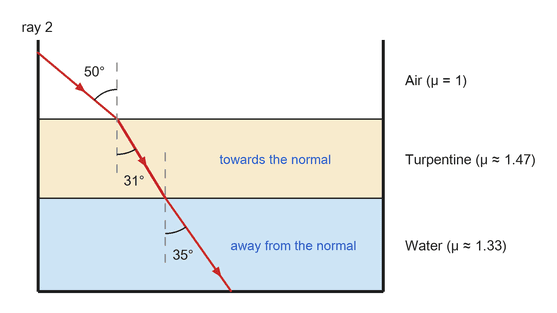
Concept: Bending depends on optical density (refractive index), not on mass density. Turpentine floats on water because it is lighter, but it is optically denser: air (μ = 1) < water (about 1.33) < turpentine (about 1.47).
Step 1 — Air to turpentine.
This is rarer to denser, so the ray must bend towards the normal.
Step 2 — Turpentine to water.
Water is optically rarer than turpentine, so the ray must bend away from the normal.
Step 3 — Compare with air.
Water is still denser than air, so in water the ray is nearer the normal than it was in air. For a ray at 50° in air (an example), it makes about 31° in turpentine and about 35° in water.
Step 4 — Pick the ray.
Only ray 2 bends towards the normal in turpentine and then away from it in water, ending between its two earlier directions.
Watch out: Turpentine floats on water but is optically denser; mass density does not decide the bending.
Why the other options are wrong:
- (A) Ray 1: ray 1 bends towards the normal again in water, as if water were optically denser than turpentine.
- (C) Ray 3: ray 3 does not bend at either surface, although it meets both surfaces obliquely.
- (D) Ray 4: ray 4 bends to the wrong side at the turpentine surface, away from the normal, while a ray entering a denser medium must bend towards the normal.
Therefore, ray 2 shows the correct path, option (B).
- 151 mark
Question 15
With respect to light passing from air into water, which of the following statements is correct ?
Solve with AIAnswer
(A) Angle of incidence is equal to the angle of refraction
- Correct
(B) Angle of incidence is always greater than the angle of refraction
(C) Angle of incidence is always less than the angle of refraction
(D) Angle of incidence has no effect on the angle of refraction.
Answer: (B) Angle of incidence is always greater than the angle of refraction
Concept: Snell's law: for light going from medium 1 into medium 2, sin i ÷ sin r = ₁μ₂, a constant called the refractive index of medium 2 with respect to medium 1. Here i is the angle of incidence and r the angle of refraction, both measured from the normal. For air to water, = 4/3.
Step 1 — Write Snell's law for air to water.
Rearranging Snell's law gives the sine of the angle of refraction.
Step 2 — Compare r with i.
Dividing by 4/3 (more than 1) makes sin r smaller than sin i, so r is smaller than i for every oblique ray. For example, i = 50° gives r ≈ 35°. At normal incidence both are 0°.
Watch out: "always" here means for every oblique ray; at normal incidence both angles are zero.
Why the other options are wrong:
- (A) Angle of incidence is equal to the angle of refraction: i equals r only at normal incidence, where both are 0°.
- (C) Angle of incidence is always less than the angle of refraction: i is less than r when light goes from water into air, the opposite direction.
- (D) Angle of incidence has no effect on the angle of refraction: by Snell's law r depends on i: a larger i gives a larger r.
Therefore, the angle of incidence is always greater than the angle of refraction, option (B).
- 162 marks
Question 16
A ray of light is incident normally on a plane glass slab. What will be (i) the angle of refraction, and (ii) the angle of deviation for the ray ?
Solve with AIWritten solution
Solution:
Concept: Snell's law: for light going from medium 1 into medium 2, sin i ÷ sin r = ₁μ₂, a constant called the refractive index of medium 2 with respect to medium 1. Here i is the angle of incidence and r the angle of refraction, both measured from the normal. A ray that falls normally on a surface travels along the normal, so its angle of incidence is 0°.
(i) Angle of refraction
Step 1 — Use Snell's law with i = 0°.
The ray falls normally on the top face, so i = 0° and sin r = sin 0° ÷ μ.
Step 2 — Read off r.
Since sin r is 0, the angle of refraction is 0°: the ray travels straight down inside the slab along the normal.
(ii) Angle of deviation
Step 3 — Follow the ray out of the slab.
The ray meets the bottom face normally as well, so it leaves the slab along the same straight line. Its direction never changes, so the angle of deviation is 0°.
Watch out: The ray does not bend, but its speed still changes inside the glass.
Therefore, (i) the angle of refraction is 0° and (ii) the angle of deviation is 0°.
- 171 mark
Question 17
An obliquely incident light ray bends at the surface due to change in speed, when passing from one medium to another. The ray does not bend when it is incident normally. Will the ray have different speed in the other medium ?
Solve with AIWritten solution
Solution:
Concept: The refractive index of a medium is μ = c ÷ V, the speed of light in vacuum (or air), c = 3 × 10⁸ m s⁻¹, divided by the speed of light V in the medium. A larger μ means light is slower there; for example μ is 1.5 for glass and 4/3 for water. The speed depends on the medium, not on the angle at which light arrives.
Step 1 — Ask what fixes the speed.
In the second medium light travels at V = c ÷ μ of that medium, whatever its direction. So the speed changes even at normal incidence.
Step 2 — Explain why the ray does not bend.
At normal incidence the whole beam reaches the surface at the same moment and slows down (or speeds up) together, so it does not turn. Only its speed changes. For example, light going from air into glass slows from 3 × 10⁸ m s⁻¹ to 2 × 10⁸ m s⁻¹.
Watch out: No bending does not mean no change of speed.
Therefore, yes: the ray has a different speed in the other medium even when it is incident normally.
- 181 mark
Question 18
A ray of light passes from medium 1 to medium 2. Which of the following quantities of the refracted ray will differ from that of the incident ray : speed, intensity, frequency, and wavelength ?
Solve with AIWritten solution
Solution:
Concept: When light is refracted its frequency f does not change (the source fixes it). Speed and wavelength are linked by V = fλ, so the wavelength changes in the same ratio as the speed.
Step 1 — Speed.
The speed of light is different in different media (V = c ÷ μ), so the speed changes.
Step 2 — Wavelength.
λ = V ÷ f; V changes while f does not, so the wavelength changes.
Step 3 — Intensity.
Part of the light is reflected back at the boundary, so the refracted ray is less intense than the incident ray.
Step 4 — Frequency.
The frequency is fixed by the source of light, so it stays the same.
Watch out: The frequency is the one quantity that never changes on refraction.
Therefore, the speed, intensity and wavelength of the refracted ray differ from those of the incident ray; only the frequency stays the same.
- 192 marks
Question 19
A light ray passes from water to (i) air, and (ii) glass. In each case, state how does the speed of light change.
Solve with AIWritten solution
Solution:
Concept: The refractive index of a medium is μ = c ÷ V, the speed of light in vacuum (or air), c = 3 × 10⁸ m s⁻¹, divided by the speed of light V in the medium. A larger μ means light is slower there; for example μ is 1.5 for glass and 4/3 for water. Light is faster in an optically rarer medium and slower in a denser one.
(i) Water to air
Step 1 — Compare the refractive indices.
Air has μ = 1 and water has μ = 4/3, so air is optically rarer and light speeds up: from 2.25 × 10⁸ m s⁻¹ in water to 3 × 10⁸ m s⁻¹ in air.
(ii) Water to glass
Step 2 — Compare the refractive indices.
Glass (μ = 1.5) is optically denser than water, so light slows down: from 2.25 × 10⁸ m s⁻¹ in water to 2 × 10⁸ m s⁻¹ in glass.
Therefore, (i) from water to air the speed of light increases, and (ii) from water to glass it decreases.
- 202 marks
Question 20
(a) For which colour of white light, is the refractive index of a transparent medium (i) the least, (ii) the most ?
(b) Which colour of white light travels fastest in any medium except air ?
Solve with AIWritten solution
Solution:
Concept: The refractive index of a medium depends on the colour (wavelength) of light: it is greatest for violet (shortest wavelength) and least for red (longest wavelength). So violet light travels slowest in glass and bends the most. Since V = c ÷ μ, the colour with the smallest μ travels fastest in a medium.
(a)
Step 1 — Least refractive index.
μ decreases as the wavelength increases, and red has the longest wavelength, so (i) the refractive index is least for red light.
Step 2 — Most refractive index.
Violet has the shortest wavelength, so (ii) the refractive index is most for violet light.

(b)
Step 3 — Fastest colour in a medium.
The speed in a medium is V = c ÷ μ, and μ is least for red, so red light travels fastest in any medium other than air (in vacuum all colours have the same speed).
Therefore, (a) the refractive index is (i) least for red and (ii) most for violet light, and (b) red light travels fastest in a medium.
- 211 mark
Question 21
How does the refractive index of a medium depend on the wavelength of light used ?
Solve with AIWritten solution
Solution:
Concept: The refractive index of a medium depends on the colour (wavelength) of light: it is greatest for violet (shortest wavelength) and least for red (longest wavelength). So violet light travels slowest in glass and bends the most.
Step 1 — State the dependence.
The speed of light in a medium is greatest for red and least for violet, so μ = c ÷ V is smallest for red and largest for violet. The refractive index decreases as the wavelength increases.
Step 2 — See the effect.
For the same angle of incidence, violet light bends more than red light on entering glass.
Therefore, the refractive index of a medium decreases as the wavelength of light increases (μ for violet > μ for red).
- 221 mark
Question 22
How does the refractive index of a medium depend on its temperature ?
Solve with AIWritten solution
Solution:
Concept: The refractive index of a medium is μ = c ÷ V, the speed of light in vacuum (or air), c = 3 × 10⁸ m s⁻¹, divided by the speed of light V in the medium. A larger μ means light is slower there; for example μ is 1.5 for glass and 4/3 for water.
Step 1 — See what heating does.
When a medium is heated it expands and becomes optically rarer, so light travels faster in it.
Step 2 — Apply μ = c ÷ V.
A larger speed V in the warmer medium gives a smaller μ.
Therefore, the refractive index of a medium decreases as its temperature increases.
- 231 mark
Question 23
The refractive index of water with respect to air is and of glass with respect to air is . Express the refractive index of glass with respect to water.
Solve with AIWritten solution
Solution:
Concept: The refractive index of medium 2 with respect to medium 1 is the ratio of the speed of light in medium 1 to its speed in medium 2. With speeds c ÷ μ in each medium, this becomes ₁μ₂ = μ₂ ÷ μ₁.
Step 1 — Write the ratio of speeds.
Light goes from water into glass, so we divide its speed in water by its speed in glass.
Step 2 — Cancel c.
The speed of light in air, c, cancels from the top and bottom.
Step 3 — Check with numbers.
With = 3/2 and = 4/3 (an example), this gives 9/8.
Watch out: The medium the light goes into (glass) goes on top.
Therefore, the refractive index of glass with respect to water is ÷ .
- 242 marks
Question 24
Fill in the blanks to complete the following sentences :
(a) When light travels from a rarer to a denser medium, its speed ..........................
(b) When light travels from a denser to a rarer medium, its speed ..........................
Solve with AIWritten solution
Solution:
Concept: The refractive index of a medium is μ = c ÷ V, the speed of light in vacuum (or air), c = 3 × 10⁸ m s⁻¹, divided by the speed of light V in the medium. A larger μ means light is slower there; for example μ is 1.5 for glass and 4/3 for water. A denser medium has a larger μ, so light is slower in it.
(a)
Step 1 — Rarer to denser.
μ increases, so V = c ÷ μ falls: the speed decreases (for example from 3 × 10⁸ m s⁻¹ in air to 2 × 10⁸ m s⁻¹ in glass).
(b)
Step 2 — Denser to rarer.
μ decreases, so the speed increases again.
Therefore, (a) when light travels from a rarer to a denser medium, its speed decreases; (b) when it travels from a denser to a rarer medium, its speed increases.
- 252 marks
Question 25
What do you understand by refraction of light ?
Solve with AIWritten solution
Solution:
Concept: Refraction is the change in direction of light when it passes obliquely from one transparent medium into another. It happens because light travels at different speeds in different media. Light bends towards the normal when it enters an optically denser medium (it slows down) and away from the normal when it enters an optically rarer medium (it speeds up). All angles are measured from the normal, the line at 90° to the surface at the point of incidence.
Step 1 — Define refraction.
Refraction of light is the change in the direction of the path of light when it passes obliquely from one transparent medium into another.
Step 2 — Explain with the figure.
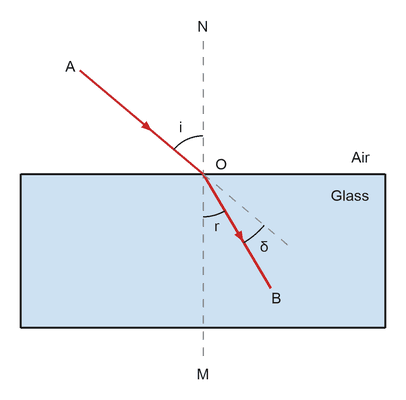
In the figure AO is the incident ray, OB the refracted ray and NOM the normal at O. Going from air into glass the ray bends towards the normal (r < i), so it turns through the angle of deviation δ, which is i − r.
Step 3 — Note the special case.
A ray falling normally on the boundary does not change direction, although its speed still changes. Refraction takes place at the surface separating the two media.
Therefore, refraction is the bending (change of direction) of light at the boundary when it passes obliquely from one medium into another.
- 262 marks
Question 26
What is the cause of refraction of light when it passes from one medium to another ?
Solve with AIWritten solution
Solution:
Concept: Light travels at different speeds in different media: fastest in vacuum (or air), slower in water and slower still in glass.
Step 1 — State the cause.
Refraction is caused by the change in the speed of light as it goes from one medium into another.
Step 2 — Explain why the beam turns.
When a beam strikes the boundary obliquely, one edge of it enters the new medium first and changes speed first, while the other edge is still in the old medium. So the beam swings round and changes direction. The blue lines in the figure are wavefronts; they are closer together where light is slower.
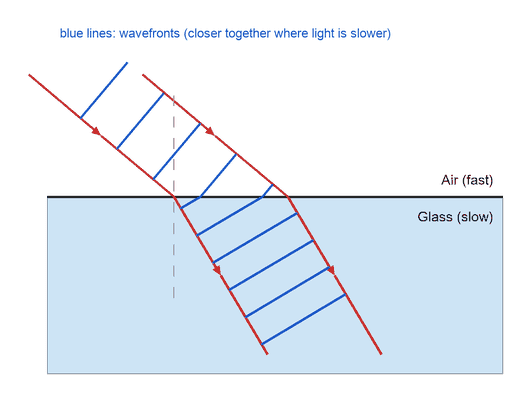
Step 3 — Decide the direction.
If light slows down (enters a denser medium) it bends towards the normal; if it speeds up (enters a rarer medium) it bends away from the normal. If the speed does not change, it does not bend.
Therefore, refraction is caused by the change in the speed of light in going from one medium into another.
- 272 marks
Question 27
State the Snell's laws of refraction of light.
Solve with AIWritten solution
Solution:
Concept: Refraction obeys two laws, called Snell's laws after Willebrord Snell.
Step 1 — First law.
The incident ray, the refracted ray and the normal at the point of incidence all lie in the same plane.
Step 2 — Second law (Snell's law).
For a given pair of media and light of a given colour, the ratio of the sine of the angle of incidence to the sine of the angle of refraction is a constant.
The constant ₁μ₂ is the refractive index of the second medium with respect to the first.
Step 3 — Check with an example.
For air to glass (μ = 1.5), i = 30° gives r ≈ 19.5° and i = 60° gives r ≈ 35.3°. In both cases sin i ÷ sin r works out to 1.5.
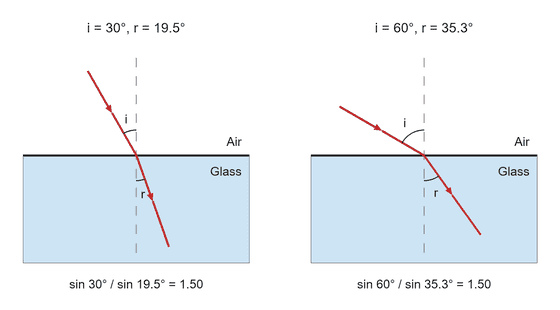
Therefore, (1) the incident ray, refracted ray and normal lie in one plane, and (2) sin i ÷ sin r is constant for a given pair of media and colour of light.
- 282 marks
Question 28
Define the term refractive index of a medium. Can it be less than 1 ?
Solve with AIWritten solution
Solution:
Concept: The refractive index of a medium is μ = c ÷ V, the speed of light in vacuum (or air), c = 3 × 10⁸ m s⁻¹, divided by the speed of light V in the medium. A larger μ means light is slower there; for example μ is 1.5 for glass and 4/3 for water.
Step 1 — Define the refractive index.
The refractive index μ of a medium is the ratio of the speed of light in vacuum (or air) to the speed of light in that medium. For light going from vacuum (air) into the medium it also equals sin i ÷ sin r.
It has no unit, because it is a ratio of two speeds.
Step 2 — Absolute refractive index.
Light travels slower in every material medium than in vacuum (V < c), so the absolute refractive index of a medium cannot be less than 1.
Step 3 — Relative refractive index.
A relative refractive index can be less than 1. For example, the refractive index of air with respect to glass is 1 ÷ 1.5, which is about 0.67.
Therefore, μ = speed of light in vacuum ÷ speed of light in the medium; the absolute refractive index cannot be less than 1, but a relative refractive index can.
- 292 marks
Question 29
(a) Compare the speeds of light of wavelength 4000Å (i.e. violet light) and 8000Å (i.e. red light) in vacuum.
(b) How is the refractive index of a medium related to the speed of light in it and in vacuum or air?
Solve with AIWritten solution
Solution:
Concept: In vacuum (or air) light of every colour travels at the same speed, c = 3 × 10⁸ m s⁻¹. Colours travel at different speeds only inside a material medium.
(a)
Step 1 — Compare the speeds in vacuum.
Light of wavelength 4000 Å and light of wavelength 8000 Å both travel at 3 × 10⁸ m s⁻¹ in vacuum, so the ratio of their speeds is 1 : 1. (8000 Å is in fact just beyond the visible red, but the answer is the same: every wavelength has the same speed in vacuum.)
(b)
Step 2 — Relate μ to the speeds.
The refractive index of a medium is the speed of light in vacuum (or air) divided by its speed in the medium.
So the slower light travels in a medium, the larger its refractive index.
Therefore, (a) the two speeds in vacuum are equal (ratio 1 : 1), and (b) μ = speed of light in vacuum (or air) ÷ speed of light in the medium.
- 302 marks
Question 30
A light ray in passing from water to a medium (a) speeds up, (b) slows down. In each case, (i) give one example of the medium, (ii) state whether the refractive index of medium is equal to, less than or greater than the refractive index of water.
Solve with AIWritten solution
Solution:
Concept: The refractive index of a medium is μ = c ÷ V, the speed of light in vacuum (or air), c = 3 × 10⁸ m s⁻¹, divided by the speed of light V in the medium. A larger μ means light is slower there; for example μ is 1.5 for glass and 4/3 for water. Water has μ = 1.33. Light speeds up on going into a medium of lower μ and slows down on going into one of higher μ.
(a) Light speeds up
Step 1 — Example.
(i) The medium can be air (μ = 1).
Step 2 — Compare with water.
(ii) Light is faster there, so its refractive index is less than that of water.
(b) Light slows down
Step 3 — Example.
(i) The medium can be glass (μ = 1.5).
Step 4 — Compare with water.
(ii) Light is slower there, so its refractive index is greater than that of water.
Therefore, (a) speeding up: air, with μ less than that of water; (b) slowing down: glass, with μ greater than that of water.
- 312 marks
Question 31
What do you understand by the statement 'the refractive index of glass is 1·5 for white light' ?
Solve with AIWritten solution
Solution:
Concept: The refractive index of a medium is μ = c ÷ V, the speed of light in vacuum (or air), c = 3 × 10⁸ m s⁻¹, divided by the speed of light V in the medium. A larger μ means light is slower there; for example μ is 1.5 for glass and 4/3 for water.
Step 1 — Say what the number means.
μ = 1.5 means that the speed of white light in air (or vacuum) is 1.5 times its speed in glass. Equivalently, for light going from air into glass, sin i ÷ sin r is 1.5.
Step 2 — Find the speed in glass.
Divide the speed of light in air by 1.5.
Step 3 — A remark on colour.
Strictly, μ is slightly different for each colour; 1.5 is the value for white light as a whole.
Therefore, the statement means light travels 1.5 times faster in air than in glass (about 2 × 10⁸ m s⁻¹ in glass).
- 322 marks
Question 32
A monochromatic ray of light passes from air to glass. The wavelength of light in air is , the speed of light in air is and in glass is . If the refractive index of glass is 1·5, write down (a) the relationship between and , (b) the wavelength of light in glass.
Solve with AIWritten solution
Solution:
Concept: The refractive index of a medium is μ = c ÷ V, the speed of light in vacuum (or air), c = 3 × 10⁸ m s⁻¹, divided by the speed of light V in the medium. A larger μ means light is slower there; for example μ is 1.5 for glass and 4/3 for water. When light is refracted its frequency f does not change (the source fixes it). Speed and wavelength are linked by V = fλ, so the wavelength changes in the same ratio as the speed.
(a) Relation between c and V
Step 1 — Use the definition of μ.
The refractive index of glass is c ÷ V and equals 1.5.
(b) Wavelength in glass
Step 2 — Keep the frequency fixed.
The frequency f is the same in air and glass, so c = fλ in air and V = f in glass. Dividing one by the other cancels f.
Step 3 — Substitute V/c.
From part (a), V ÷ c is 1 ÷ 1.5.
Watch out: The wavelength falls in the same ratio as the speed, because the frequency does not change.
Therefore, (a) c = 1.5 V, and (b) the wavelength in glass is λ ÷ 1.5 = 2λ/3.
- 332 marks
Question 33
A boy uses blue colour of light to find the refractive index of glass. He then repeats the experiment using red colour of light. Will the refractive index be the same or different in the two cases ? Give a reason to support your answer.
Solve with AIWritten solution
Solution:
Concept: The refractive index of a medium depends on the colour (wavelength) of light: it is greatest for violet (shortest wavelength) and least for red (longest wavelength). So violet light travels slowest in glass and bends the most.
Step 1 — Compare the speeds.
Blue light has a shorter wavelength than red light, and in glass it travels slower than red light.
Step 2 — Compare the refractive indices.
μ = speed in air ÷ speed in glass, so the smaller speed of blue light gives a larger refractive index: μ for blue > μ for red. For the same angle of incidence, blue light bends more.
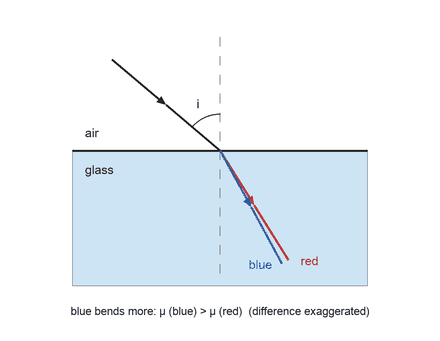
Therefore, the refractive index will be different: it is more for blue light than for red light, because the refractive index depends on the wavelength (colour) of light.
- 342 marks
Question 34
Name two factors on which the refractive index of a medium depends ? State how does it depend on the factors stated by you.
Solve with AIWritten solution
Solution:
Concept: The refractive index of a medium is μ = c ÷ V, the speed of light in vacuum (or air), c = 3 × 10⁸ m s⁻¹, divided by the speed of light V in the medium. A larger μ means light is slower there; for example μ is 1.5 for glass and 4/3 for water. Anything that changes the speed of light in the medium changes μ.
Step 1 — Factor 1: wavelength (colour) of light.
The refractive index decreases as the wavelength increases: it is most for violet light and least for red light.
Step 2 — Factor 2: temperature of the medium.
The refractive index decreases as the temperature rises, because light travels faster in the warmer, rarer medium.
Step 3 — The medium itself.
It also depends on the nature of the medium: the slower light travels in it, the larger μ is (glass 1.5, water 1.33).
Therefore, the refractive index depends on (1) the wavelength of light, decreasing as the wavelength increases, and (2) the temperature, decreasing as the temperature rises.
- 352 marks
Question 35
Light of a single colour is passed through a liquid having a piece of glass suspended in it. On changing the temperature of liquid, at a particular temperature the glass piece is not seen.
(i) When is the glass piece not seen ?
(ii) Why is the light of a single colour used ?
Solve with AIWritten solution
Solution:
Concept: A clear, colourless glass piece in a liquid is seen only because light bends (and partly reflects) at its surface. If light crosses its surface with no change of speed, nothing marks the boundary and the glass cannot be told apart from the liquid. The refractive index of a medium depends on the colour (wavelength) of light: it is greatest for violet (shortest wavelength) and least for red (longest wavelength). So violet light travels slowest in glass and bends the most.
(i) When the glass piece is not seen
Step 1 — Match the refractive indices.
The refractive index of the liquid changes with temperature. At one particular temperature it becomes equal to the refractive index of the glass.
Step 2 — See what happens to the light.
Light then passes from the liquid into the glass and out again with no change of speed, so there is no refraction and no reflection at the glass surface. The glass piece cannot be seen.
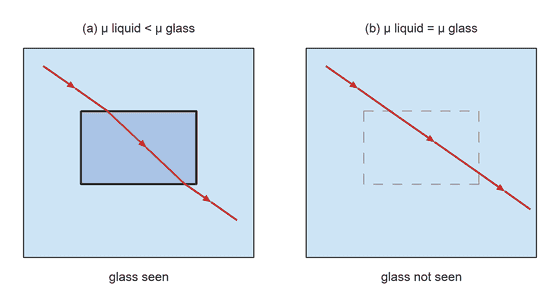
(ii) Why light of a single colour is used
Step 3 — Use the colour dependence.
The refractive index of each medium is different for different colours. With white light, the two indices could be equal for only one colour at a time, and the glass would still be seen in the other colours. With light of one colour they can be matched exactly.
Therefore, (i) the glass piece is not seen when the refractive index of the liquid equals that of the glass, and (ii) single-colour light is used because the refractive index depends on colour.
- 362 marks
Question 36
When an illuminated object is held in front of a thick plane glass mirror, several images are seen, out of which the second image is brightest. Give reason.
Solve with AIWritten solution
Solution:
Concept: A thick glass mirror reflects light at two surfaces: weakly at the front (unsilvered) glass surface and strongly at the silvered back surface. Each reflection forms an image.
Step 1 — The first image is faint.
At the front surface only a small part of the light (about 4% for glass) is reflected. This forms the first, faint image.
Step 2 — The second image is the brightest.
Most of the light (about 96%) is refracted into the glass, reaches the silvered back surface and is strongly reflected there. It comes out through the front surface and forms the second image, which carries most of the light.
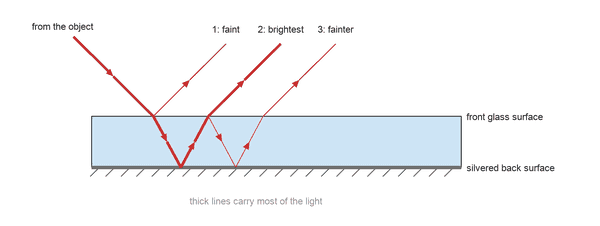
Step 3 — Further images are fainter.
At the front surface a little of this light is reflected back inside again, reflected by the silvering, and comes out to form more images, each fainter than the one before.
Therefore, the second image is brightest because it is formed by the strong reflection at the silvered back surface, which receives most of the light.
- 374 marks
Question 37
Draw diagrams to show the refraction of light from (i) air to glass, and (ii) glass to air. In each diagram, label the incident ray, refracted ray, the angle of incidence () and the angle of refraction ()
Solve with AIWritten solution
Solution:
Concept: Refraction is the change in direction of light when it passes obliquely from one transparent medium into another. It happens because light travels at different speeds in different media. Light bends towards the normal when it enters an optically denser medium (it slows down) and away from the normal when it enters an optically rarer medium (it speeds up). All angles are measured from the normal, the line at 90° to the surface at the point of incidence.
Step 1 — Draw the normal first.
In each diagram draw the surface, then the normal (dotted) at the point of incidence, and measure both angles from it.
(i) Air to glass
Step 2 — Bend towards the normal.
Glass is optically denser, so the refracted ray bends towards the normal: r < i.
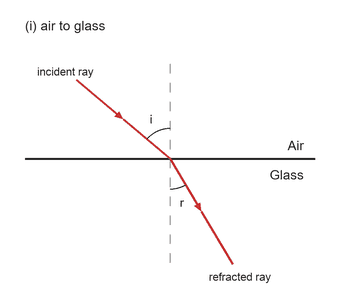
(ii) Glass to air
Step 3 — Bend away from the normal.
Air is optically rarer, so the refracted ray bends away from the normal: r > i.

Step 4 — Label each diagram.
Show the surface, the normal, the incident ray and the refracted ray with arrows, and the angles i and r, each measured from the normal.
Watch out: Angles of incidence and refraction are measured from the normal, never from the surface.
Therefore, from air to glass the ray bends towards the normal (r < i), and from glass to air it bends away from the normal (r > i).
- 383 marks
Question 38
A light ray suffers reflection and refraction at the boundary in passing from air to water. Draw a neat labelled ray diagram to show it.
Solve with AIWritten solution
Solution:
Concept: At the air–water boundary light is partly reflected and partly refracted. The reflected ray obeys the laws of reflection (angle of reflection = angle of incidence); the refracted ray obeys Snell's law.
Step 1 — Draw the reflected ray.
A small part of the light goes back into the air on the other side of the normal, at an angle equal to the angle of incidence i.
Step 2 — Draw the refracted ray.
Most of the light enters the water. Water is optically denser than air, so the ray bends towards the normal: r < i, with sin i ÷ sin r equal to 4/3.
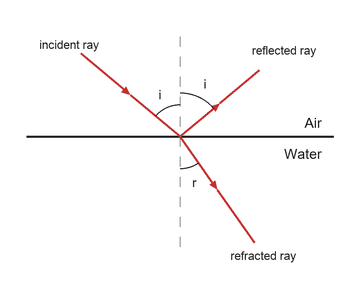
Step 3 — Label the diagram.
Show the air–water surface, the normal at the point of incidence, the incident, reflected and refracted rays with arrows, the two equal angles i and the angle r.
Therefore, the diagram shows one incident ray giving a weaker reflected ray at angle i and a refracted ray bent towards the normal (r < i).
- 394 marks
Question 39
In Fig. 4.18, a ray of light A incident from air suffers partial reflection and refraction at the boundary of water.
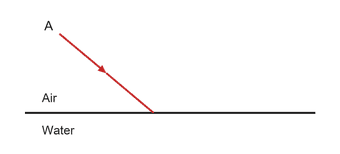
(a) Complete the diagram showing (i) the reflected ray B and (ii) the refracted ray C.
(b) How are the angles of incidence and refraction related ?
Solve with AIWritten solution
Solution:
Concept: At the point where ray A meets the water, draw the normal. The reflected ray makes the same angle with the normal as the incident ray. The refracted ray bends towards the normal, because water is optically denser than air.
(a) Completing the diagram
Step 1 — Reflected ray B.
(i) Draw B going back into the air on the other side of the normal, making the same angle i with the normal as A.
Step 2 — Refracted ray C.
(ii) Draw C going into the water, bent towards the normal, so its angle r is smaller than i.

(b) Relation between i and r
Step 3 — Use Snell's law.
For air to water the ratio of the sines is the refractive index of water.
So r is less than i. For example, i = 50° gives r ≈ 35°.
Therefore, B leaves at angle i on the other side of the normal, C bends towards the normal, and sin i ÷ sin r = 4/3 (so r < i).
- 404 marks
Question 40
The diagram alongside shows the refraction of a ray of light from air to a liquid.
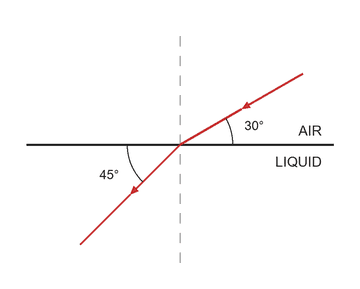
(a) Write the values of (i) angle of incidence, and (ii) angle of refraction.
(b) Use Snell's law to find the refractive index of liquid with respect to air.
Solve with AIWritten solution
Solution:
Concept: The angles marked in the figure are measured from the surface. The angles of incidence and refraction are measured from the normal, so each is 90° minus the marked angle. Snell's law: for light going from medium 1 into medium 2, sin i ÷ sin r = ₁μ₂, a constant called the refractive index of medium 2 with respect to medium 1. Here i is the angle of incidence and r the angle of refraction, both measured from the normal.

(a)
Step 1 — Angle of incidence.
(i) The incident ray makes 30° with the surface, so its angle with the normal is
Step 2 — Angle of refraction.
(ii) The refracted ray makes 45° with the surface, so
(b)
Step 3 — Apply Snell's law.
Divide sin i by sin r.
Step 4 — Check the answer.
r (45°) is less than i (60°), so the ray bent towards the normal, as expected for a liquid denser than air; and μ is more than 1.
Watch out: Angles of incidence and refraction are measured from the normal, never from the surface.
Therefore, (a) i = 60° and r = 45°, and (b) the refractive index of the liquid is √1.5 ≈ 1.22.
- 414 marks
Question 41
What is lateral displacement ? Draw a ray diagram showing the lateral displacement of a ray of light when it passes through a parallel sided glass slab.
Solve with AIWritten solution
Solution:
Concept: A ray crossing a parallel-sided glass slab is refracted twice: towards the normal on entering (air to glass) and away from the normal on leaving (glass to air). Because the two faces are parallel, the angle of emergence e equals the angle of incidence i, so the emergent ray is parallel to the incident ray, only shifted sideways (lateral displacement).
Step 1 — Define lateral displacement.
The lateral displacement is the perpendicular distance between the path of the incident ray (produced forward) and the emergent ray when light passes obliquely through a parallel-sided glass slab. It is marked d in the figure.
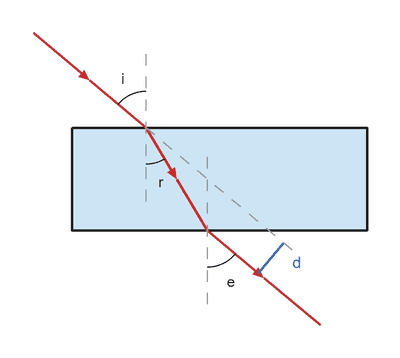
Step 2 — Read the diagram.
The incident ray bends towards the normal inside the slab (r < i) and away from the normal on leaving (angle of emergence e = i), so the emergent ray is parallel to the incident ray. The dashed line is the incident ray produced, and d is measured at right angles to both.
Step 3 — What d depends on.
d is larger for a thicker slab, for a larger angle of incidence and for a larger refractive index (so it is more for violet light than for red light).
Therefore, lateral displacement is the perpendicular distance between the incident ray produced and the emergent ray, which are parallel.
- 424 marks
Question 42
A ray of light strikes the surface of a rectangular glass slab such that the angle of incidence in air is (i) , (ii) . In each case, draw a diagram to show the path taken by the ray as it passes through the glass slab and emerges from it.
Solve with AIWritten solution
Solution:
Concept: A ray crossing a parallel-sided glass slab is refracted twice: towards the normal on entering (air to glass) and away from the normal on leaving (glass to air). Because the two faces are parallel, the angle of emergence e equals the angle of incidence i, so the emergent ray is parallel to the incident ray, only shifted sideways (lateral displacement). A ray incident normally does not bend at all.
(i) i = 0°
Step 1 — Follow the normal ray.
The ray falls along the normal, so r = 0°. It passes straight through both faces without bending and comes out along the same line: no deviation and no lateral displacement.
(ii) i = 45°
Step 2 — At the top face.
The ray bends towards the normal. For glass of μ = 1.5, Snell's law gives
Step 3 — At the bottom face.
The ray meets the bottom face at 28.1° and bends away from the normal, emerging at 45°. The emergent ray is parallel to the incident ray but laterally displaced.
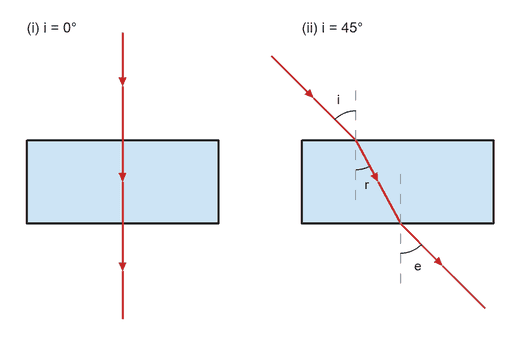
Therefore, at 0° the ray goes straight through undeviated; at 45° it bends to about 28° inside and emerges at 45°, parallel to the incident ray and shifted sideways.
- 435 marks
Question 43
In the adjacent diagram, AO is a ray of light incident on a rectangular glass slab.

(a) Complete the path of the ray till it emerges out of the slab.
(b) In the diagram, mark the angle of incidence () and the angle of refraction () at the first interface. How is the refractive index of glass related to the angles and ?
(c) Mark angle of emergence by the letter . How are the angles and related ?
(d) Which two rays are parallel to each other ? Name them.
(e) Indicate in the diagram the lateral displacement between the emergent ray and the incident ray. State one factor that affects the lateral displacement.
Solve with AIWritten solution
Solution:
Concept: A ray crossing a parallel-sided glass slab is refracted twice: towards the normal on entering (air to glass) and away from the normal on leaving (glass to air). Because the two faces are parallel, the angle of emergence e equals the angle of incidence i, so the emergent ray is parallel to the incident ray, only shifted sideways (lateral displacement).
(a) Path of the ray
Step 1 — Follow the ray through the slab.
At O the ray enters the glass and bends towards the normal. It travels straight through the glass to the lower face, where it bends away from the normal and emerges into air.

(b) Angles i and r
Step 2 — Mark the angles.
i is the angle between AO and the normal at O; r is the angle between the refracted ray inside the glass and the same normal. Snell's law links them to the refractive index.
(c) Angle of emergence e
Step 3 — Relate e to i.
e is the angle between the emergent ray and the normal at the lower face. The normals at the two faces are parallel, so the ray meets the lower face at angle r. By the principle of reversibility, a ray leaving glass at angle r comes out at angle i, so e = i.
(d) Parallel rays
Step 4 — Name them.
The incident ray AO and the emergent ray are parallel to each other.
(e) Lateral displacement
Step 5 — Mark d and name a factor.
d is the perpendicular distance between AO produced (dashed) and the emergent ray. One factor: the thickness of the slab (thicker slab, larger d). It also increases with the angle of incidence and with the refractive index of the glass.
Watch out: E is measured from the normal at the lower face, not from the face itself.
Therefore, μ = sin i ÷ sin r, e = i, AO is parallel to the emergent ray, and the lateral displacement grows with the thickness of the slab.
- 445 marks
Question 44
A ray of green light enters a liquid from air, as shown in Fig. 4.21. Angle 1 is and angle 2 is .
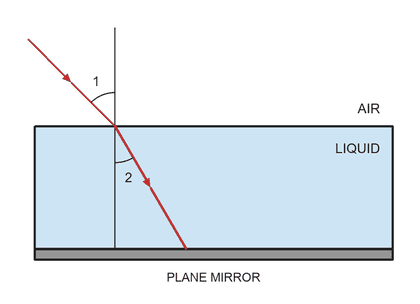
(a) Find the refractive index of the liquid.
(b) Show in the diagram the path of the ray after it strikes the mirror and re-enters in air. Mark in the diagram the angles wherever necessary.
(c) Redraw the diagram if plane mirror becomes normal to the refracted ray inside the liquid. State the principle used.
Solve with AIWritten solution
Solution:
Concept: Angle 1 is the angle of incidence and angle 2 the angle of refraction at the liquid surface. Snell's law: for light going from medium 1 into medium 2, sin i ÷ sin r = ₁μ₂, a constant called the refractive index of medium 2 with respect to medium 1. Here i is the angle of incidence and r the angle of refraction, both measured from the normal. At the mirror the law of reflection holds, and the principle of reversibility says that a ray sent back along its path retraces it exactly.
(a) Refractive index of the liquid
Step 1 — Apply Snell's law.
Here i = 45° and r = 30°.
(b) Path after the mirror
Step 2 — Reflection at the mirror.
The normals at the liquid surface and at the horizontal mirror are both vertical, so the refracted ray meets the mirror at 30° to its normal and is reflected at 30°.
Step 3 — Refraction back into air.
The reflected ray reaches the surface at an angle of incidence of 30° and goes from the liquid into air, bending away from the normal.
The ray emerges into air at 45° to the normal.
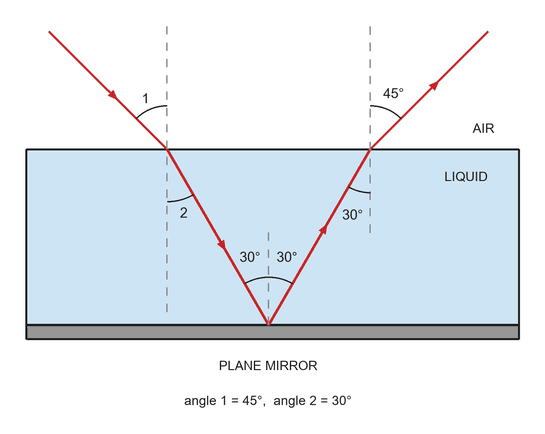
(c) Mirror normal to the refracted ray
Step 4 — Reflection along the normal.
The refracted ray now falls on the mirror along its normal, so it is reflected straight back along its own path. It reaches the surface at 30°, refracts into air at 45°, and leaves along the original incident ray in the reverse direction.
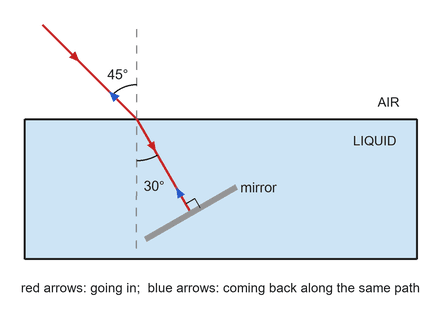
Step 5 — Principle used.
This is the principle of reversibility of the path of light: if a ray is reversed, it retraces its path exactly.
Watch out: The angle of incidence at the mirror is measured from the mirror's normal (vertical here), not from the mirror.
Note: the stem's misprint "digaram" is corrected to "diagram".
Therefore, (a) μ = √2 ≈ 1.41; (b) the ray reflects at 30° and leaves the liquid at 45°; (c) it retraces its path, by the principle of reversibility.
- 453 marks
Question 45
The speed of light in air is . Calculate the speed of light in glass. The refractive index of glass is 1·5.
Solve with AIWritten solution
Solution:
Concept: The refractive index of a medium is μ = c ÷ V, the speed of light in vacuum (or air), c = 3 × 10⁸ m s⁻¹, divided by the speed of light V in the medium. A larger μ means light is slower there; for example μ is 1.5 for glass and 4/3 for water.
Given: Speed of light in air c = 3 × 10⁸ m s⁻¹; refractive index of glass μ = 1.5.
Step 1 — Rearrange μ = c ÷ V.
We want the speed in glass, so make V the subject.
Step 2 — Substitute the values.
Put c = 3 × 10⁸ m s⁻¹ and μ = 1.5.
Step 3 — Check.
Light should be slower in glass than in air, and 2 × 10⁸ is less than 3 × 10⁸ m s⁻¹.
Watch out: Divide c by μ; multiplying would give a speed faster than light in air.
Therefore, the speed of light in glass is 2 × 10⁸ m s⁻¹.
- 463 marks
Question 46
The speed of light in diamond is 125,000 km s. What is its refractive index ? (Speed of light in air ).
Solve with AIWritten solution
Solution:
Concept: The refractive index of a medium is μ = c ÷ V, the speed of light in vacuum (or air), c = 3 × 10⁸ m s⁻¹, divided by the speed of light V in the medium. A larger μ means light is slower there; for example μ is 1.5 for glass and 4/3 for water. Both speeds must be in the same unit before dividing.
Given: Speed of light in diamond V = 125 000 km s⁻¹; speed of light in air c = 3 × 10⁸ m s⁻¹.
Step 1 — Convert the speed in diamond to m s⁻¹.
1 km is 1000 m, so multiply by 1000.
Step 2 — Divide the speeds.
The refractive index is the speed in air divided by the speed in diamond.
Step 3 — Interpret.
μ has no unit. Light travels 2.4 times faster in air than in diamond, so diamond is optically very dense.
Watch out: Convert km s⁻¹ to m s⁻¹ first; dividing 3 × 10⁸ by 125 000 would give a meaningless 2400.
Therefore, the refractive index of diamond is 2.4.
- 473 marks
Question 47
The refractive index of water with respect to air is 4/3. What is the refractive index of air with respect to water ?
Solve with AIWritten solution
Solution:
Concept: By the principle of reversibility, the refractive index of medium 1 with respect to medium 2 is the reciprocal of that of medium 2 with respect to medium 1: ₂μ₁ = 1 ÷ ₁μ₂.
Given: = 4/3.
Step 1 — Write the reciprocal.
Light from water into air is the reverse of air into water.
Step 2 — Substitute = 4/3.
Dividing 1 by 4/3 turns the fraction upside down.
Step 3 — Check.
It is less than 1 because air is optically rarer than water: light is faster in air.
Therefore, the refractive index of air with respect to water is 3/4 = 0.75.
- 483 marks
Question 48
A ray of light of wavelength 6600 Å suffers refraction from air to glass. Taking , find the wavelength of light in glass.
Solve with AIWritten solution
Solution:
Concept: When light is refracted its frequency f does not change (the source fixes it). Speed and wavelength are linked by V = fλ, so the wavelength changes in the same ratio as the speed. So = ÷ μ.
Given: Wavelength in air = 6600 Å; = 3/2.
Step 1 — Write the relation.
The frequency is the same in air and glass, so the wavelength falls in the same ratio as the speed.
Step 2 — Substitute the values.
Put = 6600 Å and = 3/2.
Step 3 — Interpret.
The light keeps its colour (same frequency); only its wavelength inside the glass is shorter, because it travels slower there.
Watch out: The wavelength gets shorter in glass; multiplying by 3/2 would make it longer.
Therefore, the wavelength of light in glass is 4400 Å.
- 491 mark
Question 49
In refraction of light through a prism, the light ray:
Solve with AIAnswer
(A) suffers refraction only at one face of the prism
(B) emerges out from the prism in a direction parallel to the incident ray
- Correct
(C) bends at both the surfaces of the prism towards its base
(D) bends at both the surfaces of the prism opposite to its base.
Answer: (C) bends at both the surfaces of the prism towards its base
Concept: A prism refracts a ray twice, at two faces inclined at the angle of the prism A. Inside, the angles of refraction at the two faces add up to A (r₁ + r₂ = A); the total turning of the ray is the angle of deviation (δ = i₁ + i₂ − A), where i₁ is the angle of incidence and i₂ the angle of emergence. Both bends turn the ray towards the base of the prism.
Step 1 — At the first face.
The ray goes from air into glass, so it bends towards the normal of that face.
Step 2 — At the second face.
The ray goes from glass into air, so it bends away from the normal of that face.
Step 3 — Combine the two bends.
The faces are inclined to each other, so both bends turn the ray the same way: towards the base of the prism.
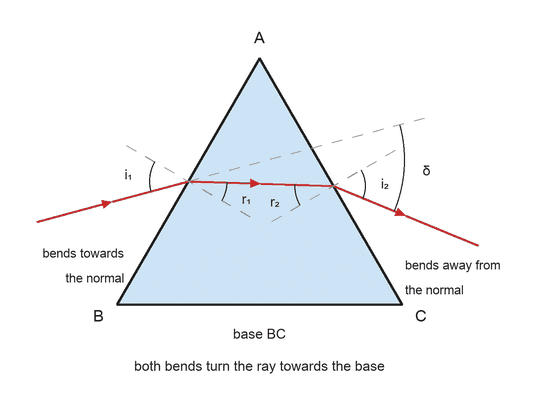
Why the other options are wrong:
- (A) suffers refraction only at one face of the prism: the ray is refracted at both faces, not just one.
- (B) emerges out from the prism in a direction parallel to the incident ray: an emergent ray parallel to the incident ray happens with a parallel-sided slab, not a prism.
- (D) bends at both the surfaces of the prism opposite to its base: the ray bends towards the base, not away from it.
Therefore, the ray bends at both surfaces towards the base, option (C).
- 501 mark
Question 50
A ray of light suffers refraction through an equilateral prism. The deviation produced by the prism does not depend on the :
Solve with AIAnswer
(A) angle of incidence
(B) colour of light
(C) material of prism
- Correct
(D) size of prism
Answer: (D) size of prism
Concept: The angle of deviation of a prism depends on the angle of incidence, the colour (wavelength) of light, the material (refractive index) of the prism and its refracting angle. The size of the prism is not on this list.
Step 1 — Look at an equilateral prism of any size.
Every equilateral prism has a refracting angle of 60°, whether it is small or large.
Step 2 — Compare a small and a large prism.
For the same glass, the same light and the same angle of incidence, the ray bends by the same amount at each face. For example, with i of 40° and μ of 1.5, δ is about 38.5° for both prisms; only the path inside is longer.
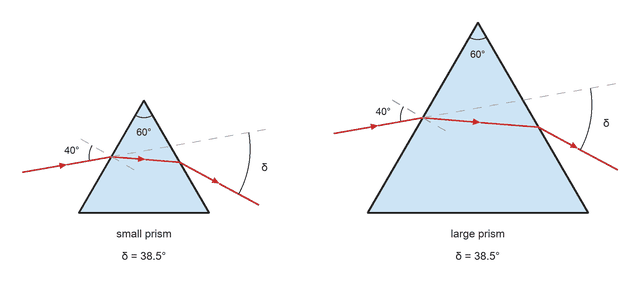
Why the other options are wrong:
- (A) angle of incidence: changing the angle of incidence changes the deviation (it first falls to a minimum, then rises).
- (B) colour of light: violet light is deviated more than red light, so the colour matters.
- (C) material of prism: a prism of higher refractive index (such as flint glass) deviates light more, so the material matters.
Therefore, the deviation does not depend on the size of the prism, option (D).
- 511 mark
Question 51
In the figure given ahead, the correct statement is :
 Solve with AI
Answer
(A) ABED and ABC are the refracting surfaces.
- Correct
(B) line AD is the refracting edge.
(C) angle is the angle of deviation
(D) AB is the base of the prism
Answer: (B) line AD is the refracting edge.
Concept: The two rectangular faces through which light enters and leaves are the refracting surfaces. The line where they meet is the refracting edge, the angle between them is the refracting angle, and the face opposite the edge is the base.
Step 1 — Find the refracting surfaces.
In the figure the refracting surfaces are the rectangular faces ABED and ACFD.
Step 2 — Find where they meet.
These two faces meet along the line AD, so AD is the refracting edge.

Why the other options are wrong:
- (A) ABED and ABC are the refracting surfaces: ABC is a triangular end face, not a refracting surface; only ABED is a refracting surface.
- (C) angle is the angle of deviation: angle a (between AB and AC) is the refracting angle (angle of the prism), not the angle of deviation.
- (D) AB is the base of the prism: the base is the face BCFE, opposite the refracting edge; AB is only an edge.
Therefore, AD is the refracting edge, option (B).
- 521 mark
Question 52
The angle of prism A is given as :
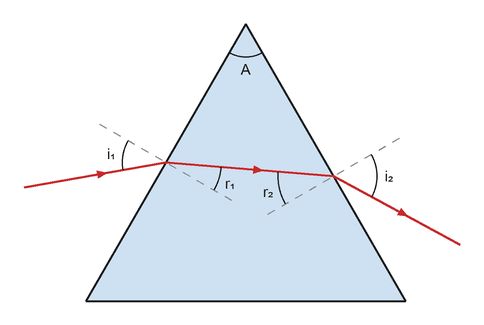 Solve with AI
Answer
(A)
(B)
- Correct
(C)
(D)
Answer: (C)
Concept: The angles r₁ and r₂ are the angles the ray inside the prism makes with the normals at the two faces. A little geometry links them to the angle of the prism A.
Step 1 — Use the quadrilateral AQNR.
The normals at Q and R meet at N. Each normal makes 90° with its face, and the angles of a quadrilateral add up to 360°.
So ∠N is 180° − A.
Step 2 — Use the triangle QNR.
The angles of triangle QNR add up to 180°.
Putting ∠N = 180° − A and cancelling 180° gives the result.
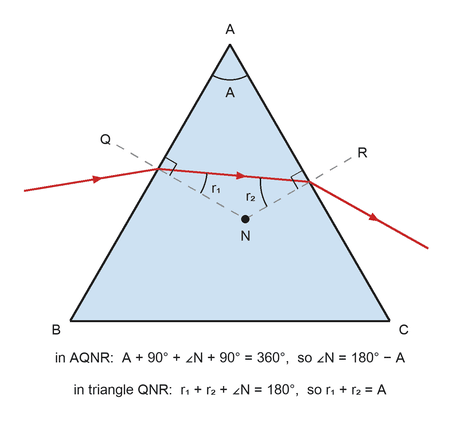
Why the other options are wrong:
- (A) : r₁ − r₂ is zero at minimum deviation, where A is clearly not zero.
- (B) : i₁ + i₂ uses the angles outside the glass; it equals A + δ, not A.
- (D) : r₁ ÷ r₂ is a pure number, not an angle, so it cannot equal A.
Therefore, the angle of the prism is A = r₁ + r₂, option (C).
- 531 mark
Question 53
The angle of deviation becomes minimum when :
Solve with AIAnswer
(A)
(B)
- Correct
(C)
(D)
Answer: (C)
Concept: As the angle of incidence increases, the deviation produced by a prism first decreases, reaches a minimum δmin, and then increases. At minimum deviation the ray passes symmetrically: the angles of incidence and emergence are equal (each i), r₁ and r₂ are each A/2, the ray inside is parallel to the base, and δmin = 2i − A.
Step 1 — Picture the symmetric path.
At minimum deviation the ray passes through the prism symmetrically, so it leaves the second face at the same angle at which it met the first: i₁ = i₂.
Step 2 — See what follows.
Then the angles inside are equal too (r₁ and r₂ are the same), and the deviation has its least value δmin.

Why the other options are wrong:
- (A) : this would mean no bending at the first face, which happens only at normal incidence.
- (B) : this compares an angle outside the glass with an angle inside it; it is not the condition.
- (D) : this would mean no bending at the second face.
Therefore, the deviation is minimum when i₁ = i₂, option (C).
- 541 mark
Question 54
In position of minimum deviation, the refracted ray inside the prism is .......... to its base :
Solve with AIAnswer
(A) normal
(B) inclined at
- Correct
(C) parallel
(D) none of the above
Answer: (C) parallel
Concept: As the angle of incidence increases, the deviation produced by a prism first decreases, reaches a minimum δmin, and then increases. At minimum deviation the ray passes symmetrically: the angles of incidence and emergence are equal (each i), r₁ and r₂ are each A/2, the ray inside is parallel to the base, and δmin = 2i − A.
Step 1 — Use the symmetry.
At minimum deviation the ray makes equal angles r₁ and r₂ with the normals of the two faces.
Step 2 — Relate this to the base.
In an equilateral (or isosceles) prism the two faces are equally inclined to the base, so a ray making equal angles with both faces runs parallel to the base.

Why the other options are wrong:
- (A) normal: a ray normal to the base would not make equal angles with the two faces.
- (B) inclined at : a ray inclined at 45° to the base is not symmetric either.
- (D) none of the above: option (C) is correct, so "none of the above" is wrong.
Therefore, the ray inside is parallel to the base, option (C).
- 551 mark
Question 55
Mention the incorrect statement :
Solve with AIAnswer
(A) The angle of deviation produced by a prism depends on the colour or wavelength of the light used.
(B) The angle of incidence also affects the angle of deviation produced by the prism.
- Correct
(C) In a prism as well as a parallel-sided glass slab, the emergent ray is parallel to the incident ray with a lateral displacement.
(D) The angle of deviation of prism is also affected by the material of prism.
Answer: (C) In a prism as well as a parallel-sided glass slab, the emergent ray is parallel to the incident ray with a lateral displacement.
Concept: A ray crossing a parallel-sided glass slab is refracted twice: towards the normal on entering (air to glass) and away from the normal on leaving (glass to air). Because the two faces are parallel, the angle of emergence e equals the angle of incidence i, so the emergent ray is parallel to the incident ray, only shifted sideways (lateral displacement). A prism's faces are inclined, so it deviates the ray.
Step 1 — Test the slab.
In a parallel-sided slab the bend at the second face undoes the bend at the first, so the emergent ray is parallel to the incident ray, only laterally displaced.
Step 2 — Test the prism.
In a prism both bends turn the ray towards the base, so the emergent ray is deviated, not parallel. Statement (C) is wrong for the prism, so it is the incorrect statement.
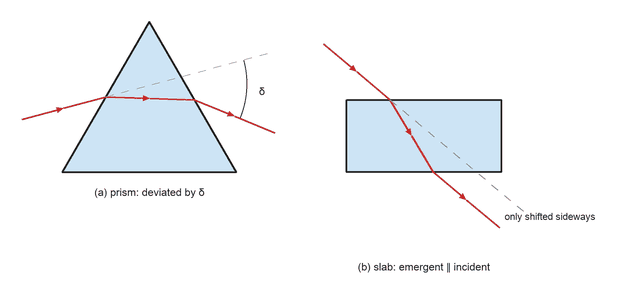
Watch out: The question asks for the incorrect statement.
Why the other options are wrong:
- (A) The angle of deviation produced by a prism depends on the colour or wavelength of the light used: it is a correct statement (violet is deviated more than red), so it is not the answer.
- (B) The angle of incidence also affects the angle of deviation produced by the prism: it is a correct statement (the deviation changes with i and is least at one angle), so it is not the answer.
- (D) The angle of deviation of prism is also affected by the material of prism: it is a correct statement (a higher refractive index gives more deviation), so it is not the answer.
Therefore, the incorrect statement is (C), option (C).
- 561 mark
Question 56
A ray of light is incident normally on the face of an equilateral glass prism. The angle of refraction from the first face of prism is :
Solve with AIAnswer
(A)
(B)
(C)
- Correct
(D)
Answer: (D)
Concept: Snell's law: for light going from medium 1 into medium 2, sin i ÷ sin r = ₁μ₂, a constant called the refractive index of medium 2 with respect to medium 1. Here i is the angle of incidence and r the angle of refraction, both measured from the normal. A ray falling normally on a face travels along its normal.
Step 1 — Angle of incidence.
Normal incidence means i = 0° at the first face.
Step 2 — Angle of refraction.
Snell's law gives the sine of the angle of refraction.
So r₁ is 0°: the ray enters without bending.
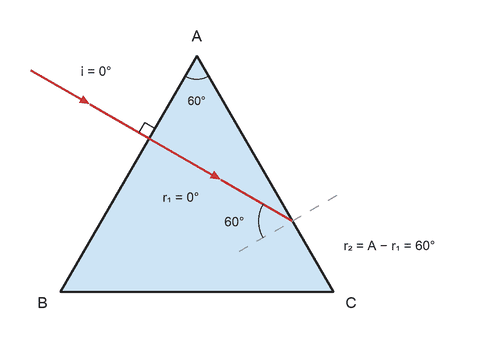
Why the other options are wrong:
- (A) : 45° would need the ray to bend on entry, which a normal ray does not.
- (B) : 90° would mean the ray travels along the face, not into the prism.
- (C) : 60° is the angle at the second face: since r₁ + r₂ is 60°, r₂ is 60° − 0°.
Therefore, the angle of refraction at the first face is 0°, option (D).
- 571 mark
Question 57
Assertion (A) : If the angles of the base of a prism are equal, then in the position of minimum deviation, the refracted ray will pass parallely to the base of the prism.
Reason (R) : For minimum deviation, angle of incidence is equal to the angle of emergence.
Solve with AIAnswer
- Correct
(A) both A and R are true and R is the correct explanation of A
(B) both A and R are True and R is not the correct explanation of A
(C) assertion is false but reason is true
(D) assertion is true but reason is false
Answer: (A) both A and R are true and R is the correct explanation of A
Concept: As the angle of incidence increases, the deviation produced by a prism first decreases, reaches a minimum δmin, and then increases. At minimum deviation the ray passes symmetrically: the angles of incidence and emergence are equal (each i), r₁ and r₂ are each A/2, the ray inside is parallel to the base, and δmin = 2i − A.
Step 1 — Judge the assertion.
If the base angles are equal (an isosceles or equilateral prism), the two refracting faces are equally inclined to the base. At minimum deviation the ray inside makes equal angles with both faces, so it runs parallel to the base. The assertion is true.
Step 2 — Judge the reason.
For minimum deviation the angle of incidence equals the angle of emergence. The reason is true.
Step 3 — Does R explain A?.
Because i₁ and i₂ are equal, the angles inside are equal too (r₁ and r₂ are the same). With equal base angles, equal angles inside mean the ray is parallel to the base. So R explains A.
Why the other options are wrong:
- (B) both A and R are True and R is not the correct explanation of A: R does explain A, as Step 3 shows.
- (C) assertion is false but reason is true: the assertion is true, not false.
- (D) assertion is true but reason is false: the reason is true, not false.
Therefore, both A and R are true and R is the correct explanation of A, option (A).
- 581 mark
Question 58
Complete the following sentence :
Angle of deviation is the angle which the ........... ray makes with the direction of ........... ray.
Solve with AIWritten solution
Solution:
Concept: The angle of deviation δ measures how far a prism turns a ray: it is the angle between the direction in which the ray was going (incident ray produced forward) and the direction in which it leaves (emergent ray).
Step 1 — Picture the two directions.
Produce the incident ray forward (dashed line). Without the prism the light would have gone along this line.
Step 2 — Fill the blanks.
The angle between this line and the emergent ray is the angle of deviation, so the blanks are emergent and incident.

Therefore, the angle of deviation is the angle which the emergent ray makes with the direction of the incident ray.
- 591 mark
Question 59
State whether the following statement is 'true' or 'false' :
The deviation produced by a prism is independent of the angle of incidence and is same for all colours of light.
Solve with AIWritten solution
Solution:
Concept: As the angle of incidence increases, the deviation produced by a prism first decreases, reaches a minimum δmin, and then increases. At minimum deviation the ray passes symmetrically: the angles of incidence and emergence are equal (each i), r₁ and r₂ are each A/2, the ray inside is parallel to the base, and δmin = 2i − A. The refractive index of a medium depends on the colour (wavelength) of light: it is greatest for violet (shortest wavelength) and least for red (longest wavelength). So violet light travels slowest in glass and bends the most.
Step 1 — Check the angle of incidence part.
The deviation depends on the angle of incidence: as i increases, δ first decreases to a minimum and then increases.
Step 2 — Check the colour part.
The deviation is different for different colours. Glass has a larger refractive index for violet than for red, so violet is deviated the most and red the least. This is why a prism splits white light into colours.
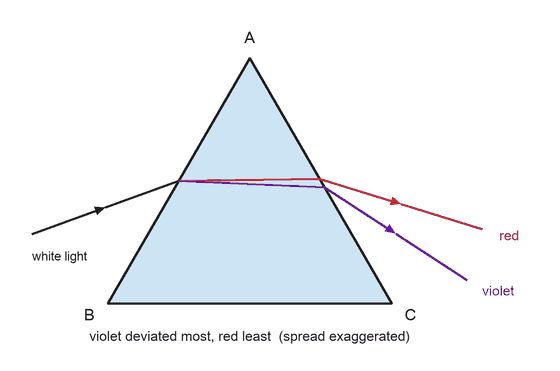
Therefore, the statement is false: the deviation depends on the angle of incidence and differs for different colours.
- 602 marks
Question 60
How does the angle of minimum deviation produced by a prism change with increase in (i) the wavelength of incident light, and (ii) the refracting angle of prism ?
Solve with AIWritten solution
Solution:
Concept: The more strongly a prism bends light, the larger its minimum deviation δmin. The refractive index of a medium depends on the colour (wavelength) of light: it is greatest for violet (shortest wavelength) and least for red (longest wavelength). So violet light travels slowest in glass and bends the most.
(i) Increase in wavelength
Step 1 — Effect of wavelength.
The refractive index of glass is smaller for longer wavelengths, so light of longer wavelength (towards red) is bent less. So δmin decreases.
(ii) Increase in refracting angle
Step 2 — Effect of the refracting angle.
A larger angle between the faces makes the bends at the two faces larger, so δmin increases. For example, for glass of μ = 1.5, δmin is about 21.7° when A is 40° but about 37.2° when A is 60°.
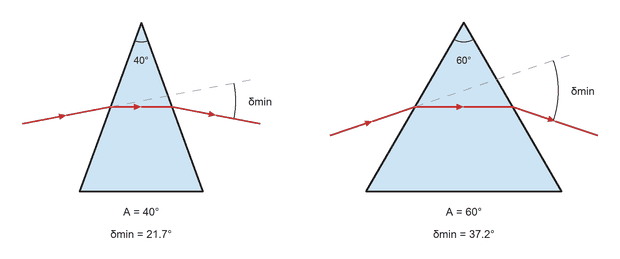
Therefore, δmin (i) decreases as the wavelength increases, and (ii) increases as the refracting angle increases.
- 611 mark
Question 61
Write a relation for the angle of deviation () for a ray of light passing through an equilateral prism in terms of the angle of incidence (), angle of emergence () and angle of prism ().
Solve with AIWritten solution
Solution:
Concept: A prism refracts a ray twice, at two faces inclined at the angle of the prism A. Inside, the angles of refraction at the two faces add up to A (r₁ + r₂ = A); the total turning of the ray is the angle of deviation (δ = i₁ + i₂ − A), where i₁ is the angle of incidence and i₂ the angle of emergence. Both bends turn the ray towards the base of the prism.
Step 1 — Add the turnings at the two faces.
The ray turns by (i₁ − r₁) at the first face and by (i₂ − r₂) at the second face, both towards the base.
Step 2 — Use r₁ + r₂ = A.
Replace r₁ + r₂ by the angle of the prism A (60° for an equilateral prism).
Therefore, δ = (i₁ + i₂) − A.
- 622 marks
Question 62
Name the colour of white light which is deviated (i) the most, and (ii) the least, on passing through a prism.
Solve with AIWritten solution
Solution:
Concept: The refractive index of a medium depends on the colour (wavelength) of light: it is greatest for violet (shortest wavelength) and least for red (longest wavelength). So violet light travels slowest in glass and bends the most. More refractive index means more bending, and so more deviation.
Step 1 — Most deviated.
μ is largest for violet, so (i) violet light is deviated the most.
Step 2 — Least deviated.
μ is smallest for red, so (ii) red light is deviated the least.
Therefore, (i) violet is deviated the most and (ii) red is deviated the least.
- 631 mark
Question 63
Which of the two prisms, A made of crown glass and B made of flint glass, deviates a ray of light more ?
Solve with AIWritten solution
Solution:
Concept: A prism of higher refractive index bends a ray more at each face, so it deviates the ray more. Flint glass has a higher refractive index than crown glass.
Step 1 — Compare the refractive indices.
Flint glass has a larger μ (about 1.62) than crown glass (about 1.52).
Step 2 — Compare the deviations.
For the same ray at i = 45° on two 60° prisms, crown glass deviates it by about 39° and flint glass by about 50°.
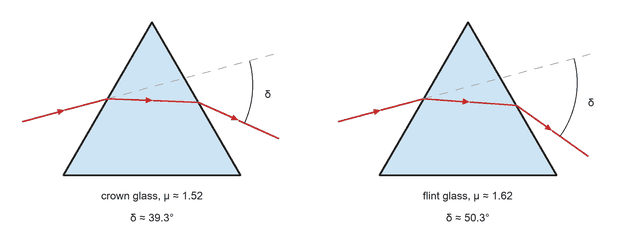
Therefore, prism B (flint glass) deviates a ray of light more.
- 642 marks
Question 64
Define the term angle of deviation.
Solve with AIWritten solution
Solution:
Concept: A prism refracts a ray twice, at two faces inclined at the angle of the prism A. Inside, the angles of refraction at the two faces add up to A (r₁ + r₂ = A); the total turning of the ray is the angle of deviation (δ = i₁ + i₂ − A), where i₁ is the angle of incidence and i₂ the angle of emergence. Both bends turn the ray towards the base of the prism.
Step 1 — Define the angle of deviation.
The angle of deviation δ is the angle through which a ray turns on passing through the prism: the angle between the direction of the incident ray (produced forward) and the direction of the emergent ray.
Step 2 — Explain with the figure.
Without the prism the ray would have gone straight on along the dashed line. The prism bends it towards its base, and the angle between the dashed line and the emergent ray measures this turn.
Therefore, the angle of deviation is the angle between the incident ray produced and the emergent ray; δ = i₁ + i₂ − A.
- 652 marks
Question 65
How does the deviation produced by a prism depend on (i) the refractive index of its material, and (ii) the wavelength of incident light.
Solve with AIWritten solution
Solution:
Concept: Deviation comes from the bending at the two faces. Anything that makes the glass bend light more increases the deviation. The refractive index of a medium depends on the colour (wavelength) of light: it is greatest for violet (shortest wavelength) and least for red (longest wavelength). So violet light travels slowest in glass and bends the most.
(i) Refractive index of the material
Step 1 — Effect of μ.
The higher the refractive index, the greater the deviation. A flint-glass prism (higher μ) deviates light more than a crown-glass prism of the same angle.
(ii) Wavelength of incident light
Step 2 — Effect of wavelength.
The longer the wavelength, the smaller the deviation, because μ decreases as the wavelength increases. Red light (longest wavelength) is deviated least and violet (shortest) most.
Therefore, the deviation (i) increases with the refractive index, and (ii) decreases as the wavelength increases.
- 662 marks
Question 66
A ray of light incident at an angle of incidence passes through an equilateral glass prism such that the refracted ray inside the prism is parallel to its base and emerges at an angle of emergence .
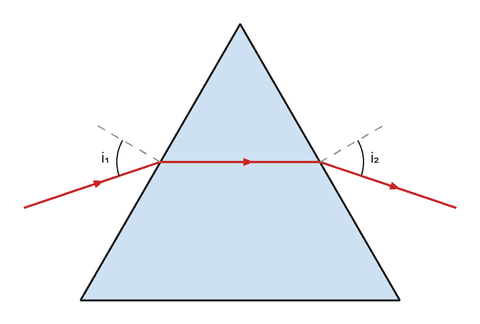
(i) How is the angle of emergence '' related to the angle of incidence '' ? (ii) What can you say about the angle of deviation in such a situation ?
Solve with AIWritten solution
Solution:
Concept: As the angle of incidence increases, the deviation produced by a prism first decreases, reaches a minimum δmin, and then increases. At minimum deviation the ray passes symmetrically: the angles of incidence and emergence are equal (each i), r₁ and r₂ are each A/2, the ray inside is parallel to the base, and δmin = 2i − A.
(i) Relation between i₂ and i₁
Step 1 — Use the symmetry.
A ray inside an equilateral prism parallel to the base makes equal angles with the two faces (r₁ and r₂ are each 30°). So it leaves the second face at the same angle at which it entered the first.
(ii) Angle of deviation
Step 2 — Name the position.
This symmetric path is the position of minimum deviation: the deviation is the least possible.
Therefore, (i) i₂ = i₁, and (ii) the deviation is the minimum deviation, δmin = 2i₁ − A.
- 673 marks
Question 67
A light ray of yellow colour is incident on an equilateral glass prism at an angle of incidence equal to and suffers minimum deviation by an angle of . (i) What will be the angle of emergence ? (ii) If the angle of incidence is changed to (a) , (b) , state in each case whether the angle of deviation will be equal to, less than or more than ?
Solve with AIWritten solution
Solution:
Concept: As the angle of incidence increases, the deviation produced by a prism first decreases, reaches a minimum δmin, and then increases. At minimum deviation the ray passes symmetrically: the angles of incidence and emergence are equal (each i), r₁ and r₂ are each A/2, the ray inside is parallel to the base, and δmin = 2i − A. So 36° is the least deviation this prism can give for yellow light.
(i) Angle of emergence
Step 1 — Use the symmetry.
At minimum deviation the angle of emergence equals the angle of incidence.
Step 2 — Check with δ = i₁ + i₂ − A.
The values give back the stated deviation.

(ii) Other angles of incidence
Step 3 — Compare with the minimum.
36° is reached only at i = 48°. At every other angle of incidence the deviation is more than 36°.
Step 4 — Case (a): i = 30°.
The deviation is more than 36° (about 44° for this prism).
Step 5 — Case (b): i = 60°.
The deviation is again more than 36° (about 38° for this prism).

Watch out: 36° is the smallest deviation; changing i either way increases δ.
Therefore, (i) the angle of emergence is 48°, and (ii) for both (a) 30° and (b) 60° the deviation is more than 36°.
- 682 marks
Question 68
How does the angle of deviation depend on the refracting angle of the prism ?
Solve with AIWritten solution
Solution:
Concept: A prism refracts a ray twice, at two faces inclined at the angle of the prism A. Inside, the angles of refraction at the two faces add up to A (r₁ + r₂ = A); the total turning of the ray is the angle of deviation (δ = i₁ + i₂ − A), where i₁ is the angle of incidence and i₂ the angle of emergence. Both bends turn the ray towards the base of the prism.
Step 1 — See what a larger A does inside.
With a larger angle between the faces, r₂ (equal to A − r₁) is larger, so the ray meets the second face at a larger angle and bends more there.
Step 2 — Give an example.
A glass prism (μ = 1.5) of angle 40° gives a minimum deviation of about 21.7°, while one of angle 60° gives about 37.2°.
Therefore, the angle of deviation increases as the refracting angle of the prism increases.
- 694 marks
Question 69
What is a prism ? With the help of a diagram of the principal section of a prism, indicate its refracting surfaces, refracting angle and base.
Solve with AIWritten solution
Solution:
Concept: A prism is a block of glass whose two refracting faces are inclined to each other, so it turns light instead of only shifting it.
Step 1 — Define a prism.
A prism is a transparent refracting medium bounded by five plane surfaces: two parallel triangular ends and three rectangular faces. Two of the rectangular faces are inclined to each other; light enters through one and leaves through the other.
Step 2 — The principal section.
The principal section is the triangle ABC obtained by cutting the prism at right angles to its rectangular faces.

Step 3 — Mark the parts.
On the principal section: the refracting surfaces are the faces AB and AC; the refracting angle (angle of the prism) is the angle A between them; the base is the face BC opposite A. The line where the two refracting surfaces meet is the refracting edge.
Therefore, the refracting surfaces are AB and AC, the refracting angle is A, and the base is BC.
- 705 marks
Question 70
Diagrams (a) and (b) in Fig. 4.34 below show the refraction of a ray of light of single colour through a prism and a parallel sided glass slab respectively.
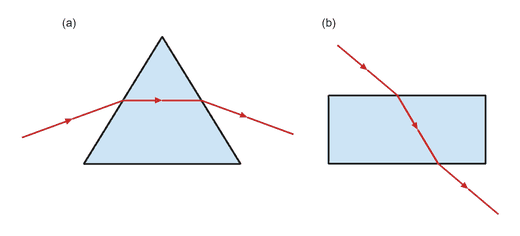
(i) In each diagram, label the incident, refracted, emergent rays and the angle of deviation.
(ii) In what way the direction of the emergent ray in the two cases differ with respect to the incident ray ? Explain your answer.
Solve with AIWritten solution
Solution:
Concept: In both cases the ray is refracted twice: towards the normal on entering glass and away from the normal on leaving. What differs is whether the two faces are parallel (slab) or inclined (prism).
(i) Labelling the rays
Step 1 — Name the rays.
The incident ray is the ray in air falling on the first face; the refracted ray travels inside the glass; the emergent ray leaves the second face into air.
Step 2 — Mark the deviation.
In the prism, δ is the angle between the incident ray produced and the emergent ray. In the slab the deviation is zero.
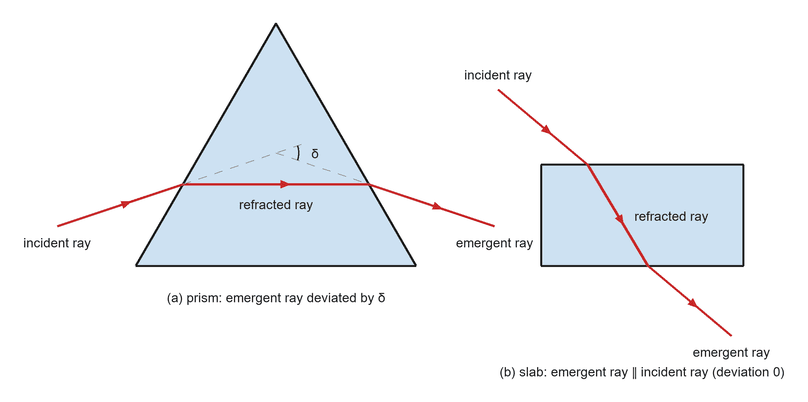
(ii) How the emergent rays differ
Step 3 — The prism.
The emergent ray is not parallel to the incident ray; it is deviated towards the base. The faces are inclined, so the second bend does not undo the first: both turn the ray towards the base.
Step 4 — The slab.
The emergent ray is parallel to the incident ray, only shifted sideways. The faces are parallel, so the second bend is equal and opposite to the first.
Therefore, a prism changes the direction of the light (deviation δ), while a parallel-sided slab only shifts it sideways (no deviation).
- 714 marks
Question 71
What do you understand by the deviation produced by a prism ? Why is it caused ? State three factors on which the angle of deviation depends.
Solve with AIWritten solution
Solution:
Concept: A prism refracts a ray twice, at two faces inclined at the angle of the prism A. Inside, the angles of refraction at the two faces add up to A (r₁ + r₂ = A); the total turning of the ray is the angle of deviation (δ = i₁ + i₂ − A), where i₁ is the angle of incidence and i₂ the angle of emergence. Both bends turn the ray towards the base of the prism.
Step 1 — What deviation is.
When a ray passes through a prism it bends towards the base at both faces, so it leaves in a different direction. The angle between the incident ray (produced) and the emergent ray is the angle of deviation δ.
Step 2 — Why it is caused.
It is caused by refraction at the two inclined faces: at the first face (air to glass) the ray bends towards the normal, and at the second (glass to air) away from the normal. Since the faces are not parallel, both bends turn the ray towards the base and add up.
Step 3 — Three factors.
The angle of deviation depends on (1) the angle of incidence (it first decreases, reaches a minimum, then increases); (2) the material of the prism (higher μ, more deviation); (3) the wavelength (colour) of light (violet most, red least). It also depends on the refracting angle.
Therefore, deviation is the turning of a ray by the prism, caused by refraction at its two inclined faces, and it depends on the angle of incidence, the material and the wavelength of light.
- 725 marks
Question 72
(a) How does the angle of deviation produced by a prism change with increase in the angle of incidence. Draw a curve showing the variation in the angle of deviation with the angle of incidence at a prism surface.
(b) Using the curve in part (a) above, how would you infer that for a given prism, the angle of minimum deviation is unique for light of a given wavelength ?
Solve with AIWritten solution
Solution:
Concept: As the angle of incidence increases, the deviation produced by a prism first decreases, reaches a minimum δmin, and then increases. At minimum deviation the ray passes symmetrically: the angles of incidence and emergence are equal (each i), r₁ and r₂ are each A/2, the ray inside is parallel to the base, and δmin = 2i − A.
(a) Change with the angle of incidence
Step 1 — Describe the change.
As the angle of incidence increases, the angle of deviation first decreases, reaches a minimum value δmin, and then increases again. The graph of δ against i is a U-shaped curve.
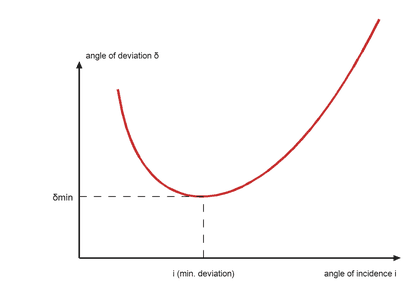
(b) Why δmin is unique
Step 2 — A line above the minimum.
Draw a horizontal line at any deviation δ₁ above the minimum. It cuts the curve at two points, so that deviation is produced by two different angles of incidence (each is the angle of emergence of the other, since the path can be reversed).
Step 3 — The line at the minimum.
At the lowest point the horizontal line only touches the curve, at one point. So just one angle of incidence (where i₁ and i₂ are equal) gives the least deviation.
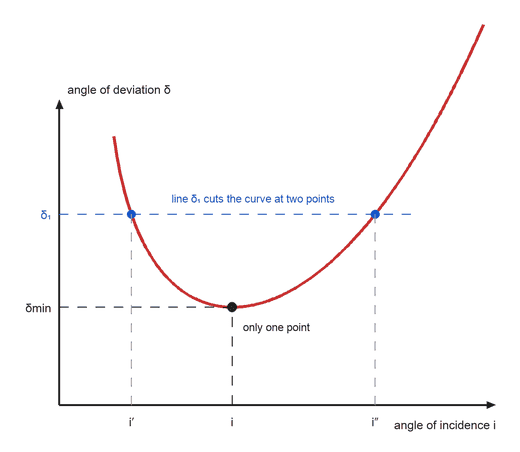
Therefore, the deviation first decreases and then increases with i, and since only one point of the curve gives the least deviation, δmin is unique for a given prism and wavelength.
- 734 marks
Question 73
Draw a ray diagram to show the refraction of a monochromatic ray through a prism when it suffers minimum deviation. How is the angle of emergence related to the angle of incidence in this position.
Solve with AIWritten solution
Solution:
Concept: As the angle of incidence increases, the deviation produced by a prism first decreases, reaches a minimum δmin, and then increases. At minimum deviation the ray passes symmetrically: the angles of incidence and emergence are equal (each i), r₁ and r₂ are each A/2, the ray inside is parallel to the base, and δmin = 2i − A.
Step 1 — Draw the ray diagram.
The monochromatic ray falls on face AB at an angle of incidence i₁ and bends towards the normal. Inside, it travels parallel to the base BC. At face AC it bends away from the normal and leaves at the angle of emergence i₂.
Step 2 — Relate the angles.
In this position the path is symmetric, so the angle of emergence equals the angle of incidence; the angles inside are each A/2, and δmin = 2i₁ − A.
Note: the stem's misprint "minium" is corrected to "minimum".
Therefore, at minimum deviation the ray inside is parallel to the base and the angle of emergence equals the angle of incidence.
- 744 marks
Question 74
An object is viewed through a glass prism with its vertex pointing upwards. Draw a ray diagram to show the formation of its image as seen by the observer on the other side of the object.
Solve with AIWritten solution
Solution:
Concept: A prism always deviates light towards its base. The eye, however, sees an object in the direction from which the light enters the eye.
Step 1 — Path of the light.
A ray from the object O falls on the first face and bends towards the normal; at the second face it bends away from the normal. Both bends turn the ray towards the base, that is, downward.
Step 2 — What the eye sees.
The emergent ray enters the eye. Produced backward (dashed line), it appears to come from a point I higher than O.

Step 3 — The image.
So the observer sees a virtual image I of the object, shifted upward, towards the vertex of the prism.
Watch out: The light is bent towards the base, but the image appears shifted towards the vertex.
Therefore, the image seen through the prism is virtual and displaced towards the vertex (upward).
- 754 marks
Question 75
A ray of light is normally incident on one face of an equilateral glass prism.
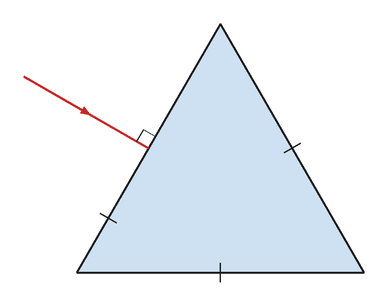
Answer the following :
(a) What is the angle of incidence on the first face of the prism ?
(b) What is the angle of refraction from the first face of the prism ?
(c) What will be the angle of incidence at the second face of the prism ?
(d) Will the light ray suffer minimum deviation by the prism ?
Solve with AIWritten solution
Solution:
Concept: A ray along the normal enters the glass without bending. A prism refracts a ray twice, at two faces inclined at the angle of the prism A. Inside, the angles of refraction at the two faces add up to A (r₁ + r₂ = A); the total turning of the ray is the angle of deviation (δ = i₁ + i₂ − A), where i₁ is the angle of incidence and i₂ the angle of emergence.
(a) Angle of incidence on the first face
Step 1 — Normal incidence.
The ray falls normally, that is, along the normal, so the angle of incidence is 0°.
(b) Angle of refraction from the first face
Step 2 — No bending.
With i = 0° the ray goes straight in without bending, so r₁ is 0°.
(c) Angle of incidence at the second face
Step 3 — Use r₁ + r₂ = A.
The angle of an equilateral prism is 60°.
(d) Minimum deviation?
Step 4 — Compare with the symmetric path.
At minimum deviation the path is symmetric (r₁ and r₂ each 30°, ray parallel to the base). Here r₁ is 0° and r₂ is 60°, so the path is not symmetric: no.
Step 5 — What really happens.
60° is more than the critical angle of glass (about 42°), so the ray is totally internally reflected at the second face and leaves through the base.
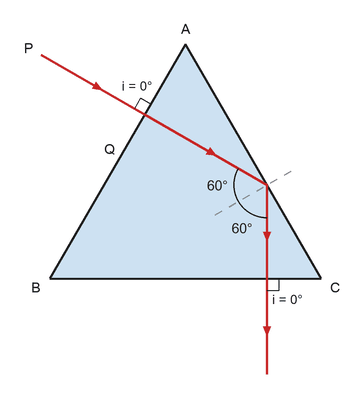
Therefore, (a) 0°, (b) 0°, (c) 60°, and (d) no, the ray does not suffer minimum deviation.
- 764 marks
Question 76
Fig. 4.35 below shows two identical prisms A and B placed with their faces parallel to each other. A ray of light of single colour PQ is incident at the face of the prism A. Complete the diagram to show the path of the ray till it emerges out of the prism B.
[Hint : The emergent ray out of the prism B will be parallel to the incident ray PQ]
 Solve with AI
Written solution
Solution:
Concept: Each prism deviates a ray towards its own base. Two identical prisms placed the opposite way round, with their facing sides parallel, turn the ray through equal angles in opposite directions.
Step 1 — Prism A.
PQ enters prism A and is deviated towards its base. Prism A is inverted (base on top), so the ray is turned upward.
Step 2 — The gap.
The ray leaves prism A, crosses the air gap and enters prism B through the face parallel to A's second face.
Step 3 — Prism B.
Prism B is upright (base at the bottom), so it deviates the ray downward, towards its base, by the same angle.
Step 4 — Result.
The two deviations cancel. The ray emerges from B parallel to PQ, only shifted sideways, as in a glass slab.
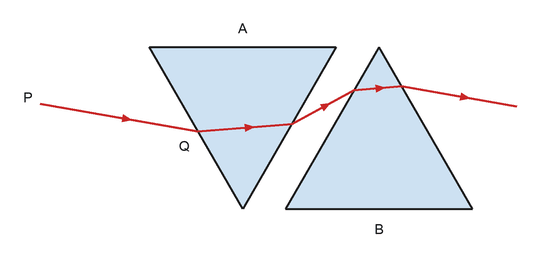
Therefore, the ray emerges from prism B parallel to the incident ray PQ, displaced sideways.
- 773 marks
Question 77
A ray of light incident at an angle of incidence on a prism of refracting angle suffers minimum deviation. Calculate the angle of minimum deviation.
[Hint : ]
Solve with AIWritten solution
Solution:
Concept: As the angle of incidence increases, the deviation produced by a prism first decreases, reaches a minimum δmin, and then increases. At minimum deviation the ray passes symmetrically: the angles of incidence and emergence are equal (each i), r₁ and r₂ are each A/2, the ray inside is parallel to the base, and δmin = 2i − A.
Given: Angle of incidence i = 48°; angle of prism A = 60°; minimum deviation.
Step 1 — Write the formula.
At minimum deviation the angle of emergence equals the angle of incidence, so δ = i₁ + i₂ − A becomes
Step 2 — Substitute.
Put i = 48° and A = 60°.
Step 3 — Interpret.
The prism turns the ray through 36°, and no other angle of incidence turns it through less.
Therefore, the angle of minimum deviation is 36°.
- 783 marks
Question 78
What should be the angle of incidence for a ray of light which suffers minimum deviation of through an equilateral prism ?
[Hint : , ]
Solve with AIWritten solution
Solution:
Concept: As the angle of incidence increases, the deviation produced by a prism first decreases, reaches a minimum δmin, and then increases. At minimum deviation the ray passes symmetrically: the angles of incidence and emergence are equal (each i), r₁ and r₂ are each A/2, the ray inside is parallel to the base, and δmin = 2i − A.
Given: Equilateral prism, so A = 60°; minimum deviation δmin = 36°.
Step 1 — Rearrange δmin = 2i − A.
Add A to both sides and divide by 2.
Step 2 — Substitute.
An equilateral prism has A = 60°, and δmin is 36°.
Step 3 — Interpret.
A ray falling at 48° goes through the prism symmetrically (parallel to the base) and leaves at 48°.
Therefore, the angle of incidence is 48°.
- 791 mark
Question 79
Refractive index of a liquid can be found using :
Solve with AIAnswer
(A) = real depth × apparent depth
(B) = apparent depth/real depth
- Correct
(C) = real depth/apparent depth
(D) none of the above
Answer: (C) = real depth/apparent depth
Concept: An object inside a denser medium, seen from the rarer medium (air) along the normal, appears raised: light from it bends away from the normal on leaving, and the eye traces the rays straight back. For viewing from vertically above, μ = real depth ÷ apparent depth. The object appears raised by the shift (real depth − apparent depth), which works out as t(1 − 1/μ) for real depth t.
Step 1 — Write the relation.
For an object in a liquid seen from vertically above, the refractive index of the liquid is the real depth divided by the apparent depth.
Step 2 — Check that it makes sense.
The real depth is more than the apparent depth, so this ratio is more than 1, as a refractive index must be. For example, a real depth of 20 cm and an apparent depth of 15 cm give μ = 20/15, which is 4/3 for water.
Why the other options are wrong:
- (A) = real depth × apparent depth: a product of two depths has the unit cm², but μ has no unit.
- (B) = apparent depth/real depth: this is the reciprocal, 1/μ, which is less than 1.
- (D) none of the above: option (C) is correct, so "none of the above" is wrong.
Therefore, μ = real depth ÷ apparent depth, option (C).
- 801 mark
Question 80
A small air bubble in a glass block when seen from above appears to be raised because of :
Solve with AIAnswer
- Correct
(A) refraction of light
(B) reflection of light
(C) reflection and refraction of light
(D) none of the above.
Answer: (A) refraction of light
Concept: An object inside a denser medium, seen from the rarer medium (air) along the normal, appears raised: light from it bends away from the normal on leaving, and the eye traces the rays straight back. For viewing from vertically above, μ = real depth ÷ apparent depth. The object appears raised by the shift (real depth − apparent depth), which works out as t(1 − 1/μ) for real depth t.
Step 1 — Follow the light from the bubble.
Light from the bubble travels up through the glass and leaves the top surface into air, bending away from the normal.
Step 2 — See where it seems to come from.
The eye traces the bent rays straight back. They seem to come from a point I above the bubble, so the bubble appears raised.
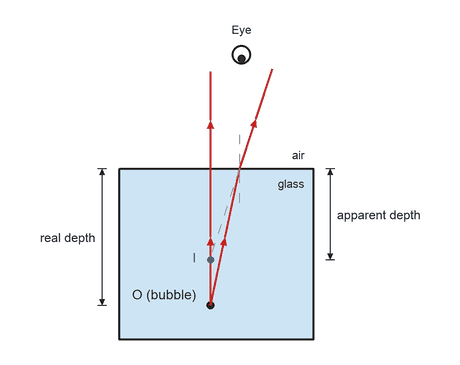
Why the other options are wrong:
- (B) reflection of light: no light is reflected back to the eye to form this image; the light passes out through the surface.
- (C) reflection and refraction of light: reflection plays no part; refraction alone explains the raised image.
- (D) none of the above: refraction does explain it, so "none of the above" is wrong.
Therefore, the bubble appears raised because of refraction of light, option (A).
- 811 mark
Question 81
An object in a denser medium when viewed from a rarer medium appears to be raised. The shift is maximum for :
Solve with AIAnswer
(A) red light
- Correct
(B) violet light
(C) yellow light
(D) green light.
Answer: (B) violet light
Concept: An object inside a denser medium, seen from the rarer medium (air) along the normal, appears raised: light from it bends away from the normal on leaving, and the eye traces the rays straight back. For viewing from vertically above, μ = real depth ÷ apparent depth. The object appears raised by the shift (real depth − apparent depth), which works out as t(1 − 1/μ) for real depth t. The refractive index of a medium depends on the colour (wavelength) of light: it is greatest for violet (shortest wavelength) and least for red (longest wavelength). So violet light travels slowest in glass and bends the most.
Step 1 — See what controls the shift.
The shift is t(1 − 1/μ), so a larger μ gives a larger shift.
Step 2 — Pick the colour.
μ is greatest for violet light, so 1/μ is smallest and the shift is the greatest. Violet light bends the most on leaving, so its image is the highest.
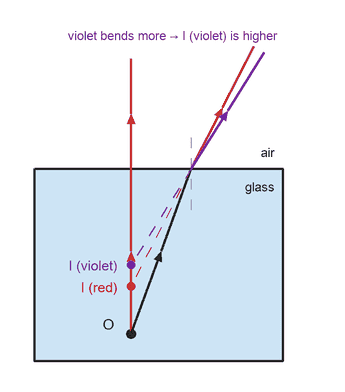
Why the other options are wrong:
- (A) red light: μ is least for red light, so its shift is the least, not the most.
- (C) yellow light: the μ of yellow light lies between those of red and violet, so its shift is not the maximum.
- (D) green light: the μ of green light also lies between those of red and violet, so its shift is not the maximum.
Therefore, the shift is maximum for violet light, option (B).
- 821 mark
Question 82
The shift by which the object appears to be raised depends on :
Solve with AIAnswer
(A) the refractive index of the medium
(B) the thickness of denser medium
(C) the wavelength of incident light
- Correct
(D) all of the above
Answer: (D) all of the above
Concept: An object inside a denser medium, seen from the rarer medium (air) along the normal, appears raised: light from it bends away from the normal on leaving, and the eye traces the rays straight back. For viewing from vertically above, μ = real depth ÷ apparent depth. The object appears raised by the shift (real depth − apparent depth), which works out as t(1 − 1/μ) for real depth t.
Step 1 — Thickness.
The shift t(1 − 1/μ) is directly proportional to the thickness t of the denser medium, so (B) is a factor.
Step 2 — Refractive index.
The shift increases as μ increases, so (A) is a factor.
Step 3 — Wavelength.
μ itself depends on the wavelength (colour) of light, more for violet and less for red, so the shift also depends on the wavelength: (C) is a factor.
Why the other options are wrong:
- (A) the refractive index of the medium: it is true, but it is only one of the three factors.
- (B) the thickness of denser medium: it is true, but it is only one of the three factors.
- (C) the wavelength of incident light: it is true, but it is only one of the three factors.
Therefore, the shift depends on all three, option (D).
- 831 mark
Question 83
An object when placed in a rarer medium and is viewed from a denser medium appears to be at a ............. distance than its real distance.
Solve with AIAnswer
(A) smaller
- Correct
(B) greater
(C) same
(D) cannot say
Answer: (B) greater
Concept: Light going from a rarer into a denser medium bends towards the normal. An observer always traces the light entering the eye straight back.
Step 1 — Follow the light.
Light from an object O in air enters the water and bends towards the normal.
Step 2 — Trace it back.
An observer in the water traces these rays straight back. They meet at I, which is farther from the surface than O, so the object appears at a greater distance.
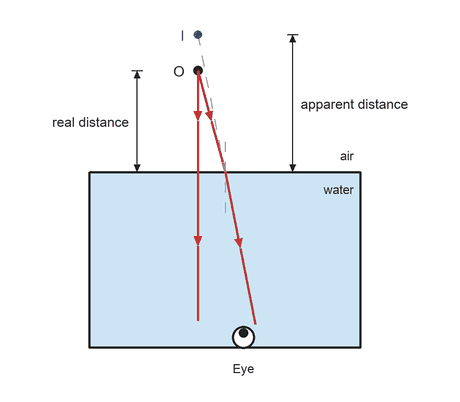
Step 3 — An example.
A fish sees a plant at the edge of a pond taller than it really is.
Watch out: This is the opposite of a coin in water seen from air, which appears nearer.
Why the other options are wrong:
- (A) smaller: a smaller distance is the case of an object in a denser medium viewed from a rarer one.
- (C) same: the distance would appear the same only if the rays did not bend, but oblique rays do bend.
- (D) cannot say: the direction of bending is fixed by the laws of refraction, so the answer can be stated.
Therefore, the object appears at a greater distance, option (B).
- 841 mark
Question 84
A glass slab is placed over a piece of paper on which VGYR is printed with letter V in violet, G in green, Y in yellow and R in red colour. The letter of colour ................. appears to be the most raised.
Solve with AIAnswer
(A) red
(B) green
(C) yellow
- Correct
(D) violet
Answer: (D) violet
Concept: An object inside a denser medium, seen from the rarer medium (air) along the normal, appears raised: light from it bends away from the normal on leaving, and the eye traces the rays straight back. For viewing from vertically above, μ = real depth ÷ apparent depth. The object appears raised by the shift (real depth − apparent depth), which works out as t(1 − 1/μ) for real depth t. The refractive index of a medium depends on the colour (wavelength) of light: it is greatest for violet (shortest wavelength) and least for red (longest wavelength). So violet light travels slowest in glass and bends the most.
Step 1 — Same thickness for all letters.
All four letters lie under the same thickness t of glass, so only μ decides the shift.
Step 2 — Compare the colours.
Glass has the greatest refractive index for violet and the least for red, so the violet letter V is raised the most and R the least. The four images are not in one plane.

Why the other options are wrong:
- (A) red: μ is least for red, so R appears raised the least.
- (B) green: the μ of green lies between those of red and violet, so G is raised by an in-between amount.
- (C) yellow: the μ of yellow lies between those of red and violet, so Y is raised by an in-between amount.
Therefore, the violet letter appears the most raised, option (D).
- 851 mark
Question 85
Assertion (A) : The stars twinkle while the planets do not.
Reason (R) : Stars are more distant than the planets.
Solve with AIAnswer
(A) both A and R are true and R is the correct explanation of A
- Correct
(B) both A and R are True and R is not the correct explanation of A
(C) assertion is false but reason is true
(D) assertion is true but reason is false
Answer: (B) both A and R are True and R is not the correct explanation of A
Concept: Twinkling is caused by refraction of starlight in layers of air whose density (and so refractive index) keeps changing with temperature and wind.
Step 1 — Judge the assertion.
Stars twinkle and planets do not. The assertion is true.
Step 2 — Judge the reason.
Stars are much farther away than the planets. The reason is true.
Step 3 — Does R explain A?.
Starlight bends at each moving layer of air, so the star's apparent position and brightness keep flickering. A star is so far away that it is like a point source, so the flicker is seen. A planet is nearer and looks like a small disc; the flickers from its many points average out. The reason gives only the distance, not this refraction effect, so it is not the full explanation.

Note: some teachers argue that the great distance (which makes a star a point source) is part of the explanation, which would point to (A). The book keys (B), because the cause of twinkling is atmospheric refraction, which the reason does not mention; the printed key is kept.
Why the other options are wrong:
- (A) both A and R are true and R is the correct explanation of A: the reason is true, but distance alone does not explain twinkling; the cause is refraction in the changing atmosphere.
- (C) assertion is false but reason is true: the assertion is true, not false.
- (D) assertion is true but reason is false: the reason is true, not false.
Therefore, both A and R are true and R is not the correct explanation of A, option (B).
- 861 mark
Question 86
Assertion (A) : An empty test tube placed in water in a beaker with its mouth outside the water surface appears silvery when viewed from a suitable direction.
Reason (R) : The substance in water appears silvery due to refraction of light.
Solve with AIAnswer
(A) both A and R are true and R is the correct explanation of A
(B) both A and R are True and R is not the correct explanation of A
(C) assertion is false but reason is true
- Correct
(D) assertion is true but reason is false
Answer: (D) assertion is true but reason is false
Concept: Total internal reflection happens when light goes from a denser to a rarer medium and meets the surface at an angle of incidence greater than the critical angle. Then no light is refracted out: all of it is reflected back into the denser medium, obeying the laws of reflection.
Step 1 — Judge the assertion.
An empty test tube dipped in water looks shiny, like silver, when seen from a suitable direction. The assertion is true.
Step 2 — Judge the reason.
Light in the water (denser) meets the water–air boundary at the wall of the tube (air inside is rarer). When its angle of incidence is more than the critical angle of water (about 49°), no light enters the tube: all of it is totally reflected to the eye. So the shine is due to total internal reflection, not refraction. The reason is false.
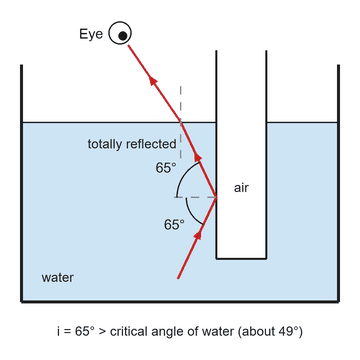
Step 3 — A check.
If water is poured into the tube, there is no water–air boundary at the wall, total internal reflection stops, and the shine disappears.
Why the other options are wrong:
- (A) both A and R are true and R is the correct explanation of A: it needs the reason to be true, but the reason is false.
- (B) both A and R are True and R is not the correct explanation of A: it needs the reason to be true, but the reason is false.
- (C) assertion is false but reason is true: the assertion is true, not false.
Therefore, the assertion is true but the reason is false, option (D).
- 871 mark
Question 87
Assertion (A) : A ray of light travelling from a rarer medium to a denser medium, slows down and bends away from the normal.
Reason (R) : The speed of light is higher in a rarer medium than in a denser medium.
Solve with AIAnswer
(A) both A and R are true and R is the correct explanation of A
(B) both A and R are True and R is not the correct explanation of A
- Correct
(C) assertion is false but reason is true
(D) assertion is true but reason is false
Answer: (C) assertion is false but reason is true
Concept: Refraction is the change in direction of light when it passes obliquely from one transparent medium into another. It happens because light travels at different speeds in different media. Light bends towards the normal when it enters an optically denser medium (it slows down) and away from the normal when it enters an optically rarer medium (it speeds up). All angles are measured from the normal, the line at 90° to the surface at the point of incidence.
Step 1 — Judge the assertion.
Going from a rarer into a denser medium, light does slow down, but it bends towards the normal (r < i), not away from it. The assertion is false.
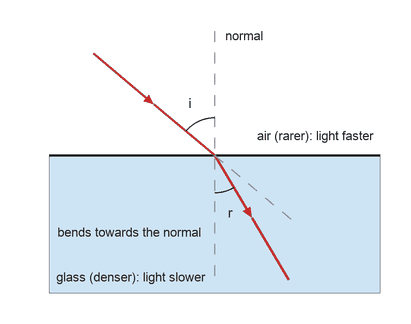
Step 2 — Judge the reason.
Light travels faster in a rarer medium than in a denser one (about 3 × 10⁸ m s⁻¹ in air and 2 × 10⁸ m s⁻¹ in glass). The reason is true.
Watch out: Check the direction of travel: light going into a denser medium bends towards the normal; going into a rarer medium it bends away from the normal.
Why the other options are wrong:
- (A) both A and R are true and R is the correct explanation of A: it needs the assertion to be true, but the assertion is false.
- (B) both A and R are True and R is not the correct explanation of A: it needs the assertion to be true, but the assertion is false.
- (D) assertion is true but reason is false: it is the assertion that is false and the reason that is true, not the other way round.
Therefore, the assertion is false but the reason is true, option (C).
- 882 marks
Question 88
How is the refractive index of a medium related to the real and apparent depths of an object in that medium?
Solve with AIWritten solution
Solution:
Concept: An object inside a denser medium, seen from the rarer medium (air) along the normal, appears raised: light from it bends away from the normal on leaving, and the eye traces the rays straight back. For viewing from vertically above, μ = real depth ÷ apparent depth. The object appears raised by the shift (real depth − apparent depth), which works out as t(1 − 1/μ) for real depth t.
Step 1 — State the relation.
When the object is viewed normally (from vertically above),
Step 2 — What it means.
Since μ is more than 1, the apparent depth is always less than the real depth: the object appears raised.
Step 3 — An example.
An object 20 cm deep in a liquid of refractive index 4/3 appears 20 ÷ (4/3), that is 15 cm, deep.
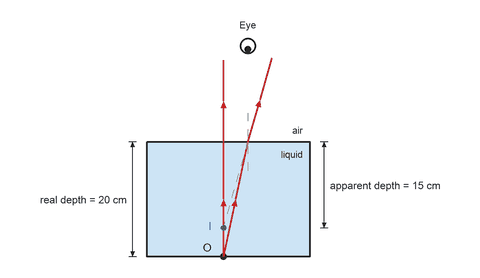
Therefore, the refractive index of the medium equals real depth ÷ apparent depth.
- 892 marks
Question 89
An object placed in one medium when seen from the other medium, appears to be vertically shifted. Name two factors on which the magnitude of the shift depends and state how does it depend on them.
Solve with AIWritten solution
Solution:
Concept: An object inside a denser medium, seen from the rarer medium (air) along the normal, appears raised: light from it bends away from the normal on leaving, and the eye traces the rays straight back. For viewing from vertically above, μ = real depth ÷ apparent depth. The object appears raised by the shift (real depth − apparent depth), which works out as t(1 − 1/μ) for real depth t.
Step 1 — Factor 1: thickness (depth) of the medium t.
The shift t(1 − 1/μ) is directly proportional to t: the deeper the object, the larger the shift. In water, an object 8 cm deep is raised by 2 cm, but one 12 cm deep by 3 cm.
Step 2 — Factor 2: refractive index μ.
The higher the refractive index, the larger the shift. For the same 12 cm, the shift is 3 cm in water (μ of 4/3) but 4 cm in glass (μ of 1.5).
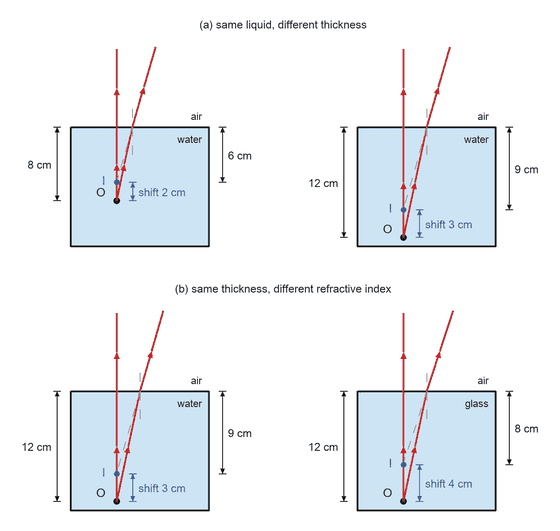
Step 3 — A related factor.
μ depends on the colour (wavelength) of light, so the shift is larger for violet light than for red light.
Therefore, the shift increases with the thickness of the medium and with its refractive index.
- 905 marks
Question 90
Prove that, refractive index .
Solve with AIWritten solution
Solution:
Concept: Trace two rays from an object at the bottom of a liquid: one along the normal and one slightly oblique. Their backward extensions meet at the image. Snell's law and two right-angled triangles then give μ.
Step 1 — Set up the figure.
Let an object O lie at the bottom of a liquid of refractive index μ, with A the point of the surface directly above O. The ray OA along the normal comes out undeviated. The ray OB, at a small angle i to the normal, refracts at B into air at angle r, bending away from the normal. Produced backward, the refracted ray meets AO at I, the image of O. So AO is the real depth and AI the apparent depth.

Step 2 — Find the angles in the triangles.
The normal at B is parallel to AO, so (by corresponding angles) ∠AOB = i and ∠AIB = r.
Step 3 — Apply Snell's law at B.
Light goes from the liquid into air, so sin i ÷ sin r is 1/μ.
Step 4 — Use the right-angled triangles.
The angle at A is 90°. In triangle ABO, sin i = AB/OB; in triangle ABI, sin r = AB/IB. Substituting these,
Step 5 — View normally.
From vertically above, only rays very close to the normal enter the eye, so B is very close to A: OB ≈ OA and IB ≈ IA.
Watch out: The result holds only for viewing from (nearly) vertically above.
Therefore, refractive index = real depth ÷ apparent depth; since μ > 1, the object always appears raised.
- 914 marks
Question 91
A tank of water is viewed normally from above.
(a) State how does the depth of the tank appear to change.
(b) Draw a labelled ray diagram to explain your answer.
Solve with AIWritten solution
Solution:
Concept: An object inside a denser medium, seen from the rarer medium (air) along the normal, appears raised: light from it bends away from the normal on leaving, and the eye traces the rays straight back. For viewing from vertically above, μ = real depth ÷ apparent depth. The object appears raised by the shift (real depth − apparent depth), which works out as t(1 − 1/μ) for real depth t.
(a) Change in depth
Step 1 — Apparent depth.
The tank appears shallower: its bottom appears raised. Apparent depth = real depth ÷ μ, and μ for water is 4/3, so the tank appears about 3/4 of its real depth. A tank 2 m deep looks 1.5 m deep.
(b) Ray diagram
Step 2 — Draw two rays from the bottom.
A ray from a point O on the bottom along the normal (OA) comes out undeviated. An oblique ray OB bends away from the normal at the water surface and reaches the eye.
Step 3 — Locate the image.
Produced backward, the two emergent rays meet at I, above O. The eye sees the bottom at I, so the apparent depth AI is less than the real depth AO.
Watch out: A pool looks shallower than it is, so take care before stepping in.
Therefore, the tank appears shallower (about three-quarters of its real depth) because light from the bottom bends away from the normal on leaving the water.
- 924 marks
Question 92
Water in a pond appears to be only three-quarter of its actual depth. (a) What property of light is responsible for this observation ? Illustrate your answer with the help of a ray diagram. (b) How is the refractive index of water calculated from its real and apparent depths ?
Solve with AIWritten solution
Solution:
Concept: An object inside a denser medium, seen from the rarer medium (air) along the normal, appears raised: light from it bends away from the normal on leaving, and the eye traces the rays straight back. For viewing from vertically above, μ = real depth ÷ apparent depth. The object appears raised by the shift (real depth − apparent depth), which works out as t(1 − 1/μ) for real depth t.
(a) Property of light and ray diagram
Step 1 — Name the property.
The property is refraction of light. Light from a point O on the bottom bends away from the normal as it passes from water (denser) into air (rarer).
Step 2 — Explain the diagram.
The eye traces the emergent rays straight back, and they appear to come from I, above O. So the bottom appears raised and the pond looks only about three-quarters as deep.
(b) Refractive index from the depths
Step 3 — Write the relation.
Let the real depth be h; then the apparent depth is 3h/4.
Step 4 — Check.
The depth h cancels, so the answer does not depend on how deep the pond is; 4/3 ≈ 1.33 is the refractive index of water.
Therefore, (a) refraction of light makes the pond look shallower, and (b) μ = 4/3 (real depth ÷ apparent depth).
- 934 marks
Question 93
Draw a ray diagram to show the appearance of a stick partially immersed in water. Explain your answer.
Solve with AIWritten solution
Solution:
Concept: Every point of the immersed part of the stick appears raised, because light from it bends away from the normal on leaving the water.
Step 1 — Observation.
A straight stick dipped obliquely in water appears bent at the water surface, and its immersed part appears shorter and raised.
Step 2 — Rays from the lower end.
Rays from the lower end B travel up through the water and bend away from the normal as they pass into air. To the eye they appear to come from B′, a point above B (the virtual image of B).
Step 3 — The whole immersed part.
Every point between A (where the stick meets the surface) and B is raised in the same way, more so the deeper it is. So the immersed part is seen along AB′ instead of AB.

Step 4 — Why it looks bent.
The part above the water is seen in its true position, so the stick appears bent at A.
Therefore, the stick appears bent at the water surface, because of refraction of light from water to air.
- 944 marks
Question 94
A fish is looking at a 1·0 m high plant at the edge of a pond. Will the plant appear to the fish shorter or taller than its actual height ? Draw a ray diagram to support your answer.
Solve with AIWritten solution
Solution:
Concept: An object in a rarer medium (air), seen from a denser medium (water), appears farther away than it really is. The eye traces the light that enters it straight back.
Step 1 — Follow the light.
Light from the top of the plant travels from air into water and bends towards the normal at the surface.
Step 2 — Trace it back from the fish.
The fish sees the light coming along the refracted direction. Traced straight back, this line meets the plant's vertical line at a point higher than the real top.
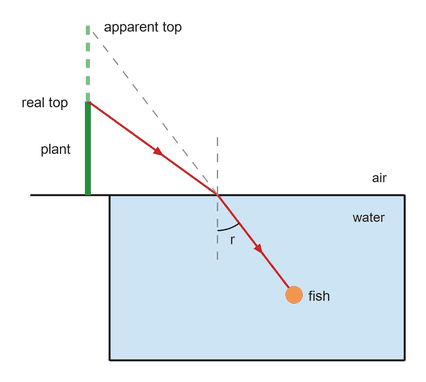
Step 3 — Conclude.
So the top of the plant appears raised, and the plant looks taller than 1.0 m.
Watch out: A coin in water seen from air looks nearer; a plant in air seen from water looks farther (taller).
Therefore, the plant appears taller to the fish than its actual height of 1.0 m.
- 954 marks
Question 95
A student puts his pencil into an empty trough and observes the pencil from the position as indicated in Fig. 4.41.
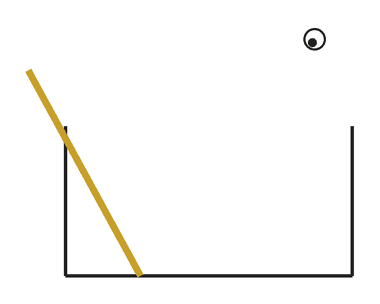
(i) What change will be observed in the appearance of the pencil when water is poured into the trough ?
(ii) Name the phenomenon which accounts for the above stated observation.
(iii) Complete the diagram showing how the student's eye sees the pencil through water.
Solve with AIWritten solution
Solution:
Concept: Once water is poured in, light from the immersed part of the pencil reaches the eye by passing from water into air, so that part appears raised.
(i) Change observed
Step 1 — Describe the change.
The part of the pencil under water appears raised and shorter, so the pencil appears bent at the water surface. Its tip appears higher than its real position.
(ii) Phenomenon
Step 2 — Name it.
Refraction of light: light from the immersed part bends away from the normal as it passes from water (denser) into air (rarer).
(iii) Completed diagram
Step 3 — Draw the rays.
Draw two rays from the tip of the pencil up to the water surface, close together. At the surface each bends away from the normal and goes on to the eye.
Step 4 — Find the image.
Produce the two emergent rays backward (dotted); they meet above the real tip. Join this image to the point where the pencil meets the water surface: this is the apparent position of the immersed part.
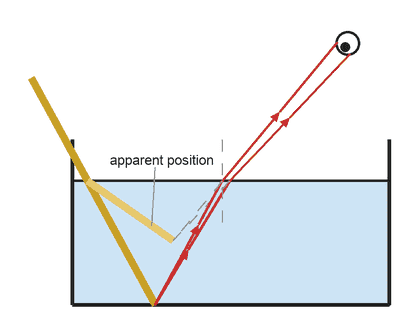
Therefore, the pencil appears bent and raised at the water surface, due to refraction of light.
- 963 marks
Question 96
A water pond appears to be 3 m deep. If the refractive index of water is 4/3, find the actual depth of the pond.
Solve with AIWritten solution
Solution:
Concept: An object inside a denser medium, seen from the rarer medium (air) along the normal, appears raised: light from it bends away from the normal on leaving, and the eye traces the rays straight back. For viewing from vertically above, μ = real depth ÷ apparent depth. The object appears raised by the shift (real depth − apparent depth), which works out as t(1 − 1/μ) for real depth t.
Given: Apparent depth = 3 m; refractive index of water μ = 4/3.
Step 1 — Rearrange the relation.
μ = real depth ÷ apparent depth, so the real depth is μ × apparent depth.
Step 2 — Substitute.
Put μ = 4/3 and apparent depth 3 m.

Step 3 — Interpret.
The pond is 1 m deeper than it looks, because its bottom appears raised.
Watch out: The real depth is the larger one; multiply by μ, do not divide.
Therefore, the actual depth of the pond is 4 m.
- 973 marks
Question 97
A coin is placed at the bottom of a beaker containing water (refractive index = 4/3) at a depth of 16 cm. By what height the coin appears to be raised when seen from vertically above ?
Solve with AIWritten solution
Solution:
Concept: An object inside a denser medium, seen from the rarer medium (air) along the normal, appears raised: light from it bends away from the normal on leaving, and the eye traces the rays straight back. For viewing from vertically above, μ = real depth ÷ apparent depth. The object appears raised by the shift (real depth − apparent depth), which works out as t(1 − 1/μ) for real depth t.
Given: Real depth = 16 cm; refractive index of water μ = 4/3.
Step 1 — Find the apparent depth.
Apparent depth = real depth ÷ μ.
Step 2 — Find the rise.
The coin is raised by the difference of the two depths.
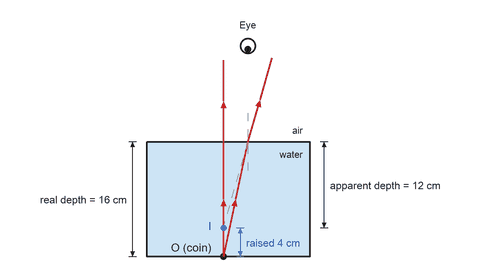
Step 3 — Check with t(1 − 1/μ).
The shift formula gives the same value.
Watch out: The question asks for the rise (4 cm), not the apparent depth (12 cm).
Therefore, the coin appears raised by 4 cm.
- 983 marks
Question 98
A postage stamp kept below a rectangular glass slab of refractive index 1·5 when viewed from vertically above it, appears to be raised by 7·0 mm. Calculate the thickness of the glass slab.
Solve with AIWritten solution
Solution:
Concept: An object inside a denser medium, seen from the rarer medium (air) along the normal, appears raised: light from it bends away from the normal on leaving, and the eye traces the rays straight back. For viewing from vertically above, μ = real depth ÷ apparent depth. The object appears raised by the shift (real depth − apparent depth), which works out as t(1 − 1/μ) for real depth t. For a stamp under a slab, the real depth is the thickness t of the slab.
Given: Refractive index of glass μ = 1.5; rise of the stamp = 7.0 mm.
Step 1 — Write the shift.
The stamp is raised by t − t/μ.
Step 2 — Substitute μ = 1.5 and shift 7.0 mm.
1/1.5 is 2/3, so the bracket is 1/3.
Step 3 — Solve for t.
Multiply both sides by 3.
Step 4 — Check.
The apparent depth is 21 ÷ 1.5, which is 14 mm, and 21 − 14 is 7 mm, the given rise.

Watch out: The 7.0 mm is the rise, not the apparent depth.
Therefore, the thickness of the glass slab is 21 mm (2.1 cm).
- 991 mark
Question 99
At angle of incidence equal to the critical angle, the angle of refraction is :
Solve with AIAnswer
(A)
(B)
- Correct
(C)
(D)
Answer: (C)
Concept: The critical angle C is the angle of incidence in the denser medium for which the angle of refraction in the rarer medium is 90° (the refracted ray grazes the surface). It is given by sin C = 1/μ; it is about 42° for glass (μ of 1.5) and about 48° to 49° for water (μ of 4/3).
Step 1 — See how r grows.
When light goes from glass into air it bends away from the normal, so r is larger than i. As i is increased, r increases faster and reaches 90° first.
Step 2 — Apply the definition.
The value of i at that moment is the critical angle C. So at i = C the angle of refraction is 90°: the refracted ray just grazes along the surface.
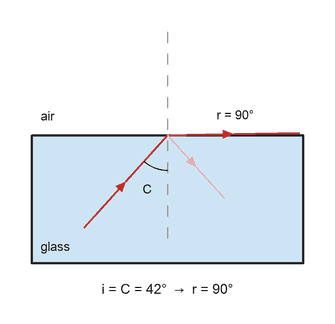
Why the other options are wrong:
- (A) : 0° is the angle of refraction for normal incidence (i = 0°), not for i = C.
- (B) : 30° has no special meaning here; at i = C the ray is bent all the way to the surface.
- (D) : 180° would send the ray back the way it came; a refracted ray cannot do that.
Therefore, at the critical angle the angle of refraction is 90°, option (C).
- 1001 mark
Question 100
The condition required for total internal reflection to take place is :
Solve with AIAnswer
(A) light ray passes from a rarer to denser medium.
- Correct
(B) light ray passes from a denser to rarer medium.
(C) angle of incidence is less than critical angle.
(D) none of the above.
Answer: (B) light ray passes from a denser to rarer medium.
Concept: Total internal reflection happens when light goes from a denser to a rarer medium and meets the surface at an angle of incidence greater than the critical angle. Then no light is refracted out: all of it is reflected back into the denser medium, obeying the laws of reflection.
Step 1 — List the two conditions.
Total internal reflection needs (1) light going from a denser to a rarer medium and (2) an angle of incidence greater than the critical angle.
Step 2 — Match the options.
Only option (B) states one of these conditions correctly. It is the first, necessary condition: without it, total internal reflection can never happen.
Step 3 — See the three cases.
Below C the light refracts out; at C it grazes the surface; above C it is all reflected back.

Why the other options are wrong:
- (A) light ray passes from a rarer to denser medium: from a rarer to a denser medium the ray bends towards the normal and always enters the second medium, so it is never totally reflected.
- (C) angle of incidence is less than critical angle: with i less than C the light refracts out; i must be greater than C.
- (D) none of the above: option (B) is a correct condition, so "none of the above" is wrong.
Therefore, the required condition is that light passes from a denser to a rarer medium, option (B).
- 1011 mark
Question 101
A scientist while performing an experiment desires that no incident light escapes from the top of a glass block. He varies the angle X continuously and finally manages to achieve his objective. Which of the following options describes the correct answer ?
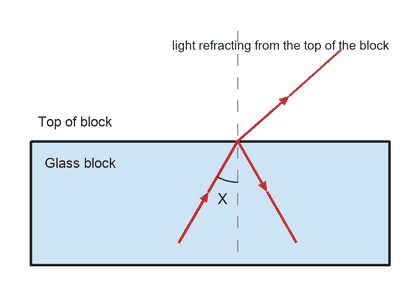
The table gives the four choices.
Angle X Effect produced (a) Decreased Total internal reflection (b) Decreased Total internal refraction (c) Increased Total internal refraction (d) Increased Total internal reflection Solve with AIAnswer
(A) (a)
(B) (b)
(C) (c)
- Correct
(D) (d)
Answer: (D) (d)
Concept: Total internal reflection happens when light goes from a denser to a rarer medium and meets the surface at an angle of incidence greater than the critical angle. Then no light is refracted out: all of it is reflected back into the denser medium, obeying the laws of reflection. X is the angle of incidence inside the glass at the top face.
Step 1 — Read the figure.
In the figure X is less than 42°, the critical angle of glass, so light refracts out of the top face.
Step 2 — Change X.
As X is increased, the refracted ray bends further from the normal. Once X is more than 42°, no light refracts out; all of it is reflected back into the block.

Watch out: There is no such thing as "total internal refraction"; the effect is a reflection.
Why the other options are wrong:
- (A) (a): decreasing X lets even more light pass out of the top.
- (B) (b): decreasing X lets more light out, and "total internal refraction" is not a real effect.
- (C) (c): X must be increased, but "total internal refraction" is not a real effect; it is total internal reflection.
Therefore, X is increased and the effect is total internal reflection, option (D).
- 1021 mark
Question 102
When a ray of light travels from substance A to substance B and reaches their boundary, it suffers total internal reflection. Out of the following possibilities, which one is correct ?
The table gives the four possibilities.
Angle Substance B (a) optical density of A is less than B. (b) optical density of A is more than B. (c) optical density of A is less than B. (d) optical density of A is more than B. Solve with AIAnswer
(A) (a)
(B) (b)
(C) (c)
- Correct
(D) (d)
Answer: (D) (d)
Concept: Total internal reflection happens when light goes from a denser to a rarer medium and meets the surface at an angle of incidence greater than the critical angle. Then no light is refracted out: all of it is reflected back into the denser medium, obeying the laws of reflection.
Step 1 — Condition on the media.
The ray is totally reflected, so A must be optically denser than B.
Step 2 — Condition on the angle.
The angle of incidence must be more than C, so i > C. Only (d) has both.
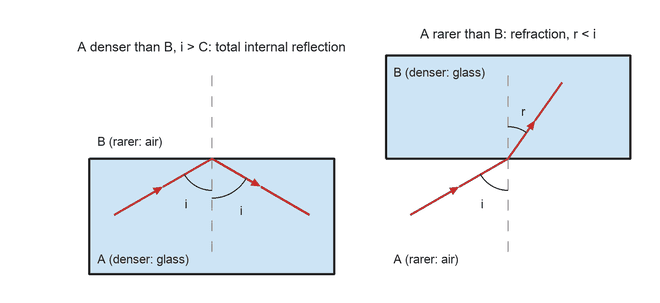
Why the other options are wrong:
- (A) (a): (a) has i < C and A rarer than B; the ray simply refracts into B.
- (B) (b): (b) has i = C, where the ray grazes along the boundary (r = 90°); it is not yet totally reflected.
- (C) (c): (c) has A rarer than B; the ray bends towards the normal and always enters B, however large i is.
Therefore, i > C and A optically denser than B, option (D).
- 1031 mark
Question 103
An equilateral prism can be used to deviate a ray of light through :
Solve with AIAnswer
(A)
- Correct
(B)
(C)
(D)
Answer: (B)
Concept: Total internal reflection happens when light goes from a denser to a rarer medium and meets the surface at an angle of incidence greater than the critical angle. Then no light is refracted out: all of it is reflected back into the denser medium, obeying the laws of reflection. A prism refracts a ray twice, at two faces inclined at the angle of the prism A. Inside, the angles of refraction at the two faces add up to A (r₁ + r₂ = A); the total turning of the ray is the angle of deviation (δ = i₁ + i₂ − A), where i₁ is the angle of incidence and i₂ the angle of emergence. Both bends turn the ray towards the base of the prism.
Step 1 — Send the ray in normally.
A ray falling normally on face AB of an equilateral prism goes straight in.
Step 2 — At the second face.
Since r₁ + r₂ is 60° and r₁ is 0°, the ray meets face AC at 60°. This is more than 42°, so the ray is totally reflected. A reflection at 60° turns the ray through
Step 3 — At the third face.
The reflected ray meets the base BC along its normal and leaves without bending. So the total deviation is 60°.
Why the other options are wrong:
- (A) : 30° does not arise from total internal reflection in a 60° prism.
- (C) : 75° does not arise from total internal reflection in a 60° prism.
- (D) : 90° needs a right-angled isosceles (45°–90°–45°) prism, where the ray meets the hypotenuse at 45°.
Therefore, an equilateral prism can deviate a ray through 60°, option (B).
- 1041 mark
Question 104
Which of the following figures will depict deviation of ray of light A through
 Solve with AI
Answer
(A) (a)
(B) (b)
(C) (c)
- Correct
(D) (d)
Answer: (D) (d)
Concept: A total reflecting prism is a glass prism whose principal section is a right-angled isosceles triangle (90°, 45°, 45°). Light entering a face normally goes in without bending and meets the next face at 45°, which is more than the critical angle of glass (42°), so it is totally reflected there.
Step 1 — Figure (d).
In figure (d) the ray enters the hypotenuse along the normal, without bending.
Step 2 — Two reflections.
It meets each short face at 45°, more than the critical angle of glass (42°), so it is totally reflected at both faces, turning 90° each time.
Step 3 — Result.
It comes out through the hypotenuse travelling back the way it came: a deviation of 180°. This arrangement is used in binoculars.
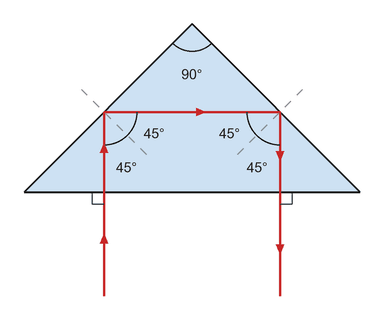
Why the other options are wrong:
- (A) (a): in the 30° prism of figure (a) the ray meets the slant face at only 30°, less than 42°, so it refracts out instead of being reflected.
- (B) (b): in figure (b) the ray falls obliquely on an equilateral prism; it is refracted and bent towards the base, not turned back.
- (C) (c): in figure (c) the ray enters a short face of the 45° prism and is reflected only once, so it turns through 90°, not 180°.
Therefore, figure (d) shows a deviation of 180°, option (D).
- 1051 mark
Question 105
The diagram below shows a light source P embedded in a rectangular glass block ABCD of critical angle . The ray PQ would :
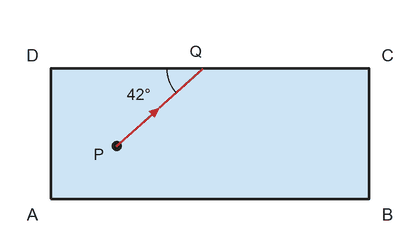 Solve with AI
Answer
(A) pass undeviated
(B) suffer refraction
(C) suffer reflection
- Correct
(D) suffer total internal reflection
Answer: (D) suffer total internal reflection
Concept: Total internal reflection happens when light goes from a denser to a rarer medium and meets the surface at an angle of incidence greater than the critical angle. Then no light is refracted out: all of it is reflected back into the denser medium, obeying the laws of reflection. Angles of incidence and refraction are measured from the normal, never from the surface.
Step 1 — Find the angle of incidence at Q.
PQ makes 42° with the surface DC, so its angle with the normal is
Step 2 — Compare with the critical angle.
The ray goes from glass (denser) to air (rarer), and 48° is more than the critical angle 42°. Both conditions hold, so PQ is totally internally reflected at Q.
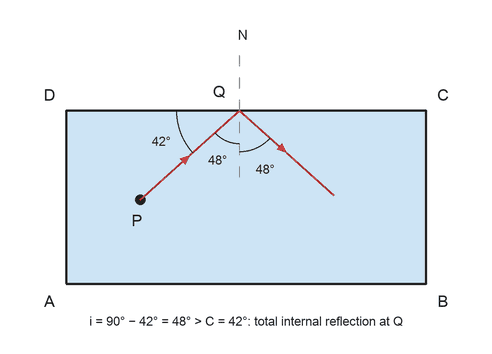
Watch out: The 42° in the figure is the angle with the surface, not the angle of incidence.
Why the other options are wrong:
- (A) pass undeviated: a ray passes undeviated only when it meets the surface along the normal (i = 0°).
- (B) suffer refraction: refraction out of the glass happens only when i is less than 42°.
- (C) suffer reflection: plain "reflection" is incomplete: here all the light is reflected, which is total internal reflection.
Therefore, PQ suffers total internal reflection, option (D).
- 1061 mark
Question 106
In the process of total internal reflection, ....... of energy (or intensity) of light is reflected back.
Solve with AIAnswer
(A) 70%
(B) 80%
- Correct
(C) 100%
(D) 50%
Answer: (C) 100%
Concept: Total internal reflection happens when light goes from a denser to a rarer medium and meets the surface at an angle of incidence greater than the critical angle. Then no light is refracted out: all of it is reflected back into the denser medium, obeying the laws of reflection.
Step 1 — Ordinary reflection shares the light.
In ordinary reflection or refraction the light energy is shared: part is reflected, part is refracted, and a silvered mirror also absorbs some.
Step 2 — Total internal reflection keeps it all.
When i is more than C there is no refracted ray at all, so the whole 100% of the light is reflected. That is why a total reflecting prism gives a brighter image than a plane mirror.

Why the other options are wrong:
- (A) 70%: 70% describes partial reflection, where some light escapes or is absorbed.
- (B) 80%: 80% describes partial reflection, where some light escapes or is absorbed.
- (D) 50%: 50% describes partial reflection, where some light escapes or is absorbed.
Therefore, 100% of the light is reflected in total internal reflection, option (C).
- 1071 mark
Question 107
Out of violet, blue, yellow and red, the critical angle would be the least for ........ light for a pair of media.
Solve with AIAnswer
- Correct
(A) violet
(B) blue
(C) blue
(D) yellow
Answer: (A) violet
Concept: The critical angle C is the angle of incidence in the denser medium for which the angle of refraction in the rarer medium is 90° (the refracted ray grazes the surface). It is given by sin C = 1/μ; it is about 42° for glass (μ of 1.5) and about 48° to 49° for water (μ of 4/3). The refractive index of a medium depends on the colour (wavelength) of light: it is greatest for violet (shortest wavelength) and least for red (longest wavelength). So violet light travels slowest in glass and bends the most.
Step 1 — Link C to μ.
sin C = 1/μ, so a larger μ gives a smaller sin C and a smaller C.
Step 2 — Order the colours.
For a given medium μ is greatest for violet and then falls through blue and yellow to red. So the critical angle is least for violet and greatest for red.
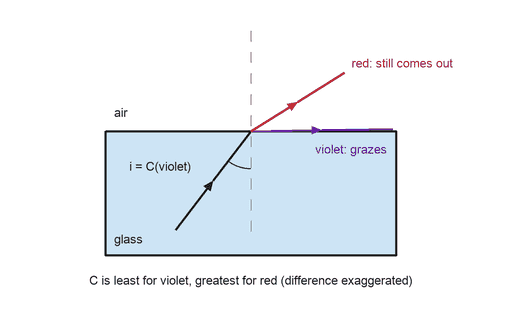
Note: the book prints "blue" twice, as options (B) and (C); the second was probably meant to be red. This does not change the answer.
Why the other options are wrong:
- (B) blue: blue has a smaller μ than violet, so its critical angle is larger than violet's.
- (C) blue: this option repeats "blue": blue has a smaller μ than violet, so its critical angle is larger.
- (D) yellow: yellow has a still smaller μ, so its critical angle is larger again.
Therefore, the critical angle is least for violet light, option (A).
- 1081 mark
Question 108
How is the critical angle related to the refractive index of a medium ?
Solve with AIWritten solution
Solution:
Concept: The critical angle C is the angle of incidence in the denser medium for which the angle of refraction in the rarer medium is 90° (the refracted ray grazes the surface). It is given by sin C = 1/μ; it is about 42° for glass (μ of 1.5) and about 48° to 49° for water (μ of 4/3).
Step 1 — Apply Snell's law at the critical angle.
For light going from the medium into air, i is C and r is 90°. Snell's law (written for air into the medium) gives
Step 2 — Rearrange.
Turning both sides upside down gives the relation.
Step 3 — Read the relation.
The larger the refractive index, the smaller the critical angle: glass (μ = 1.5) has C ≈ 42°, water (4/3) has C ≈ 49°.
Note: the book's printed answer, sin C = i/μ, is a misprint for sin C = 1/μ.
Therefore, the critical angle is related to the refractive index by sin C = 1/μ.
- 1092 marks
Question 109
State the approximate value of the critical angle for (a) glass-air surface (b) water-air surface.
Solve with AIWritten solution
Solution:
Concept: The critical angle C is the angle of incidence in the denser medium for which the angle of refraction in the rarer medium is 90° (the refracted ray grazes the surface). It is given by sin C = 1/μ; it is about 42° for glass (μ of 1.5) and about 48° to 49° for water (μ of 4/3).
(a) Glass–air surface
Step 1 — Use μ = 1.5.
sin C is 1 ÷ 1.5, which is 2/3.
(b) Water–air surface
Step 2 — Use μ = 4/3.
sin C is 3/4.
This is often rounded to 48° or 49°.
Step 3 — Compare.
Water has the smaller refractive index, so its critical angle is the larger of the two.
Therefore, the critical angle is about (a) 42° for glass–air and (b) 48° to 49° for water–air.
- 1101 mark
Question 110
A light ray is incident from a denser medium on the boundary separating it from a rarer medium at an angle of incidence equal to the critical angle. What is the angle of refraction for the ray ?
Solve with AIWritten solution
Solution:
Concept: The critical angle C is the angle of incidence in the denser medium for which the angle of refraction in the rarer medium is 90° (the refracted ray grazes the surface). It is given by sin C = 1/μ; it is about 42° for glass (μ of 1.5) and about 48° to 49° for water (μ of 4/3).
Step 1 — Use the definition.
The critical angle is exactly the angle of incidence that gives an angle of refraction of 90°.
Step 2 — Describe the ray.
So the refracted ray grazes along the boundary between the two media.
Therefore, the angle of refraction is 90°.
- 1112 marks
Question 111
The critical angle for glass-air is for the light of yellow colour. State whether it will be less than, equal to, or more than for (i) red light, and (ii) blue light ?
Solve with AIWritten solution
Solution:
Concept: The critical angle C is the angle of incidence in the denser medium for which the angle of refraction in the rarer medium is 90° (the refracted ray grazes the surface). It is given by sin C = 1/μ; it is about 42° for glass (μ of 1.5) and about 48° to 49° for water (μ of 4/3). The refractive index of a medium depends on the colour (wavelength) of light: it is greatest for violet (shortest wavelength) and least for red (longest wavelength). So violet light travels slowest in glass and bends the most.
(i) Red light
Step 1 — Compare with yellow.
Red light has a smaller μ than yellow, so sin C (1/μ) is larger and C is more than 45°.
(ii) Blue light
Step 2 — Compare with yellow.
Blue light has a larger μ than yellow, so sin C is smaller and C is less than 45°.
Therefore, the critical angle is (i) more than 45° for red light and (ii) less than 45° for blue light.
- 1121 mark
Question 112
Which colour of light has a higher critical angle ? Red light or green light.
Solve with AIWritten solution
Solution:
Concept: The critical angle C is the angle of incidence in the denser medium for which the angle of refraction in the rarer medium is 90° (the refracted ray grazes the surface). It is given by sin C = 1/μ; it is about 42° for glass (μ of 1.5) and about 48° to 49° for water (μ of 4/3). The refractive index of a medium depends on the colour (wavelength) of light: it is greatest for violet (shortest wavelength) and least for red (longest wavelength). So violet light travels slowest in glass and bends the most.
Step 1 — Compare the refractive indices.
The refractive index of a medium is lower for red light (longer wavelength) than for green light.
Step 2 — Compare the critical angles.
A lower μ gives a larger sin C, so red light has the higher critical angle.
Therefore, red light has a higher critical angle than green light.
- 1132 marks
Question 113
Fill in the blanks to complete the following sentences:
(a) Total internal reflection occurs only when a ray of light passes from a .......... medium to a .............. medium.
(b) Critical angle is the angle of .......... in denser medium for which the angle of ....... in rarer medium is ..........
Solve with AIWritten solution
Solution:
Concept: The critical angle C is the angle of incidence in the denser medium for which the angle of refraction in the rarer medium is 90° (the refracted ray grazes the surface). It is given by sin C = 1/μ; it is about 42° for glass (μ of 1.5) and about 48° to 49° for water (μ of 4/3). Total internal reflection happens when light goes from a denser to a rarer medium and meets the surface at an angle of incidence greater than the critical angle. Then no light is refracted out: all of it is reflected back into the denser medium, obeying the laws of reflection.
(a)
Step 1 — Direction of travel.
Total internal reflection can happen only where light tries to enter a medium in which it travels faster, so the blanks are denser and rarer.
(b)
Step 2 — The definition.
The critical angle is an angle of incidence in the denser medium, for which the angle of refraction in the rarer medium is 90°.
Therefore, (a) denser, rarer; (b) incidence, refraction, 90°.
- 1141 mark
Question 114
State whether the following statement is true or false ? If the angle of incidence is greater than the critical angle, light is not refracted at all, when it falls on the surface from a denser medium to a rarer medium.
Solve with AIWritten solution
Solution:
Concept: Total internal reflection happens when light goes from a denser to a rarer medium and meets the surface at an angle of incidence greater than the critical angle. Then no light is refracted out: all of it is reflected back into the denser medium, obeying the laws of reflection.
Step 1 — Try Snell's law.
For light going from the denser medium into the rarer one, sin r = μ sin i. When i is more than C, μ sin i is more than 1, and no angle has a sine greater than 1.
Step 2 — Conclude.
So there is no refracted ray: all the light is reflected back into the denser medium.
Therefore, the statement is true.
- 1152 marks
Question 115
What is meant by the statement 'the critical angle for diamond is ' ?
Solve with AIWritten solution
Solution:
Concept: The critical angle C is the angle of incidence in the denser medium for which the angle of refraction in the rarer medium is 90° (the refracted ray grazes the surface). It is given by sin C = 1/μ; it is about 42° for glass (μ of 1.5) and about 48° to 49° for water (μ of 4/3).
Step 1 — Meaning of the statement.
When light travelling inside diamond meets the diamond–air surface at an angle of incidence of 24°, the refracted ray grazes along the surface (angle of refraction 90°).
Step 2 — Larger angles.
For any angle of incidence greater than 24°, the light is totally internally reflected back into the diamond.

Step 3 — Why it matters.
The critical angle is small because μ of diamond is large (1 ÷ sin 24° ≈ 2.46). Light entering a cut diamond is totally reflected many times inside before it comes out, so the diamond sparkles.
Therefore, the statement means that light inside diamond meeting its surface at 24° grazes out at 90°, and at any larger angle it is totally reflected.
- 1162 marks
Question 116
Name two factors which affect the critical angle for a given pair of media. State how do the factors affect it.
Solve with AIWritten solution
Solution:
Concept: The critical angle C is the angle of incidence in the denser medium for which the angle of refraction in the rarer medium is 90° (the refracted ray grazes the surface). It is given by sin C = 1/μ; it is about 42° for glass (μ of 1.5) and about 48° to 49° for water (μ of 4/3).
Step 1 — Factor 1: colour (wavelength) of light.
μ decreases as the wavelength increases, so the critical angle increases with wavelength: it is most for red light and least for violet light.
Step 2 — Factor 2: temperature of the medium.
A rise in temperature decreases μ, so the critical angle increases.
Therefore, the critical angle increases with (1) the wavelength of light and (2) the temperature of the medium.
- 1173 marks
Question 117
The refractive index of air with respect to glass is expressed as .
(a) Write down a similar expression for in terms of the angles and .
(b) If angle , what is the corresponding angle called ?
(c) What is the physical significance of the angle in part (b) ?
Solve with AIWritten solution
Solution:
Concept: Here i is the angle in glass and r the angle in air, because = sin i ÷ sin r describes light going from glass into air. Reversing the light reverses the ratio.
The critical angle C is the angle of incidence in the denser medium for which the angle of refraction in the rarer medium is 90° (the refracted ray grazes the surface). It is given by sin C = 1/μ; it is about 42° for glass (μ of 1.5) and about 48° to 49° for water (μ of 4/3).
(a)
Step 1 — Use the principle of reversibility.
is the reciprocal of .
(b)
Step 2 — Name the angle.
The angle i in glass for which r is 90° is the critical angle C for the glass–air surface.
(c)
Step 3 — Its significance.
It marks the limit for light to leave the glass: if the angle of incidence in glass becomes greater than C, the light cannot refract into air at all and is totally internally reflected. With r = 90°, part (a) gives
Therefore, (a) = sin r ÷ sin i, (b) i is the critical angle, and (c) for angles of incidence above it, light is totally internally reflected.
- 1182 marks
Question 118
The table below gives refractive indices of some substances with respect to air.
Substance Water Turpentine Glass Diamond Refractive index () 1.33 1.47 1.58 2.41 (a) Which medium will have the lowest critical angle and which medium will have the highest critical angle with respect to air ?
(b) If the temperature of all the substances is raised by C, what will happen to their critical angle ?
Solve with AIWritten solution
Solution:
Concept: The critical angle C is the angle of incidence in the denser medium for which the angle of refraction in the rarer medium is 90° (the refracted ray grazes the surface). It is given by sin C = 1/μ; it is about 42° for glass (μ of 1.5) and about 48° to 49° for water (μ of 4/3).
(a)
Step 1 — Work out C for each substance.
Use sin C = 1/μ for each one.
Substance μ sin C = 1/μ C Water 1.33 0.752 48.8° Turpentine 1.47 0.680 42.9° Glass 1.58 0.633 39.3° Diamond 2.41 0.415 24.5° Step 2 — Pick the extremes.
The largest μ gives the smallest C: the lowest critical angle is for diamond (μ of 2.41). The smallest μ gives the largest C: the highest critical angle is for water (μ of 1.33).
(b)
Step 3 — Effect of heating.
On heating, the refractive index of each substance decreases, so each critical angle increases slightly.
Therefore, (a) diamond has the lowest and water the highest critical angle, and (b) on heating every critical angle increases.
- 1192 marks
Question 119
Mention one difference between reflection of light from a plane mirror and total internal reflection of light from a prism.
Solve with AIWritten solution
Solution:
Concept: A silvered mirror never reflects all the light, but total internal reflection does.
Step 1 — One difference: amount of light reflected.
A plane mirror reflects only about 90% of the incident light (the rest is absorbed by the silvering), so its image is less bright. Total internal reflection in a prism reflects 100% of the light, so its image is brighter.
Step 2 — Another difference.
Reflection from a mirror happens at any angle of incidence, but total internal reflection happens only when light goes from a denser to a rarer medium at more than the critical angle. (A thick mirror also forms several faint images, while a prism forms a single sharp image.)
Therefore, a plane mirror reflects only about 90% of the light, while a prism by total internal reflection reflects all of it.
- 1201 mark
Question 120
State one advantage of using a total reflecting prism as a reflector in place of a plane mirror.
Solve with AIWritten solution
Solution:
Concept: A total reflecting prism is a glass prism whose principal section is a right-angled isosceles triangle (90°, 45°, 45°). Light entering a face normally goes in without bending and meets the next face at 45°, which is more than the critical angle of glass (42°), so it is totally reflected there.
Step 1 — The advantage.
A total reflecting prism reflects all (100%) of the incident light, so the image is brighter than with a plane mirror, which reflects only about 90%.
Step 2 — Other benefits.
It also gives a single, sharp image with no extra faint images, and its reflecting surface does not tarnish as a silvered mirror does.
Therefore, a total reflecting prism gives a brighter image, because it reflects all the light.
- 1214 marks
Question 121
Explain the term critical angle with the aid of a labelled diagram.
Solve with AIWritten solution
Solution:
Concept: When light passes from a denser medium (glass) to a rarer medium (air), it bends away from the normal, so r is always larger than i.
Step 1 — Small angle of incidence.
The ray refracts into air with r > i (a weak reflected ray also returns into the glass).
Step 2 — Increase i.
r increases too. At one particular value of i, r becomes 90°: the refracted ray just grazes along the surface.
Step 3 — Define the critical angle.
This particular angle of incidence in the denser medium, for which the angle of refraction in the rarer medium is 90°, is the critical angle C.
For glass–air, C ≈ 42°; for water–air, C ≈ 48.6°.

Step 4 — Read the diagram.
Case (i) i < C: the ray refracts out (with a weak reflection). Case (ii) i = C: the refracted ray grazes the surface. Case (iii) i > C: all the light is reflected back (total internal reflection).
Therefore, the critical angle is the angle of incidence in the denser medium for which the angle of refraction in the rarer medium is 90°.
- 1225 marks
Question 122
(a) What is total internal reflection ?
(b) State two conditions necessary for total internal reflection to occur.
(c) Draw diagrams to illustrate total internal reflection.
Solve with AIWritten solution
Solution:
Concept: The critical angle C is the angle of incidence in the denser medium for which the angle of refraction in the rarer medium is 90° (the refracted ray grazes the surface). It is given by sin C = 1/μ; it is about 42° for glass (μ of 1.5) and about 48° to 49° for water (μ of 4/3).
(a) Definition
Step 1 — Define total internal reflection.
When a ray travelling in a denser medium meets the surface of a rarer medium at an angle of incidence greater than the critical angle, it is not refracted at all. The whole of the light is reflected back into the denser medium. This is total internal reflection.
(b) Two conditions
Step 2 — State them.
(1) Light must travel from a denser medium to a rarer medium. (2) The angle of incidence must be greater than the critical angle for the pair of media.
(c) Diagrams
Step 3 — As i increases.
Below C the refracted ray bends away from the normal; at C it grazes the surface; above C it disappears and all the light is reflected.
Step 4 — In a total reflecting prism.
A ray meeting the hypotenuse at 45° (more than 42°) is totally reflected and turned through 90°.

Watch out: Both conditions are needed together; either one alone is not enough.
Therefore, total internal reflection is the complete reflection of light at a denser-to-rarer surface when the angle of incidence exceeds the critical angle.
- 1234 marks
Question 123
Fig. 4.61 alongside shows two rays A and B travelling from water to air. If the critical angle for water – air surface is , complete the ray diagram showing the refracted rays for each. State conditions when the ray will suffer total internal reflection.
 Solve with AI
Written solution
Solution:
Concept: Compare each ray's angle of incidence at the water surface with the critical angle (48° here): less, refraction; equal, grazing; more, total internal reflection.
Step 1 — Ray A.
It strikes the surface normally (i = 0°), so it passes into air without bending.
Step 2 — Ray B.
It strikes the surface at 48°, the critical angle. So the angle of refraction is 90° and the ray grazes along the water surface.

Step 3 — Conditions for total internal reflection.
(1) The ray must travel from water (denser) towards air (rarer), as both rays here do. (2) Its angle of incidence must be greater than 48°; then it does not come out at all but is reflected back into the water.
Therefore, A goes straight out, B grazes the surface, and a ray is totally reflected if it travels from water to air at an angle of incidence greater than 48°.
- 1244 marks
Question 124
Fig. 4.62 shows a point source P inside a water container. Three rays A, B and C starting from the source P are shown up to the water surface. (a) Show in the diagram the path of these rays after striking the water surface. The critical angle for water-air surface is . (b) Name the phenomenon which the rays A, B and C exhibit.
 Solve with AI
Written solution
Solution:
Concept: All three rays go from water (denser) to air (rarer), so what happens depends only on how each angle of incidence compares with the critical angle, 48°.
(a) Paths of the rays
Step 1 — Ray A.
Its angle of incidence is about 10° (read from the figure), less than 48°. It refracts into air, bending away from the normal (to about 13°).
Step 2 — Ray B.
Its angle of incidence is 48°, equal to the critical angle. It refracts at 90° and grazes along the surface.
Step 3 — Ray C.
Its angle of incidence is about 60°, more than 48°. It is totally reflected back into the water at an equal angle (60°).
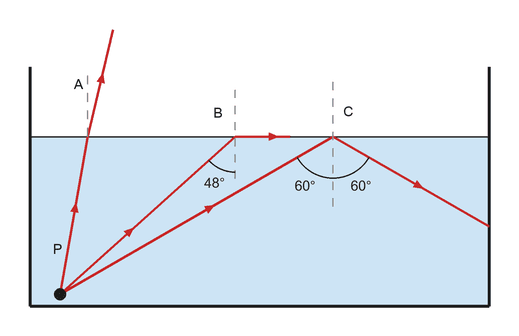
(b) Phenomena
Step 4 — Name them.
A shows refraction (denser to rarer); B shows refraction at the critical angle (grazing emergence); C shows total internal reflection.
Therefore, A refracts out, B grazes the surface, and C is totally internally reflected.
- 1255 marks
Question 125
In Fig. 4.63, PQ and PR are the two light rays emerging from an object P. The ray PQ is refracted as QS.
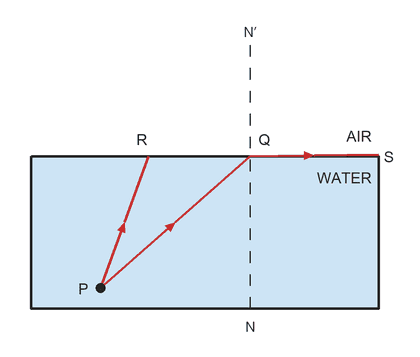
(a) State the special name given to the angle of incidence PQN for the ray PQ.
(b) What is the angle of refraction for the refracted ray QS ?
(c) Name the phenomenon that occurs if the angle of incidence PQN is increased.
(d) The ray PR suffers partial reflection and refraction on the water-air surface. Give reason.
(e) Draw in the diagram the refracted ray for the incident ray PR and hence show the position of the image of the object P by the letter P' when seen vertically from above.
Solve with AIWritten solution
Solution:
Concept: The critical angle C is the angle of incidence in the denser medium for which the angle of refraction in the rarer medium is 90° (the refracted ray grazes the surface). It is given by sin C = 1/μ; it is about 42° for glass (μ of 1.5) and about 48° to 49° for water (μ of 4/3). An object inside a denser medium, seen from the rarer medium (air) along the normal, appears raised: light from it bends away from the normal on leaving, and the eye traces the rays straight back.
(a)
Step 1 — Name the angle.
The refracted ray QS lies along the water surface, so its angle of refraction is 90°. ∠PQN is therefore the critical angle for the water–air surface.
(b)
Step 2 — Angle of refraction.
QS grazes the surface, so the angle of refraction is 90°.
(c)
Step 3 — Increase ∠PQN.
If ∠PQN is increased beyond the critical angle, PQ is reflected back entirely into the water: total internal reflection.
(d)
Step 4 — Why PR is partly reflected.
PR meets the surface at an angle of incidence less than the critical angle. For i < C most of the light is refracted into air, while a small part is reflected back into the water.
(e)
Step 5 — Find P′.
The ray PR refracts into air, bending away from the normal. Produced backward, it meets the vertical line through P at P′, above P. This is the image of P seen from above: the object appears raised.
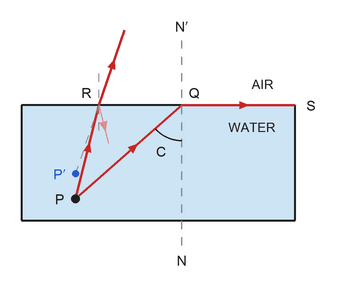
Therefore, ∠PQN is the critical angle, QS is refracted at 90°, a larger angle gives total internal reflection, PR is partly reflected because i < C, and P′ lies above P.
- 1264 marks
Question 126
The refractive index of glass is 1·5. From a point P inside a glass slab, draw rays PA, PB and PC incident on the glass-air surface at an angle of incidence , and respectively.
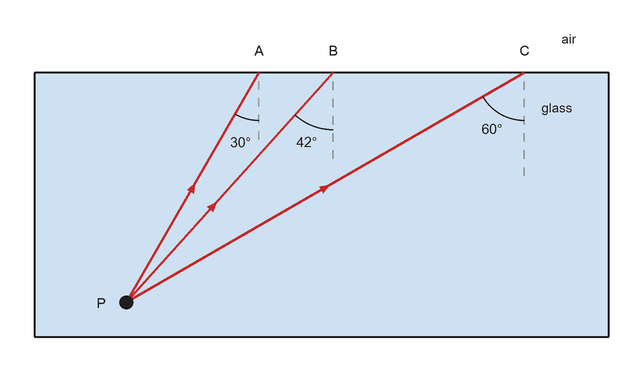
(a) In the diagram show the approximate direction of these rays as they emerge out of the slab.
(b) What is the angle of refraction for the ray PB ?
(Take )
Solve with AIWritten solution
Solution:
Concept: The critical angle C is the angle of incidence in the denser medium for which the angle of refraction in the rarer medium is 90° (the refracted ray grazes the surface). It is given by sin C = 1/μ; it is about 42° for glass (μ of 1.5) and about 48° to 49° for water (μ of 4/3).
Step 1 — Find the critical angle.
With μ = 1.5 and sin 42° taken as 2/3,
(a) Directions of the rays
Step 2 — PA (i = 30°, less than 42°).
It refracts into air, bending away from the normal. By Snell's law,
Step 3 — PB (i = 42°, the critical angle).
It refracts at 90° and grazes along the surface.
Step 4 — PC (i = 60°, more than 42°).
It is totally internally reflected back into the glass at 60°.
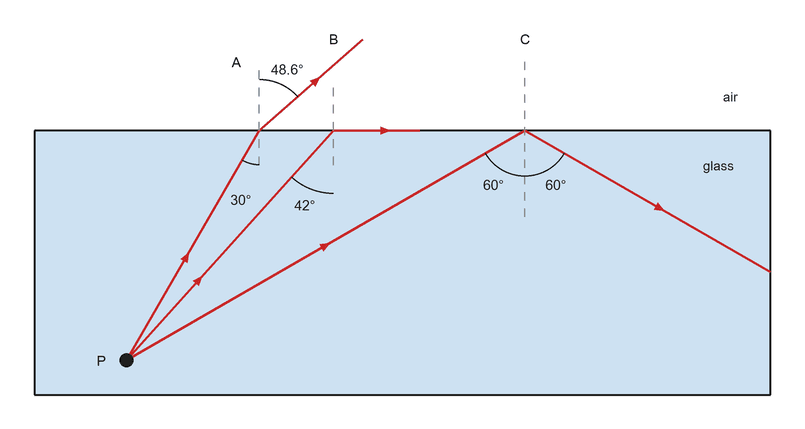
(b)
Step 5 — Angle of refraction for PB.
Its angle of incidence equals the critical angle, so its angle of refraction is 90°.
Therefore, PA emerges at about 48.6°, PB grazes the surface (r = 90°), and PC is totally reflected.
- 1275 marks
Question 127
A ray of light enters a glass slab ABDC as shown in Fig. 4.64 and strikes at the centre O of the circular part AC of the slab. The critical angle of glass is . Complete the path of the ray till it emerges out from the slab. Mark the angles in the diagram wherever necessary.
 Solve with AI
Written solution
Solution:
Concept: Total internal reflection happens when light goes from a denser to a rarer medium and meets the surface at an angle of incidence greater than the critical angle. Then no light is refracted out: all of it is reflected back into the denser medium, obeying the laws of reflection. At each surface, find the angle of incidence from the normal and compare it with the critical angle, 42°.
Step 1 — At the curved surface.
The ray is aimed at O, the centre of the circular part, so it travels along a radius. It meets the curved surface normally (i = 0°) and enters without bending.
Step 2 — At O on face AB.
The ray makes 42° with the face OA, so its angle of incidence at O is
This is more than 42°, so the ray is totally internally reflected, leaving O at 48° on the other side of the normal.
Step 3 — At face BD.
The normal to BD is parallel to AB, so the reflected ray meets BD at
This is exactly the critical angle, so the ray refracts at 90° and emerges grazing along BD.
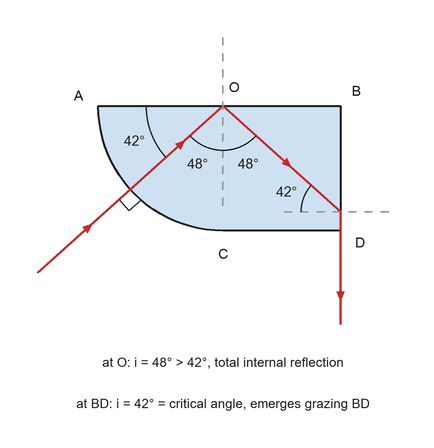
Watch out: The 42° marked at O is measured from the face, not from the normal.
Therefore, the ray enters undeviated, is totally reflected at O (i = 48°), and emerges grazing along BD (i = 42°).
- 1285 marks
Question 128
What is a total reflecting prism ? State three actions that it can produce. Draw a diagram to show one such action of the total reflecting prism.
Solve with AIWritten solution
Solution:
Concept: A total reflecting prism is a glass prism whose principal section is a right-angled isosceles triangle (90°, 45°, 45°). Light entering a face normally goes in without bending and meets the next face at 45°, which is more than the critical angle of glass (42°), so it is totally reflected there.
Step 1 — Define it.
A total reflecting prism is a glass prism whose principal section is a right-angled isosceles triangle. Light meets its reflecting face at 45°, more than 42°, so the prism acts as a perfect reflector.
Step 2 — Three actions.
(1) It can deviate a ray through 90° (light enters a short face normally; used in a periscope). (2) It can deviate a ray through 180° (light enters the hypotenuse normally; used in binoculars). (3) It can erect an inverted image without deviating the rays (an erecting prism).
Step 3 — Diagram: deviation through 90°.
The ray enters face AC normally, meets the hypotenuse AB at 45° and is totally reflected, then leaves face CB normally, turned through 90°.
Therefore, a total reflecting prism is a 90°-45°-45° glass prism that can turn a ray through 90° or 180°, or erect an inverted image.
- 1294 marks
Question 129
Show with the help of a diagram how a total reflecting prism can be used to turn a ray of light through . Name one instrument in which such a prism is used.
Solve with AIWritten solution
Solution:
Concept: A total reflecting prism is a glass prism whose principal section is a right-angled isosceles triangle (90°, 45°, 45°). Light entering a face normally goes in without bending and meets the next face at 45°, which is more than the critical angle of glass (42°), so it is totally reflected there.
Step 1 — Entry.
The ray falls normally on the short face AC and enters without bending.
Step 2 — At the hypotenuse AB.
The angle of incidence is 45°, which is more than 42°, so the ray is totally reflected. A reflection at 45° turns the ray through
Step 3 — Exit.
It then meets the other short face CB normally and leaves without bending.
Step 4 — Instrument.
Such prisms are used in a periscope (prism periscope), which uses two of them.
Therefore, the prism turns the ray through 90°, as used in a periscope.
- 1303 marks
Question 130
A ray of light XY passes through a right angled isosceles prism as shown alongside in Fig. 4.65.

(a) What is the angle through which the incident ray deviates and emerges out of the prism ?
(b) Name the instrument where this action of prism is put into use.
(c) Which prism surface will behave as a mirror ?
Solve with AIWritten solution
Solution:
Concept: A total reflecting prism is a glass prism whose principal section is a right-angled isosceles triangle (90°, 45°, 45°). Light entering a face normally goes in without bending and meets the next face at 45°, which is more than the critical angle of glass (42°), so it is totally reflected there.
Step 1 — Follow the ray.
XY enters face AC normally and meets the hypotenuse AB at 45°. Since 45° is more than 42°, the ray is totally reflected and leaves vertically downward through face CB.
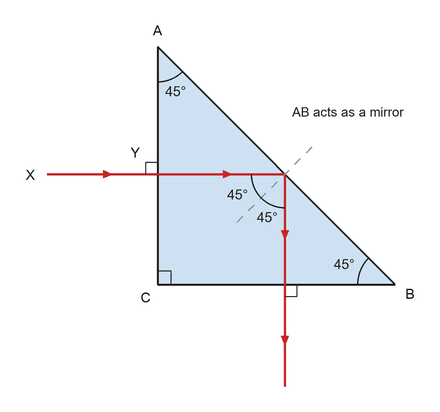
(a)
Step 2 — Angle of deviation.
The ray enters horizontally and leaves vertically, so it is deviated through 90°.
(b)
Step 3 — Instrument.
This action is used in a periscope.
(c)
Step 4 — The mirror face.
The hypotenuse face AB behaves as a mirror, because the ray is totally internally reflected there at 45°.
Therefore, (a) the ray is deviated through 90°, (b) in a periscope, and (c) face AB acts as a mirror.
- 1314 marks
Question 131
Draw a diagram of a right angled isosceles prism which is used to make an inverted image erect.
Solve with AIWritten solution
Solution:
Concept: If a right-angled isosceles prism is placed with its hypotenuse parallel to the incident rays, each ray is totally reflected once at the hypotenuse, and the top and bottom of the beam change places.
Step 1 — Entry.
The rays fall on one short face at 45°, refract into the prism and travel towards the hypotenuse.
Step 2 — At the hypotenuse.
Each ray meets it at about 73°, greater than the critical angle (42°), and is totally reflected.
Step 3 — Exit.
The rays leave through the other short face parallel to their original direction, so there is no deviation.
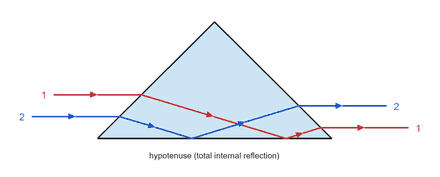
Step 4 — Result.
The ray that entered higher (ray 1) comes out lower, and the ray that entered lower (ray 2) comes out higher. The image is turned upside down, so an inverted image becomes erect. This is the erecting prism, used in binoculars and projectors.
Therefore, a right-angled isosceles prism with its hypotenuse parallel to the rays erects an inverted image.
- 1324 marks
Question 132
In Fig. 4.66, a ray of light PQ is incident normally on the hypotenuse of an isosceles right angled prism ABC. (a) Complete the path of the ray PQ till it emerges from the prism. Mark in the diagram the angle wherever necessary. (b) What is the angle of deviation of the ray PQ ? (c) Name a device in which this action is used.
 Solve with AI
Written solution
Solution:
Concept: A total reflecting prism is a glass prism whose principal section is a right-angled isosceles triangle (90°, 45°, 45°). Light entering a face normally goes in without bending and meets the next face at 45°, which is more than the critical angle of glass (42°), so it is totally reflected there.
(a) Path of the ray
Step 1 — Entry.
PQ enters the hypotenuse AC normally, so it goes in without bending.
Step 2 — At face AB.
It meets AB at 45°, more than 42°, and is totally reflected, turning through 90°.
Step 3 — At face BC.
It then meets BC at 45° and is totally reflected again, turning through another 90°.
Step 4 — Exit.
Finally it leaves through AC normally, travelling parallel to PQ but in the opposite direction.
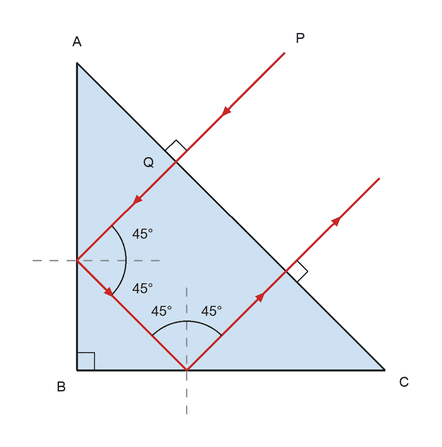
(b) Angle of deviation
Step 5 — Add the two turns.
Each reflection turns the ray through 90°.
(c) Device
Step 6 — Name it.
This action is used in binoculars (prism binoculars).
Note: the stem's misprint "isoceles" is corrected to "isosceles".
Therefore, the ray is totally reflected twice and deviated through 180°, as in binoculars.
- 1334 marks
Question 133
In Fig. 4.67, a ray of light PQ is incident normally on the face AB of an equilateral glass prism. Complete the ray diagram showing its emergence into air after passing through the prism. Take critical angle for glass = .
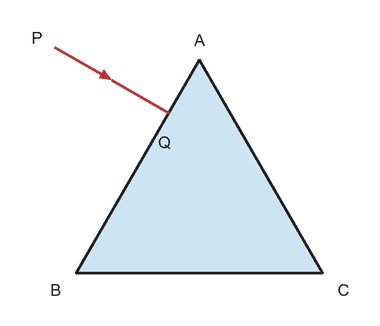
(a) Write the angles of incidence at the faces AB and AC of the prism.
(b) Name the phenomenon which the ray of light suffers at the face AB, AC and BC of the prism.
Solve with AIWritten solution
Solution:
Concept: Total internal reflection happens when light goes from a denser to a rarer medium and meets the surface at an angle of incidence greater than the critical angle. Then no light is refracted out: all of it is reflected back into the denser medium, obeying the laws of reflection. A prism refracts a ray twice, at two faces inclined at the angle of the prism A. Inside, the angles of refraction at the two faces add up to A (r₁ + r₂ = A); the total turning of the ray is the angle of deviation (δ = i₁ + i₂ − A), where i₁ is the angle of incidence and i₂ the angle of emergence. Both bends turn the ray towards the base of the prism.
Step 1 — At AB.
PQ falls normally, so it enters undeviated: the angle of incidence is 0°.
Step 2 — At AC.
Since r₁ + r₂ is 60° and r₁ is 0°, the angle of incidence at AC is
60° is more than 42°, so the ray is totally reflected.
Step 3 — At BC.
The reflected ray meets BC normally and passes out into air without bending.
(a)
Step 4 — Angles of incidence.
At face AB: 0°. At face AC: 60°.
(b)
Step 5 — Phenomena.
At AB: refraction with no deviation (normal incidence). At AC: total internal reflection (60° > 42°). At BC: refraction with no deviation (the ray meets BC normally).
Therefore, (a) the angles of incidence are 0° at AB and 60° at AC, and (b) the ray is refracted undeviated at AB, totally reflected at AC and refracted undeviated at BC.
- 1344 marks
Question 134
Draw a neat labelled ray diagram to show total internal reflection of a ray of light incident normally on one face of a , , prism.
Solve with AIWritten solution
Solution:
Concept: Total internal reflection happens when light goes from a denser to a rarer medium and meets the surface at an angle of incidence greater than the critical angle. Then no light is refracted out: all of it is reflected back into the denser medium, obeying the laws of reflection. Send the ray in normally through the shortest face BC (opposite the 30° angle). It then meets the longest face (the hypotenuse AC) at 60°, which is more than 42°.
Step 1 — Entry.
The ray PQ falls normally on the shortest face BC and enters without bending.
Step 2 — At the hypotenuse AC.
The ray travels parallel to AB, and AC makes 30° with AB, so the angle of incidence is
Since 60° > 42°, the ray is totally internally reflected.
Step 3 — At the third face AB.
The reflected ray meets AB at 30°, less than 42°, so it refracts out into air, bending away from the normal (to about 48°).
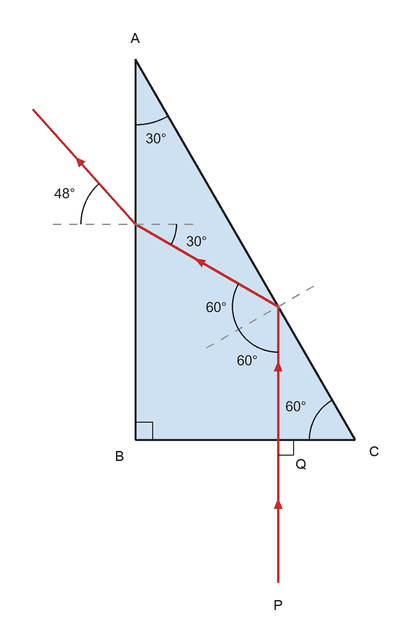
Therefore, the ray entering the shortest face normally is totally reflected at the hypotenuse (i = 60°) and then refracts out of the third face.
- 1354 marks
Question 135
Copy the diagram (Fig. 4.68) given alongside and complete the path of the light ray till it emerges out of the prism. The critical angle of glass is . In your diagram mark the angles wherever necessary.
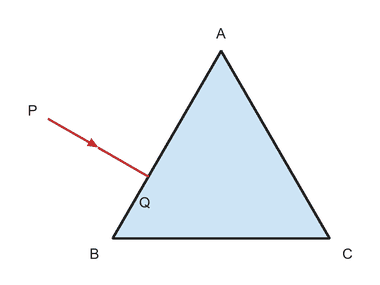 Solve with AI
Written solution
Solution:
Concept: Total internal reflection happens when light goes from a denser to a rarer medium and meets the surface at an angle of incidence greater than the critical angle. Then no light is refracted out: all of it is reflected back into the denser medium, obeying the laws of reflection. In an equilateral prism every angle is 60°.
Step 1 — At AB.
PQ meets AB normally, so it enters without bending.
Step 2 — At the base BC.
Because Q is low on AB, the ray reaches the base BC first. It travels at 30° to BC, so its angle of incidence is
60° is more than 42°, so it is totally internally reflected.
Step 3 — At AC.
The reflected ray meets face AC normally (i = 0°) and passes out into air without bending.
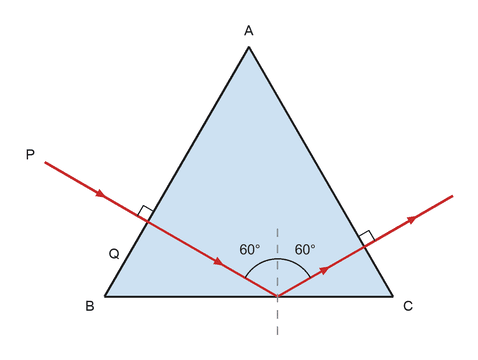
Step 4 — Deviation.
One reflection at 60° turns the ray through
Therefore, the ray enters undeviated, is totally reflected at the base (i = 60°), and leaves AC normally, deviated through 60°.
- 1364 marks
Question 136
What device other than a plane mirror can be used to turn a ray of light through ? Draw a diagram in support of your answer. Name an instrument in which this device is used.
Solve with AIWritten solution
Solution:
Concept: A total reflecting prism is a glass prism whose principal section is a right-angled isosceles triangle (90°, 45°, 45°). Light entering a face normally goes in without bending and meets the next face at 45°, which is more than the critical angle of glass (42°), so it is totally reflected there.
Step 1 — The device.
A right-angled isosceles (total reflecting) prism can turn a ray through 180°.
Step 2 — How it works.
The ray falls normally on the hypotenuse and enters undeviated. It meets each short face at 45° and is totally reflected at each, turning through 90° each time. It comes out through the hypotenuse travelling in the opposite direction.
Step 3 — Instrument.
It is used in binoculars (prism binoculars).
Therefore, a total reflecting prism, with light entering its hypotenuse normally, turns a ray through 180°; it is used in binoculars.
- 1374 marks
Question 137
Two isosceles right-angled glass prisms P and Q are placed near each other as shown in Fig. 4.69. Complete the path of the light ray entering the prism P till it emerges out of the prism Q.
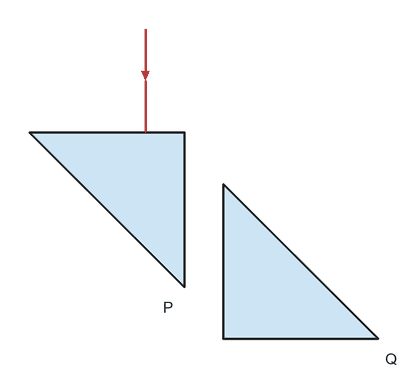 Solve with AI
Written solution
Solution:
Concept: A total reflecting prism is a glass prism whose principal section is a right-angled isosceles triangle (90°, 45°, 45°). Light entering a face normally goes in without bending and meets the next face at 45°, which is more than the critical angle of glass (42°), so it is totally reflected there.
Step 1 — In prism P.
The ray enters the top face normally and meets the hypotenuse at 45°, more than 42°. It is totally reflected through 90°, travels horizontally and leaves P's vertical face normally.
Step 2 — In prism Q.
The ray enters Q's vertical face normally, meets Q's hypotenuse at 45° and is totally reflected again through 90°. It travels downward and leaves Q's bottom face normally.

Step 3 — Result.
The two 90° turns are in opposite senses, so the ray finally travels vertically downward, parallel to the original ray but shifted sideways, as in a prism periscope.
Therefore, the ray emerges from Q travelling downward, parallel to the incident ray and displaced sideways.
- 1384 marks
Question 138
Complete the path of ray PQ through the glass prism ABC shown in Fig. 4.70 till it emerges out of the prism. Given the critical angle of the glass is .
 Solve with AI
Written solution
Solution:
Concept: Total internal reflection happens when light goes from a denser to a rarer medium and meets the surface at an angle of incidence greater than the critical angle. Then no light is refracted out: all of it is reflected back into the denser medium, obeying the laws of reflection. At each face find the angle of incidence from the normal and compare it with the critical angle, 42°.
Step 1 — At BC.
PQ enters the base normally, so it goes straight up without bending.
Step 2 — At AC.
The ray travels parallel to AB, and AC makes 30° with AB, so the angle of incidence is
This is more than 42°, so the ray is totally internally reflected.
Step 3 — At AB.
The reflected ray meets the face AB at an angle of incidence of 30°, less than 42°, so it refracts out, bending away from the normal. With μ = 1/sin 42°,
Therefore, the ray enters BC undeviated, is totally reflected at AC (i = 60°), and emerges from AB at about 48°.
- 1394 marks
Question 139
The diagram given below shows a light source P embedded in a rectangular glass block ABCD of critical angle . Complete the path of ray PQ till it emerges out of the block. [Write necessary angles]
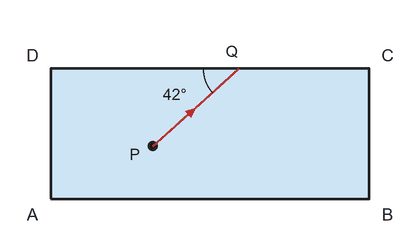 Solve with AI
Written solution
Solution:
Concept: Total internal reflection happens when light goes from a denser to a rarer medium and meets the surface at an angle of incidence greater than the critical angle. Then no light is refracted out: all of it is reflected back into the denser medium, obeying the laws of reflection. Angles of incidence and refraction are measured from the normal, never from the surface.
Step 1 — At Q on face DC.
PQ makes 42° with the surface, so its angle of incidence is
This is more than 42°, so the ray is totally internally reflected, leaving Q at 48° on the other side of the normal.
Step 2 — At face BC.
The normal to BC is parallel to DC, so the reflected ray meets BC at
This equals the critical angle, so it refracts at 90° and emerges grazing along the face BC.
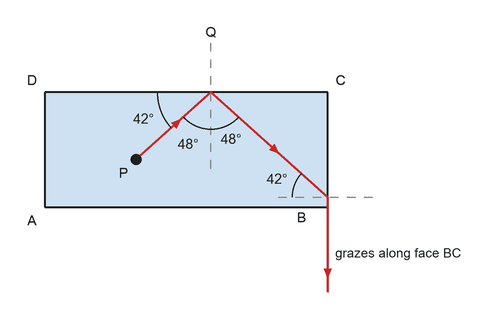
Watch out: The 42° marked at Q is the angle with the surface; the angle of incidence is 48°.
Therefore, the ray is totally reflected at Q (i = 48°) and then emerges grazing along BC (i = 42°, r = 90°).
What Class 10 Physics Ch 4 covers
The sections of the chapter, in the order the book takes them. Every question above comes from one of these.
- 01Refraction of Light
- 02Laws of Refraction
- 03Speed of Light in Different Media
- 04Refraction of Light Through a Rectangular Glass Block
- 05Refraction of Light Through a Glass Prism
- 06Real and Apparent Depth
More ways to study this chapter
The same chapter asked three other ways. Practise it, revise it, and see what the board has set on Ch 4 before.
- Competency-Based Questions (CBQ)Case study questions: a situation, and the part of the chapter that answers it.40questionsOpen
- Previous Year QuestionsQuestions that have actually appeared in board papers, each tagged with its year.57questionsOpen
- Practice QuestionsExtra questions per chapter, for when one attempt at a method is not enough.44questionsOpen
Ch 4 in past ICSE papers
The same chapter as the board has actually asked it. These are worded differently from the textbook exercise, which is the point of reading them.
- 12 marks
Board paper question 1
A boy uses blue colour of light to find the refractive index of glass. He then repeats the experiment using red colour of light. Will the refractive index be the same or different in the two cases? Give a reason to support your answer.
Solve with AIWritten solution
Solution:
Concept: Refractive index and speed: , where c is the speed of light in vacuum (or air) and v its speed in the medium. Light is slower in a medium of larger refractive index. Refractive index and colour: in glass or water, light of shorter wavelength travels more slowly, so the refractive index is larger for violet and blue light and smallest for red light (order: red < orange < yellow < green < blue < indigo < violet).
Step 1 — Compare the wavelengths.
Blue light has a shorter wavelength than red light.
Step 2 — Compare the speeds in glass.
In glass, light of shorter wavelength travels more slowly. So blue light moves more slowly through the glass than red light.
Step 3 — Compare the refractive indices.
The refractive index is the speed of light in air divided by its speed in the glass:
A smaller speed v in the glass gives a larger μ. So the glass has a larger refractive index for blue light than for red light.
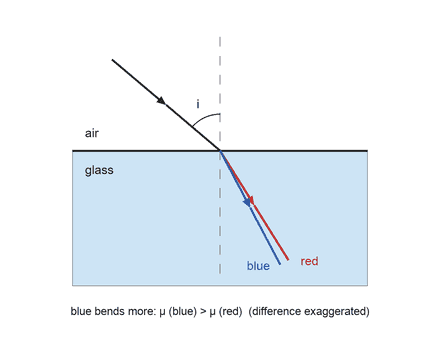
Step 4 — What the boy observes.
For the same angle of incidence, the blue ray bends more towards the normal, so its angle of refraction is smaller and comes out larger for blue light than for red light.
Watch out: The refractive index of a material is not one fixed number; it is always quoted for a particular colour of light.
Therefore, the refractive index will be different: it is greater for blue light than for red light, because blue light (shorter wavelength) travels more slowly in glass and bends more.
- 22 marks
Board paper question 2
Copy the diagram given below and complete the path of light ray till it emerges out of the prism. The critical angle of glass is 42°. In your diagram mark the angles wherever necessary.
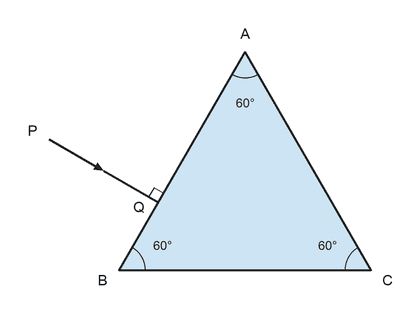 Solve with AI
Written solution
Solution:
Concept: A ray that meets a surface along the normal (angle of incidence 0°) passes into the next medium without bending (angle of refraction 0°). Total internal reflection: it happens only when light goes from a denser to a rarer medium and the angle of incidence is greater than the critical angle. Then no light is refracted out; all of it is reflected back, obeying the laws of reflection (angle of reflection = angle of incidence).
Given: Equilateral prism ABC (each angle 60°), ray PQ normal to AB, critical angle of glass 42°.
Step 1 — At face AB (point Q).
The ray PQ falls normally on AB, so the angle of incidence is 0°. It enters the glass without bending, travelling perpendicular to AB.
Step 2 — Find the angle of incidence at the base BC.
The ray inside is perpendicular to AB, and the normal at R is perpendicular to BC. The angle between two lines equals the angle between their perpendiculars, so the angle of incidence at R equals the angle between AB and BC, which is ∠B:
Step 3 — Decide what happens at R.
The ray is going from glass to air, and its angle of incidence (60°) is greater than the critical angle (42°). So it suffers total internal reflection at R. The angle of reflection is also 60°, on the other side of the normal.
Step 4 — At face AC (point S).
The reflected ray makes 90° − 60° = 30° with BC. In triangle RSC, ∠SRC = 30° and ∠C = 60°, so the third angle is
The ray therefore meets AC along the normal (angle of incidence 0°) and passes out undeviated.

Watch out: Angles of incidence and refraction are measured from the normal; if a figure gives the angle with the surface, subtract it from 90°.
Therefore, the ray enters AB undeviated (i = 0°), is totally internally reflected at BC (i = 60°, more than 42°, reflected at 60°) and emerges normally through AC (i = 0°).
- 33 marks
Board paper question 3
(i) Write a relationship between angle of incidence and angle of refraction for a given pair of media.
(ii) When a ray of light enters from one medium to another having different optical densities it bends. Why does this phenomenon occur?
(iii) Write one condition where it does not bend when entering a medium of different optical density.
Solve with AIWritten solution
Solution:
Concept: Refraction: light bends when it passes obliquely from one medium into another because its speed changes. Going into an optically denser medium it bends towards the normal; going into a rarer medium it bends away from the normal. Snell's law: is a constant (the refractive index) for a given pair of media and a given colour of light. All angles are measured from the normal, not from the surface.
Step 1 — Part (i): Snell's law.
For a given pair of media and light of a given colour, the ratio of the sine of the angle of incidence to the sine of the angle of refraction is a constant:
The constant is the refractive index of the second medium with respect to the first.
Step 2 — Part (ii): why the ray bends.
The speed of light is different in the two media: it is greater in the rarer medium and smaller in the denser medium. When a beam enters the new medium obliquely, one edge of it reaches the surface first and changes speed before the other edge, so the beam turns. It turns towards the normal on entering a denser medium and away from the normal on entering a rarer one.
Step 3 — Part (iii): when it does not bend.
If the ray falls normally on the surface (angle of incidence 0°), the whole beam reaches the surface at the same moment, so it goes straight on with angle of refraction 0°. Its speed still changes, but its direction does not.

Watch out: The ray still changes speed at normal incidence; only its direction stays the same.
Therefore, (i) sin i / sin r is a constant, the refractive index (Snell's law); (ii) the speed of light is different in the two media; (iii) when the ray is incident normally on the surface (i = 0°).
- 42 marks
Board paper question 4
How is the refractive index of a material related to?
(i) real and apparent depth?
(ii) velocity of light in vacuum or air and the velocity of light in a given medium?
Solve with AIWritten solution
Solution:
Concept: Real and apparent depth: an object inside a denser medium, seen from above (nearly along the normal), appears raised, because rays from it bend away from the normal on coming out. , and the shift (apparent rise) is real depth − apparent depth. Refractive index and speed: , where c is the speed of light in vacuum (or air) and v its speed in the medium. Light is slower in a medium of larger refractive index.
Step 1 — Part (i): real and apparent depth.
An object at the bottom of a medium appears raised, because rays from it bend away from the normal as they come out. The refractive index of the medium is the ratio of the real depth to the apparent depth:
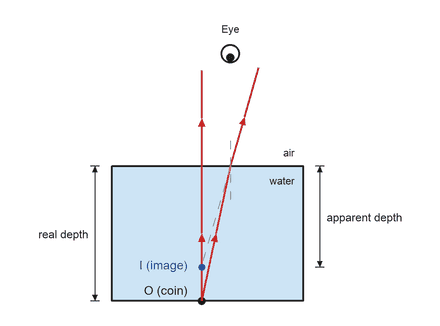
Step 2 — Part (ii): speeds of light.
The refractive index is also the ratio of the speed of light in vacuum (or air) to its speed in the medium:
Here c is the speed of light in vacuum or air and v is its speed in the medium.
Watch out: Keep the larger quantity on top in both ratios (real depth, speed in air), so μ comes out greater than 1.
Therefore, (i) μ = real depth ÷ apparent depth; (ii) μ = speed of light in vacuum (or air) ÷ speed of light in the medium.
- 52 marks
Board paper question 5
State the conditions required for total internal reflection of light to take place.
Solve with AIWritten solution
Solution:
Concept: Critical angle (C): the angle of incidence in the denser medium for which the angle of refraction in the rarer medium is 90°. For glass or water to air, . Total internal reflection: it happens only when light goes from a denser to a rarer medium and the angle of incidence is greater than the critical angle. Then no light is refracted out; all of it is reflected back, obeying the laws of reflection (angle of reflection = angle of incidence).
Step 1 — Condition 1: the direction of travel.
Light must travel from an optically denser medium to an optically rarer medium, for example from glass to air or from water to air. Only then does the refracted ray bend away from the normal, so that it can reach 90°.
Step 2 — Condition 2: the angle of incidence.
The angle of incidence in the denser medium must be greater than the critical angle for that pair of media.
Step 3 — See how the ray changes as i grows.
When i is less than C, the ray refracts out (and a weak ray is reflected). When i equals C, the refracted ray grazes the surface (r = 90°). When i is greater than C, no refracted ray exists and all the light is reflected back into the denser medium: this is total internal reflection.
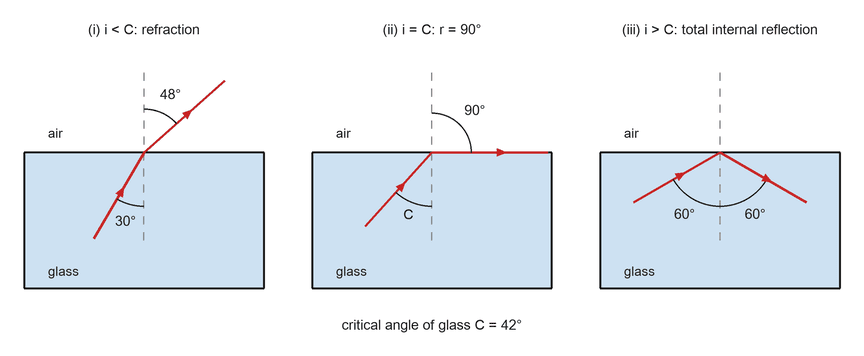
Watch out: Total internal reflection needs light going from the denser to the rarer medium; a large angle alone is not enough.
Therefore, (1) light must go from an optically denser to an optically rarer medium; (2) the angle of incidence in the denser medium must be greater than the critical angle.
- 62 marks
Board paper question 6
Draw a ray diagram to show the refraction of a monochromatic ray through a prism when it suffers minimum deviation.
Solve with AIWritten solution
Solution:
Concept: Minimum deviation: as the angle of incidence increases, the deviation first decreases, reaches a least value , then increases. At minimum deviation the ray passes symmetrically: the ray inside is parallel to the base, and are equal (each is ), and the angle of emergence equals the angle of incidence.
Step 1 — Draw the incident ray.
Draw the prism ABC and a monochromatic ray falling on face AB at an angle of incidence i. On entering the glass it bends towards the normal.
Step 2 — Draw the ray inside the prism.
For minimum deviation, draw the refracted ray QR parallel to the base BC. Then the angles of refraction at the two faces are equal, each being half the angle of the prism:
Step 3 — Draw the emergent ray.
At face AC the ray goes from glass into air and bends away from the normal. Because the path is symmetrical, it leaves at an angle of emergence equal to the angle of incidence:
Step 4 — Mark the angle of minimum deviation.
Produce the incident ray forward and the emergent ray backward (dashed). The angle between them is the angle of minimum deviation, . The ray is bent towards the base of the prism.
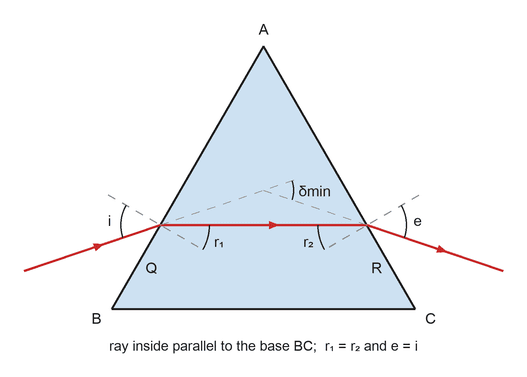
Step 5 — Check with numbers.
For example, take a 60° glass prism of refractive index 1.5. At minimum deviation the angle of refraction is 30°, and Snell's law at the first face gives the angle of incidence:
The minimum deviation is then
Watch out: The ray inside must be drawn parallel to the base; a ray sloping up or down inside the prism is not at minimum deviation.
Therefore, at minimum deviation the ray passes symmetrically: it travels parallel to the base inside the prism, r₁ and r₂ are each A/2, the angle of emergence equals the angle of incidence, and δmin is marked between the incident ray produced and the emergent ray.
All 57 board paper questions for this chapter, solved the same way.
Class 10 Physics Ch 4 questions students ask
How many questions are there in Class 10 Physics Ch 4?
139 questions. Every one is solved step by step on this page.
Are these Class 10 Physics solutions free?
Yes. Every question and its full working is free to read, with no account needed.
Can I download the Class 10 Physics Ch 4 solutions as a PDF?
There is no PDF to download. Every solution is on this page instead, which means it is searchable, always the current syllabus, and readable on a phone. Use your browser's print option if you want it on paper.