
Question 1314 marksEasy
Draw a diagram of a right angled isosceles prism which is used to make an inverted image erect.
Confirming your payment
Sign up now and get 250 free tokens.
Refraction of Light at Plane Surfaces · Question 131 of 139
Draw a diagram of a right angled isosceles prism which is used to make an inverted image erect.
Solution:
Concept: If a right-angled isosceles prism is placed with its hypotenuse parallel to the incident rays, each ray is totally reflected once at the hypotenuse, and the top and bottom of the beam change places.
Step 1 — Entry.
The rays fall on one short face at 45°, refract into the prism and travel towards the hypotenuse.
Step 2 — At the hypotenuse.
Each ray meets it at about 73°, greater than the critical angle (42°), and is totally reflected.
Step 3 — Exit.
The rays leave through the other short face parallel to their original direction, so there is no deviation.
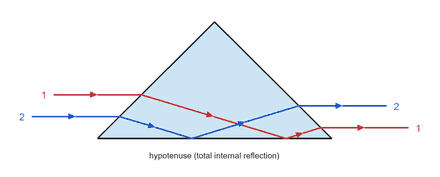
Step 4 — Result.
The ray that entered higher (ray 1) comes out lower, and the ray that entered lower (ray 2) comes out higher. The image is turned upside down, so an inverted image becomes erect. This is the erecting prism, used in binoculars and projectors.
Therefore, a right-angled isosceles prism with its hypotenuse parallel to the rays erects an inverted image.