Solution:
Concept: A total reflecting prism is a glass prism whose principal section is a right-angled isosceles triangle (90°, 45°, 45°). Light entering a face normally goes in without bending and meets the next face at 45°, which is more than the critical angle of glass (42°), so it is totally reflected there.
(a) Path of the ray
Step 1 — Entry.
PQ enters the hypotenuse AC normally, so it goes in without bending.
Step 2 — At face AB.
It meets AB at 45°, more than 42°, and is totally reflected, turning through 90°.
Step 3 — At face BC.
It then meets BC at 45° and is totally reflected again, turning through another 90°.
Step 4 — Exit.
Finally it leaves through AC normally, travelling parallel to PQ but in the opposite direction.
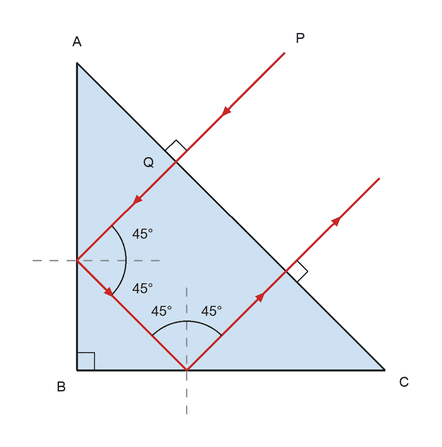
(b) Angle of deviation
Step 5 — Add the two turns.
Each reflection turns the ray through 90°.
δ=90∘+90∘=180∘
(c) Device
Step 6 — Name it.
This action is used in binoculars (prism binoculars).
Note: the stem's misprint "isoceles" is corrected to "isosceles".
Therefore, the ray is totally reflected twice and deviated through 180°, as in binoculars.

