Solution:
Concept: Total internal reflection happens when light goes from a denser to a rarer medium and meets the surface at an angle of incidence greater than the critical angle. Then no light is refracted out: all of it is reflected back into the denser medium, obeying the laws of reflection. A prism refracts a ray twice, at two faces inclined at the angle of the prism A. Inside, the angles of refraction at the two faces add up to A (r₁ + r₂ = A); the total turning of the ray is the angle of deviation (δ = i₁ + i₂ − A), where i₁ is the angle of incidence and i₂ the angle of emergence. Both bends turn the ray towards the base of the prism.
Step 1 — At AB.
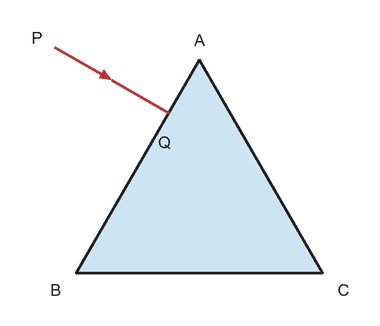
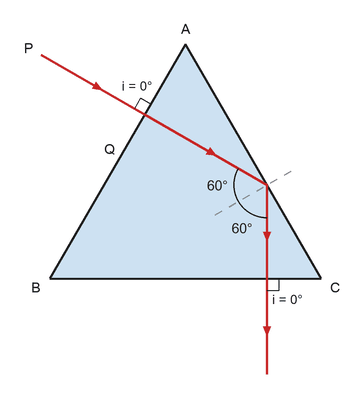
PQ falls normally, so it enters undeviated: the angle of incidence is 0°.
Step 2 — At AC.
Since r₁ + r₂ is 60° and r₁ is 0°, the angle of incidence at AC is
r2=60∘−0∘=60∘
60° is more than 42°, so the ray is totally reflected.
Step 3 — At BC.
The reflected ray meets BC normally and passes out into air without bending.
(a)
Step 4 — Angles of incidence.
At face AB: 0°. At face AC: 60°.
(b)
Step 5 — Phenomena.
At AB: refraction with no deviation (normal incidence). At AC: total internal reflection (60° > 42°). At BC: refraction with no deviation (the ray meets BC normally).
Therefore, (a) the angles of incidence are 0° at AB and 60° at AC, and (b) the ray is refracted undeviated at AB, totally reflected at AC and refracted undeviated at BC.