
Question 1344 marksEasy
Draw a neat labelled ray diagram to show total internal reflection of a ray of light incident normally on one face of a , , prism.
Confirming your payment
Sign up now and get 250 free tokens.
Refraction of Light at Plane Surfaces · Question 134 of 139
Draw a neat labelled ray diagram to show total internal reflection of a ray of light incident normally on one face of a , , prism.
Solution:
Concept: Total internal reflection happens when light goes from a denser to a rarer medium and meets the surface at an angle of incidence greater than the critical angle. Then no light is refracted out: all of it is reflected back into the denser medium, obeying the laws of reflection. Send the ray in normally through the shortest face BC (opposite the 30° angle). It then meets the longest face (the hypotenuse AC) at 60°, which is more than 42°.
Step 1 — Entry.
The ray PQ falls normally on the shortest face BC and enters without bending.
Step 2 — At the hypotenuse AC.
The ray travels parallel to AB, and AC makes 30° with AB, so the angle of incidence is
Since 60° > 42°, the ray is totally internally reflected.
Step 3 — At the third face AB.
The reflected ray meets AB at 30°, less than 42°, so it refracts out into air, bending away from the normal (to about 48°).
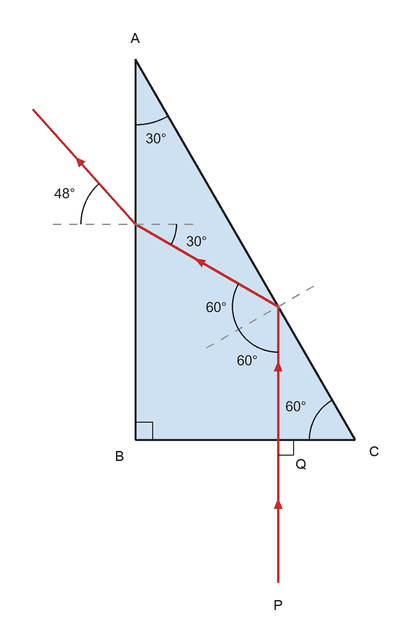
Therefore, the ray entering the shortest face normally is totally reflected at the hypotenuse (i = 60°) and then refracts out of the third face.