
Question 1354 marksMedium
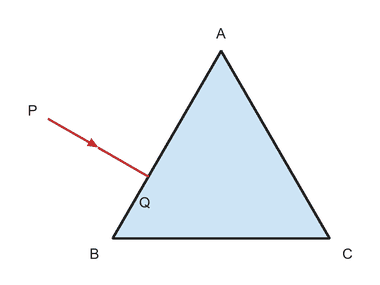
Copy the diagram (Fig. 4.68) given alongside and complete the path of the light ray till it emerges out of the prism. The critical angle of glass is . In your diagram mark the angles wherever necessary.
Confirming your payment
Sign up now and get 250 free tokens.
Refraction of Light at Plane Surfaces · Question 135 of 139
Copy the diagram (Fig. 4.68) given alongside and complete the path of the light ray till it emerges out of the prism. The critical angle of glass is . In your diagram mark the angles wherever necessary.
Solution:
Concept: Total internal reflection happens when light goes from a denser to a rarer medium and meets the surface at an angle of incidence greater than the critical angle. Then no light is refracted out: all of it is reflected back into the denser medium, obeying the laws of reflection. In an equilateral prism every angle is 60°.
Step 1 — At AB.
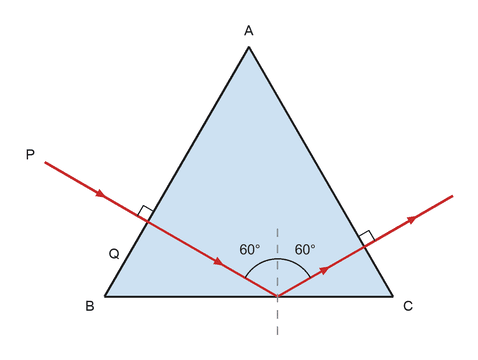
PQ meets AB normally, so it enters without bending.
Step 2 — At the base BC.
Because Q is low on AB, the ray reaches the base BC first. It travels at 30° to BC, so its angle of incidence is
60° is more than 42°, so it is totally internally reflected.
Step 3 — At AC.
The reflected ray meets face AC normally (i = 0°) and passes out into air without bending.
Step 4 — Deviation.
One reflection at 60° turns the ray through
Therefore, the ray enters undeviated, is totally reflected at the base (i = 60°), and leaves AC normally, deviated through 60°.