Solution:
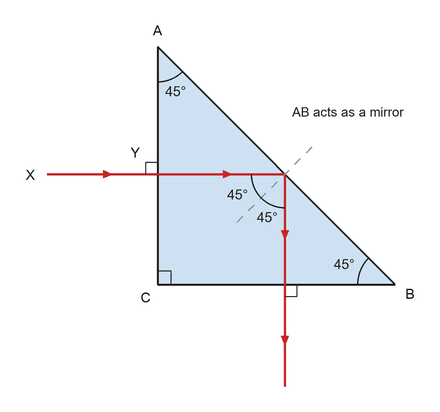
Concept: A total reflecting prism is a glass prism whose principal section is a right-angled isosceles triangle (90°, 45°, 45°). Light entering a face normally goes in without bending and meets the next face at 45°, which is more than the critical angle of glass (42°), so it is totally reflected there.
Step 1 — Follow the ray.
XY enters face AC normally and meets the hypotenuse AB at 45°. Since 45° is more than 42°, the ray is totally reflected and leaves vertically downward through face CB.
(a)
Step 2 — Angle of deviation.
The ray enters horizontally and leaves vertically, so it is deviated through 90°.
(b)
Step 3 — Instrument.
This action is used in a periscope.
(c)
Step 4 — The mirror face.
The hypotenuse face AB behaves as a mirror, because the ray is totally internally reflected there at 45°.
Therefore, (a) the ray is deviated through 90°, (b) in a periscope, and (c) face AB acts as a mirror.

