
Question 602 marksEasy
How does the angle of minimum deviation produced by a prism change with increase in (i) the wavelength of incident light, and (ii) the refracting angle of prism ?
Confirming your payment
Sign up now and get 250 free tokens.
Refraction of Light at Plane Surfaces · Question 60 of 139
How does the angle of minimum deviation produced by a prism change with increase in (i) the wavelength of incident light, and (ii) the refracting angle of prism ?
Solution:
Concept: The more strongly a prism bends light, the larger its minimum deviation δmin. The refractive index of a medium depends on the colour (wavelength) of light: it is greatest for violet (shortest wavelength) and least for red (longest wavelength). So violet light travels slowest in glass and bends the most.
(i) Increase in wavelength
Step 1 — Effect of wavelength.
The refractive index of glass is smaller for longer wavelengths, so light of longer wavelength (towards red) is bent less. So δmin decreases.
(ii) Increase in refracting angle
Step 2 — Effect of the refracting angle.
A larger angle between the faces makes the bends at the two faces larger, so δmin increases. For example, for glass of μ = 1.5, δmin is about 21.7° when A is 40° but about 37.2° when A is 60°.
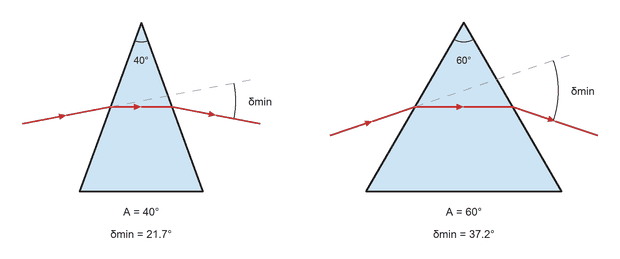
Therefore, δmin (i) decreases as the wavelength increases, and (ii) increases as the refracting angle increases.