
Opening your dashboard
Class 10 Physics Chapter 4 Refraction of Light at Plane Surfaces: Practice Questions
44 questions on Chapter 4, each worked through on its own page with the AI tutor. Class 10 Physics, ICSE 2026-27.
44 questions
1–5 marks · Mixed difficulty
- 11 mark
Question 1
Bloom's level: Remember
A beam of sunlight strikes a still lake at a slant. At the surface, part of the beam enters the water and changes its direction. This bending of the beam is known as :
- 21 mark
Question 2
Bloom's level: Remember
The critical angle for a glass-air boundary (for ordinary glass) is about :
- 31 mark
Question 3
Bloom's level: Understand
A ray of light passes obliquely from glass () into water (). On entering the water, the light :
- 41 mark
Question 4
Bloom's level: Apply
The refractive index of a transparent plastic is 1.25. If the speed of light in air is m s⁻¹, the speed of light in the plastic is :
- 51 mark
Question 5
Bloom's level: Apply
A tank is filled to a depth of 9 cm with a clear liquid of refractive index 1.5. A coin lying at the bottom, seen from directly above, appears to be at a depth of :
- 61 mark
Question 6
Bloom's level: Analyse
A student measured the angle of refraction for three angles of incidence as light passed from air into a transparent medium :
30° 0.500 19.5° 0.334 45° 0.707 28.1° 0.471 60° 0.866 35.3° 0.578 Which conclusion is supported by the data ?
- 71 mark
Question 7
Bloom's level: Understand
A ray of light falls obliquely on one face of a rectangular glass block and comes out from the opposite face. The emergent ray is :
- 81 mark
Question 8
Bloom's level: Evaluate
Rina says, "If a ray of light goes from air into water at a large enough angle of incidence, it will be totally internally reflected." Which is the best judgement ?
- 91 mark
Question 9
Bloom's level: Understand
Unlike a rectangular glass block, a prism does not give an emergent ray parallel to the incident ray. This is because :
- 101 mark
Question 10
Bloom's level: Understand
Read the Assertion (A) and the Reason (R) and choose the correct option.
Assertion (A): A straight pencil dipped obliquely in a glass of water appears bent at the water surface.
Reason (R): Light from the immersed part bends away from the normal on passing from water into air, so the immersed part appears raised.
- 111 mark
Question 11
Bloom's level: Remember
Read the Assertion (A) and the Reason (R) and choose the correct option.
Assertion (A): The critical angle of a given glass is the same for all colours of light.
Reason (R): The refractive index of a medium depends on the wavelength (colour) of light.
- 121 mark
Question 12
Bloom's level: Analyse
Read the Assertion (A) and the Reason (R) and choose the correct option.
Assertion (A): A well-cut diamond sparkles brilliantly.
Reason (R): The critical angle for a diamond-air boundary is large, about 48°.
- 131 mark
Question 13
Bloom's level: Remember
A ray of light falls on a rectangular glass block at an angle of incidence of 40°.
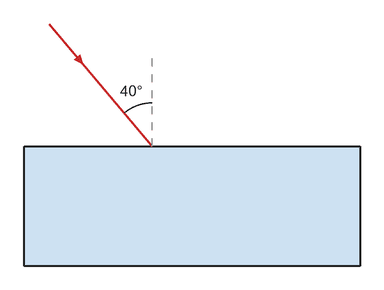
What is the angle of emergence of the ray from the opposite face ?
- 142 marks
Question 14
Bloom's level: Understand
A ray of light falling normally on the surface of water slows down on entering the water, yet it does not bend. Explain why.
- 152 marks
Question 15
Bloom's level: Apply
A ray of light passes from air into a liquid. The angle of incidence is 53° and the angle of refraction is 37°. Find the refractive index of the liquid and name a liquid that has this refractive index. (, )
- 162 marks
Question 16
Bloom's level: Apply
The speed of light is m s⁻¹ in medium A and m s⁻¹ in medium B. Find (a) the absolute refractive index of each medium, and (b) the refractive index of A with respect to B. ( m s⁻¹)
- 172 marks
Question 17
Bloom's level: Apply
A fish is swimming 1.2 m below the surface of a still pond. How deep does it appear to a person looking vertically down from above ? By how much does it appear to be raised ? (Refractive index of water )
- 182 marks
Question 18
Bloom's level: Apply
The refractive index of a transparent material is 2.0. Find its critical angle for a material-air boundary. What happens to a ray inside the material that strikes the surface at 35° ?
- 192 marks
Question 19
Bloom's level: Understand
Explain why total internal reflection can take place only when light travels from an optically denser medium to a rarer medium, and not the other way round.
- 202 marks
Question 20
Bloom's level: Analyse
Two rays of the same colour fall on the same rectangular glass block, one at an angle of incidence of 30° and the other at 60°. Which emergent ray has the greater lateral displacement ? Give a reason. Name one other factor on which the lateral displacement depends.
- 212 marks
Question 21
Bloom's level: Evaluate
A boy standing on the bank of a pond sees a fish in the water. He throws a spear aimed straight at where he sees the fish. Will he hit the fish ? Justify your answer and advise him where to aim.
- 222 marks
Question 22
Bloom's level: Analyse
For a glass prism of angle 60°, the angle of deviation was measured for different angles of incidence :
30° 40° 50° 60° 70° 47.1° 38.5° 37.2° 38.9° 42.9° (a) Estimate the angle of minimum deviation and the angle of incidence at which it occurs.
(b) How does the ray travel inside the prism in this position ?
- 234 marks
Question 23
Bloom's level: Apply
Light of wavelength 600 nm in air falls on a glass surface () at an angle of incidence such that . ( m s⁻¹)
(a) Find the angle of refraction.
(b) Find the speed of light in the glass.
(c) Find the frequency of the light, and its wavelength in the glass. Which of these two quantities does not change on refraction ?
- 244 marks
Question 24
Bloom's level: Apply
Case study: An aquarium shop owner fills a glass tank with water (refractive index ) to a depth of 20 cm. A coloured pebble lies at the bottom. Customers looking down vertically say the tank looks shallower than it is.
(a) At what depth does the pebble appear ?
(b) More water is added until the depth is 32 cm. Find the new apparent depth and the new shift of the pebble.
(c) In another tank filled to 15 cm with a different clear liquid, a pebble appears to be 12 cm deep. Find the refractive index of this liquid. Which tank looks relatively shallower ?
- 254 marks
Question 25
Bloom's level: Analyse
Case study: A science club builds a periscope. Instead of plane mirrors, they use two right-angled isosceles glass prisms (angles 90°, 45°, 45°), placed so that light enters one short face normally and strikes the long face (hypotenuse) from inside at 45°. The critical angle of the glass is 42°.

(a) Explain why the light is turned through 90° at each prism.
(b) Give two reasons why the prisms are better than plane mirrors.
(c) A member suggests using prisms of a cheaper plastic of refractive index 1.3. Will the periscope still work ? Show your reasoning.
- 264 marks
Question 26
Bloom's level: Evaluate
Case study: A trader claims that a sparkling stone is a real diamond. A gemmologist measures the critical angle of the stone for a stone-air boundary and finds it to be 41.8°. (Refractive index of diamond = 2.42; ; )
(a) Write the relation between critical angle and refractive index.
(b) Find the refractive index of the stone.
(c) Judge the trader's claim. What critical angle would a real diamond show ?
- 274 marks
Question 27
Bloom's level: Apply
A small lamp lies at the bottom of a pond 0.7 m deep. The refractive index of water is .
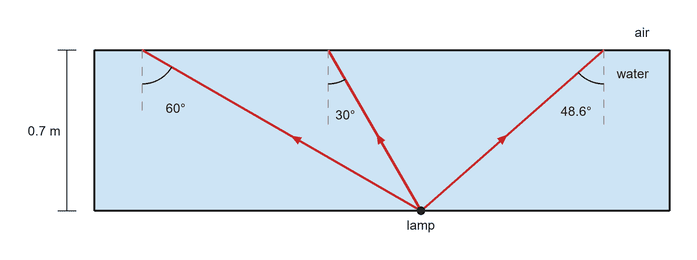
(a) Find the critical angle for the water-air boundary. ()
(b) Three rays from the lamp meet the water surface at angles of incidence of 30°, 48.6° and 60°. Describe what happens to each ray.
(c) Seen from above, light comes out only through a bright circle on the surface, directly above the lamp. Find its radius. ()
- 285 marks
Question 28
Bloom's level: Create
Plan an experiment to find the refractive index of the glass of a rectangular glass block using pins, a drawing board, white paper, a protractor and a scale.
(a) Describe the steps, including how you will trace the path of the ray through the block.
(b) State what you will measure and how you will calculate the refractive index.
(c) Make a table for three angles of incidence (30°, 45°, 60°) with sensible readings, and calculate the refractive index.
(d) State two precautions.
- 293 marks
Question 29
Bloom's level: Understand
(a) What is the cause of refraction of light ?
(b) A toy car rolls obliquely from a smooth floor onto a carpet, where it moves more slowly. One front wheel reaches the carpet before the other. Use this to explain why light bends towards the normal when it enters glass from air.
(c) Using the same idea, say which way light bends when it comes out of glass into air.
- 304 marks
Question 30
Bloom's level: Create
Design a classroom demonstration of total internal reflection using a transparent plastic box (or glass tank) filled with water, a few drops of milk, a laser pointer, and a little incense smoke above the water.
(a) Explain why the milk and the smoke are used.
(b) Describe how you will direct the laser beam and how you will vary the angle, and what the students will see as the angle of incidence increases.
(c) Explain how the students can estimate the critical angle for water, and state one safety precaution.
- 312 marks
Question 31
For a certain parallel-sided glass block, the value of is 1.50. A ray of light passes through the block and emerges at an angle of 60° to the surface of the block, as shown in the figure. Find the value of the angle marked .
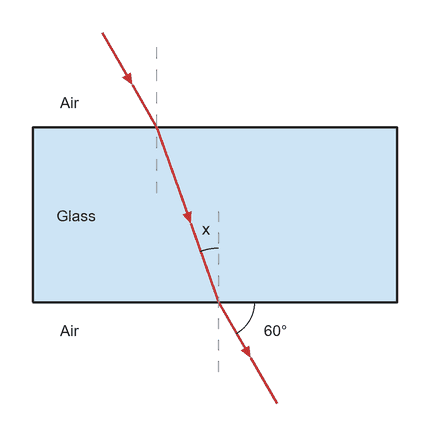
- 321 mark
Question 32
A ray of light travelling in a rarer medium meets the surface of a denser medium, as shown in the figure. Which ray represents the partially reflected ray ?
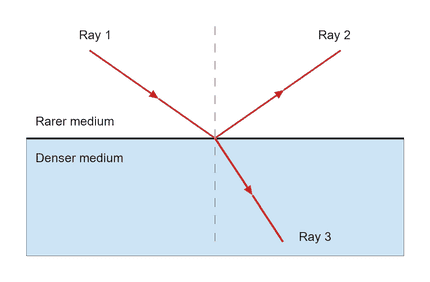
- 331 mark
Question 33
A ray of light travels from air into glass. The refractive index of the glass is 1.5. Which of the following pairs could be the values of the angle of incidence and the angle of refraction ?
- 342 marks
Question 34
The diagram below shows a ray of light incident on the face PQ of a rectangular glass block PQRS. The face RS of the block is silvered. At the face PQ, the ray is partly reflected and partly refracted.
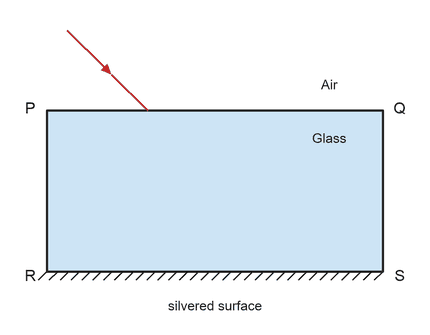
Draw a ray diagram to show the reflected and the refracted rays, and the path of the refracted ray till it comes out of the block.
- 351 mark
Question 35
A ray of light travelling in air falls on the surface of a transparent liquid at an angle of incidence of 45° and is refracted into the liquid at an angle of refraction of 30°. The refractive index of the liquid with respect to air is :
- 361 mark
Question 36
A beaker is filled with a clear liquid to a height of 12 cm. A mark at the bottom of the beaker, seen from vertically above, appears to be raised by 3 cm. The refractive index of the liquid is :
- 371 mark
Question 37
Assertion (A): The critical angle for a glass-air boundary is smaller for violet light than for red light.
Reason (R): The refractive index of glass is greater for violet light than for red light.
- 382 marks
Question 38
Light of frequency Hz travelling in air enters a transparent crystal of refractive index 2.4. The speed of light in air is m s.
(i) Calculate the speed of this light in the crystal.
(ii) Calculate the wavelength of this light in the crystal.
- 392 marks
Question 39
A ray of light of a single colour falls on one face of a rectangular glass block at an angle of incidence of 50° and comes out from the opposite face.

(i) State the angle of emergence. Give a reason for your answer.
(ii) The block is replaced by a thicker block of the same glass and the angle of incidence is kept at 50°. State how the lateral displacement of the ray changes.
- 402 marks
Question 40
A ray of monochromatic light falls on one face of an equilateral glass prism at an angle of incidence of 40°. It emerges from the other face at an angle of emergence of 58°.
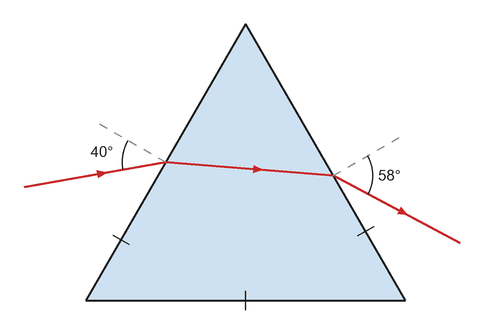
(i) Calculate the angle of deviation of the ray.
(ii) Is the prism in the position of minimum deviation for this ray ? Give a reason.
- 412 marks
Question 41
A coin lies at the bottom of an empty opaque cup. A girl moves back until the coin is just hidden from her eye by the edge of the cup. Without moving her head, she asks her friend to pour water slowly into the cup, and the coin comes into view again.

(i) Name the phenomenon of light responsible for this observation.
(ii) Explain why the coin becomes visible when water is poured into the cup.
- 424 marks
Question 42
A ray of light travels from a transparent liquid towards air. The refractive index of the liquid with respect to air is .
(i) Calculate the critical angle for the liquid-air boundary.
(ii) Calculate the angle of refraction in air when the ray meets the boundary at an angle of incidence of 30°.
(iii) State what happens to the ray when the angle of incidence is increased to 60°. Give a reason.
- 433 marks
Question 43
The diagram shows a semicircular glass block with its flat face AB in contact with air. A ray of monochromatic light PO enters the block through the curved face along a radius and meets the flat face at its centre O at an angle of incidence of 30°. The critical angle for the glass-air boundary is 42°.
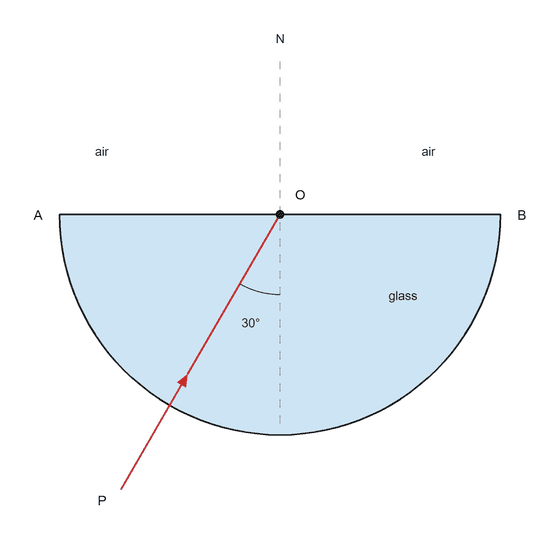
(i) Why does the ray PO not bend when it enters the block at the curved face ?
(ii) Describe the path of the ray after it meets the flat face at O.
(iii) The ray is now turned so that it still travels along a radius but meets the flat face at O at an angle of incidence of 50°. Name the phenomenon that takes place at O and state the angle which the ray makes with the normal after meeting the flat face.
- 444 marks
Question 44
A black dot is marked on a sheet of paper. A rectangular glass slab 6 cm thick is placed over the dot and the dot is viewed from vertically above. The refractive index of glass is 1.5.
(i) Calculate the apparent depth of the dot below the top face of the slab.
(ii) By how much does the dot appear to be raised ?
(iii) The slab is removed and the dot is now seen through a layer of water 6 cm deep (refractive index of water ). Calculate the shift of the dot now and state whether it is more or less than the shift with the glass slab.