Answer: (D) assertion is true but reason is false
Concept: Total internal reflection happens when light goes from a denser to a rarer medium and meets the surface at an angle of incidence greater than the critical angle. Then no light is refracted out: all of it is reflected back into the denser medium, obeying the laws of reflection.
Step 1 — Judge the assertion.
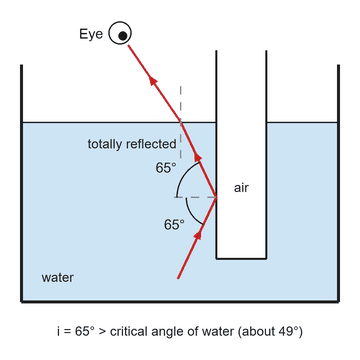
An empty test tube dipped in water looks shiny, like silver, when seen from a suitable direction. The assertion is true.
Step 2 — Judge the reason.
Light in the water (denser) meets the water–air boundary at the wall of the tube (air inside is rarer). When its angle of incidence is more than the critical angle of water (about 49°), no light enters the tube: all of it is totally reflected to the eye. So the shine is due to total internal reflection, not refraction. The reason is false.
Step 3 — A check.
If water is poured into the tube, there is no water–air boundary at the wall, total internal reflection stops, and the shine disappears.
Why the other options are wrong:
- (A) both A and R are true and R is the correct explanation of A: it needs the reason to be true, but the reason is false.
- (B) both A and R are True and R is not the correct explanation of A: it needs the reason to be true, but the reason is false.
- (C) assertion is false but reason is true: the assertion is true, not false.
Therefore, the assertion is true but the reason is false, option (D).
