
Question 1374 marksMedium
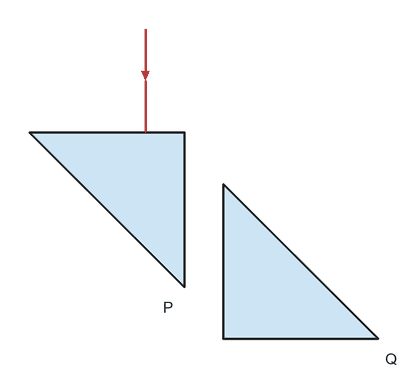
Two isosceles right-angled glass prisms P and Q are placed near each other as shown in Fig. 4.69. Complete the path of the light ray entering the prism P till it emerges out of the prism Q.
Confirming your payment
Sign up now and get 250 free tokens.
Refraction of Light at Plane Surfaces · Question 137 of 139
Two isosceles right-angled glass prisms P and Q are placed near each other as shown in Fig. 4.69. Complete the path of the light ray entering the prism P till it emerges out of the prism Q.
Solution:
Concept: A total reflecting prism is a glass prism whose principal section is a right-angled isosceles triangle (90°, 45°, 45°). Light entering a face normally goes in without bending and meets the next face at 45°, which is more than the critical angle of glass (42°), so it is totally reflected there.
Step 1 — In prism P.
The ray enters the top face normally and meets the hypotenuse at 45°, more than 42°. It is totally reflected through 90°, travels horizontally and leaves P's vertical face normally.
Step 2 — In prism Q.
The ray enters Q's vertical face normally, meets Q's hypotenuse at 45° and is totally reflected again through 90°. It travels downward and leaves Q's bottom face normally.

Step 3 — Result.
The two 90° turns are in opposite senses, so the ray finally travels vertically downward, parallel to the original ray but shifted sideways, as in a prism periscope.
Therefore, the ray emerges from Q travelling downward, parallel to the incident ray and displaced sideways.