
Question 714 marksEasy
What do you understand by the deviation produced by a prism ? Why is it caused ? State three factors on which the angle of deviation depends.
Confirming your payment
Sign up now and get 250 free tokens.
Refraction of Light at Plane Surfaces · Question 71 of 139
What do you understand by the deviation produced by a prism ? Why is it caused ? State three factors on which the angle of deviation depends.
Solution:
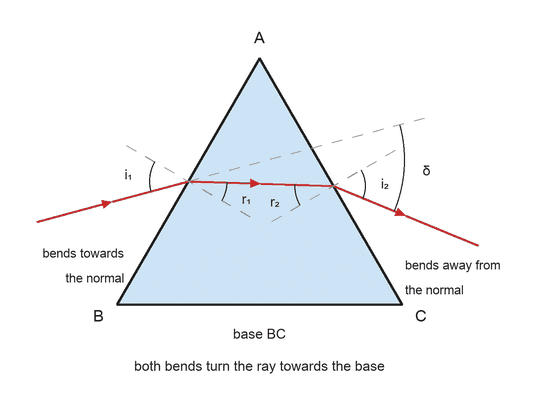
Concept: A prism refracts a ray twice, at two faces inclined at the angle of the prism A. Inside, the angles of refraction at the two faces add up to A (r₁ + r₂ = A); the total turning of the ray is the angle of deviation (δ = i₁ + i₂ − A), where i₁ is the angle of incidence and i₂ the angle of emergence. Both bends turn the ray towards the base of the prism.
Step 1 — What deviation is.
When a ray passes through a prism it bends towards the base at both faces, so it leaves in a different direction. The angle between the incident ray (produced) and the emergent ray is the angle of deviation δ.
Step 2 — Why it is caused.
It is caused by refraction at the two inclined faces: at the first face (air to glass) the ray bends towards the normal, and at the second (glass to air) away from the normal. Since the faces are not parallel, both bends turn the ray towards the base and add up.
Step 3 — Three factors.
The angle of deviation depends on (1) the angle of incidence (it first decreases, reaches a minimum, then increases); (2) the material of the prism (higher μ, more deviation); (3) the wavelength (colour) of light (violet most, red least). It also depends on the refracting angle.
Therefore, deviation is the turning of a ray by the prism, caused by refraction at its two inclined faces, and it depends on the angle of incidence, the material and the wavelength of light.