Solution:
Concept: As the angle of incidence increases, the deviation produced by a prism first decreases, reaches a minimum δmin, and then increases. At minimum deviation the ray passes symmetrically: the angles of incidence and emergence are equal (each i), r₁ and r₂ are each A/2, the ray inside is parallel to the base, and δmin = 2i − A.
(a) Change with the angle of incidence
Step 1 — Describe the change.
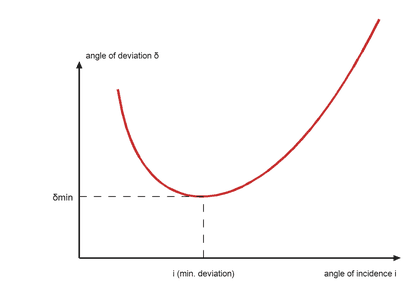
As the angle of incidence increases, the angle of deviation first decreases, reaches a minimum value δmin, and then increases again. The graph of δ against i is a U-shaped curve.
(b) Why δmin is unique
Step 2 — A line above the minimum.
Draw a horizontal line at any deviation δ₁ above the minimum. It cuts the curve at two points, so that deviation is produced by two different angles of incidence (each is the angle of emergence of the other, since the path can be reversed).
Step 3 — The line at the minimum.
At the lowest point the horizontal line only touches the curve, at one point. So just one angle of incidence (where i₁ and i₂ are equal) gives the least deviation.
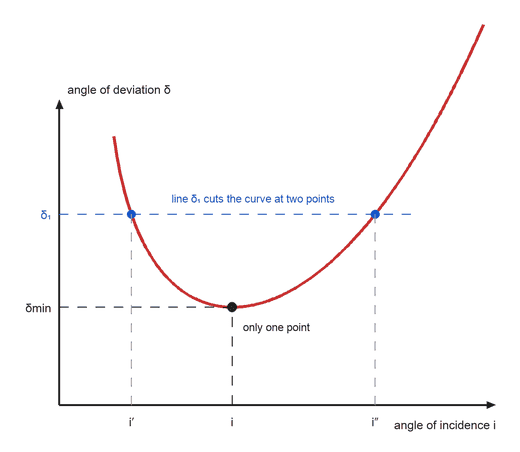
Therefore, the deviation first decreases and then increases with i, and since only one point of the curve gives the least deviation, δmin is unique for a given prism and wavelength.
