Solution:
Concept: The refractive index of a medium depends on the colour (wavelength) of light: it is greatest for violet (shortest wavelength) and least for red (longest wavelength). So violet light travels slowest in glass and bends the most.
Step 1 — Compare the speeds.
Blue light has a shorter wavelength than red light, and in glass it travels slower than red light.
Step 2 — Compare the refractive indices.
μ = speed in air ÷ speed in glass, so the smaller speed of blue light gives a larger refractive index: μ for blue > μ for red. For the same angle of incidence, blue light bends more.
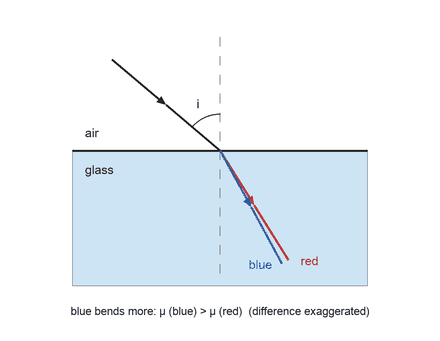
Therefore, the refractive index will be different: it is more for blue light than for red light, because the refractive index depends on the wavelength (colour) of light.
