Solution:
Concept: A ray crossing a parallel-sided glass slab is refracted twice: towards the normal on entering (air to glass) and away from the normal on leaving (glass to air). Because the two faces are parallel, the angle of emergence e equals the angle of incidence i, so the emergent ray is parallel to the incident ray, only shifted sideways (lateral displacement). A ray incident normally does not bend at all.
(i) i = 0°
Step 1 — Follow the normal ray.
The ray falls along the normal, so r = 0°. It passes straight through both faces without bending and comes out along the same line: no deviation and no lateral displacement.
(ii) i = 45°
Step 2 — At the top face.
The ray bends towards the normal. For glass of μ = 1.5, Snell's law gives
sinrr=1.5sin45∘=0.471≈28.1∘
Step 3 — At the bottom face.
The ray meets the bottom face at 28.1° and bends away from the normal, emerging at 45°. The emergent ray is parallel to the incident ray but laterally displaced.
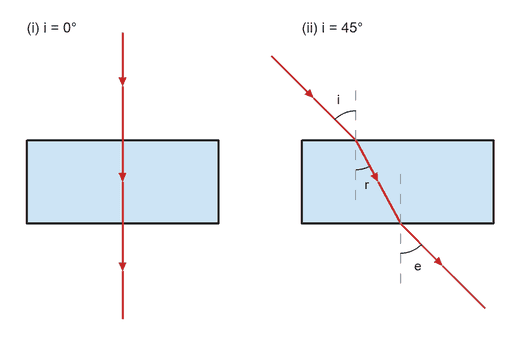
Therefore, at 0° the ray goes straight through undeviated; at 45° it bends to about 28° inside and emerges at 45°, parallel to the incident ray and shifted sideways.
