
Question 414 marksEasy
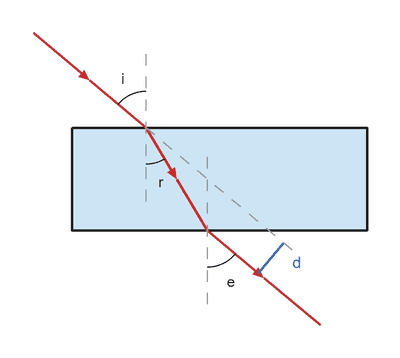
What is lateral displacement ? Draw a ray diagram showing the lateral displacement of a ray of light when it passes through a parallel sided glass slab.
Confirming your payment
Sign up now and get 250 free tokens.
Refraction of Light at Plane Surfaces · Question 41 of 139
What is lateral displacement ? Draw a ray diagram showing the lateral displacement of a ray of light when it passes through a parallel sided glass slab.
Solution:
Concept: A ray crossing a parallel-sided glass slab is refracted twice: towards the normal on entering (air to glass) and away from the normal on leaving (glass to air). Because the two faces are parallel, the angle of emergence e equals the angle of incidence i, so the emergent ray is parallel to the incident ray, only shifted sideways (lateral displacement).
Step 1 — Define lateral displacement.
The lateral displacement is the perpendicular distance between the path of the incident ray (produced forward) and the emergent ray when light passes obliquely through a parallel-sided glass slab. It is marked d in the figure.
Step 2 — Read the diagram.
The incident ray bends towards the normal inside the slab (r < i) and away from the normal on leaving (angle of emergence e = i), so the emergent ray is parallel to the incident ray. The dashed line is the incident ray produced, and d is measured at right angles to both.
Step 3 — What d depends on.
d is larger for a thicker slab, for a larger angle of incidence and for a larger refractive index (so it is more for violet light than for red light).
Therefore, lateral displacement is the perpendicular distance between the incident ray produced and the emergent ray, which are parallel.