Refraction of Light at Plane Surfaces · Question 40 of 139
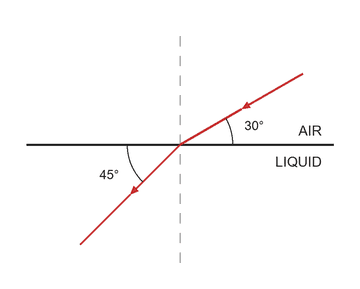
The diagram alongside shows the refraction of a ray of light from air to a liquid.
Question 404 marksEasy
The diagram alongside shows the refraction of a ray of light from air to a liquid.
(a) Write the values of (i) angle of incidence, and (ii) angle of refraction.
(b) Use Snell's law to find the refractive index of liquid with respect to air.
Solution:
Concept: The angles marked in the figure are measured from the surface. The angles of incidence and refraction are measured from the normal, so each is 90° minus the marked angle. Snell's law: for light going from medium 1 into medium 2, sin i ÷ sin r = ₁μ₂, a constant called the refractive index of medium 2 with respect to medium 1. Here i is the angle of incidence and r the angle of refraction, both measured from the normal.
(a)
Step 1 — Angle of incidence.
(i) The incident ray makes 30° with the surface, so its angle with the normal is
i=90∘−30∘=60∘
Step 2 — Angle of refraction.
(ii) The refracted ray makes 45° with the surface, so
r=90∘−45∘=45∘
(b)
Step 3 — Apply Snell's law.
Divide sin i by sin r.
μ=sin45∘sin60∘=1/23/2=23=1.5≈1.22
Step 4 — Check the answer.
r (45°) is less than i (60°), so the ray bent towards the normal, as expected for a liquid denser than air; and μ is more than 1.
Watch out: Angles of incidence and refraction are measured from the normal, never from the surface.
Therefore, (a) i = 60° and r = 45°, and (b) the refractive index of the liquid is √1.5 ≈ 1.22.