
Opening your dashboard
Class 10 Physics Chapter 4 Refraction of Light at Plane Surfaces: Competency-Based Questions (CBQ)
40 questions on Chapter 4, each worked through on its own page with the AI tutor. Class 10 Physics, ICSE 2026-27.
40 questions
1–5 marks · Mixed difficulty
- 11 mark
Question 1
Competency: Understanding & Application
When light enters from air to glass, it bends toward the normal. If red, blue, and yellow colours are allowed to enter the same glass block at the same angle of incidence, then for which colour, the value of , be greater?
- 21 mark
Question 2
Competency: Understanding & Analysis
Assertion (A): When light passes through a triangular prism, it is observed that for two angles of incidence, the angle of deviation is the same.
Reason (R): According to the principle of reversibility, the light retraces the path in reversing the direction.
- 31 mark
Question 3
Competency: Understanding
Assertion: For a glass block, the vs. graph is a straight line.
Reason: When a ray of light undergoes refraction, it follows Snell's law.
- 41 mark
Question 4
Competency: Analysis
A student traces the path of a ray of light through a glass prism for different angles of incidence. He analyses each diagram and draws the following conclusion:
I. On entering the prism, the light ray bends towards its base.
II. Light ray suffers refraction at the point of incidence and at the point of emergence while passing through the prism.
III. An emergent ray bends at a certain angle to the direction of the incident ray.
IV. While emerging from the prism at the second surface, the angle of refraction is less than the angle of incidence at that surface.
Which of the above inferences are correct?
- 51 mark
Question 5
Competency: Analysis
A ray of light passes obliquely from an optical medium of refractive index 1.33 to another medium of refractive index 1.5. While passing from the first medium to the second, the light ray will:
- 62 marks
Question 6
Competency: Recall & Understanding
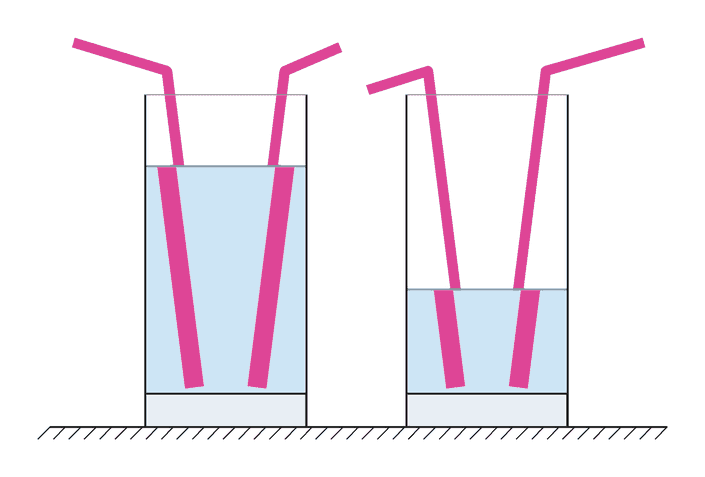
The diagram shows straw partially immersed in water in the glasses.
(a) Why does the straw in water appear thicker as compared to the straw outside water?
(b) Why does the straw appear discontinuous in water?
- 72 marks
Question 7
Competency: Recall, Analysis & Application
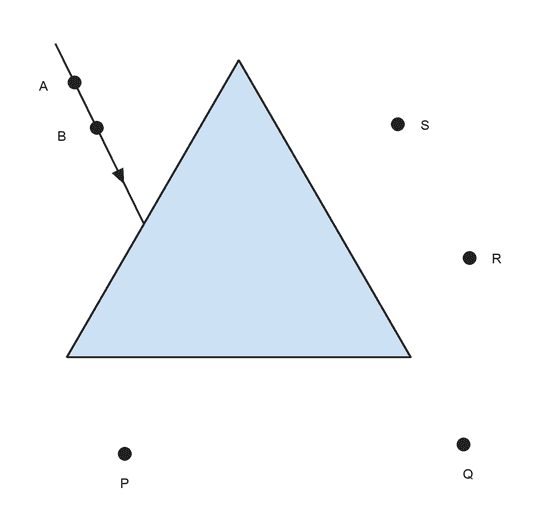
The above diagram shows a triangular prism used for tracing the path of ray AB due to the refraction through the prism. Observe the diagram and answer the following:
(a) State the correct eye position from the points P, Q, R and S to see the images of the points A and B in the same line through the prism.
(b) If the ray, after entering the prism, suffers total internal reflection, then which would be the appropriate position out of P, Q, R, and S to see the image due to TIR?
- 83 marks
Question 8
Competency: Understanding
In a science exhibition, boys of a Secondary school made two types of periscopes. In one of the periscopes, ordinary glass was used as the reflecting material, while in the other, a prism was used.
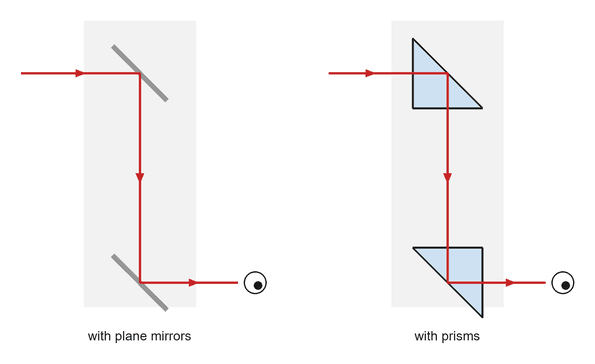
When Anushka put her eyes on the eyepiece of the periscope, she saw that the image formed in one of the periscopes was quite bright, while in the other, it was dimmer.
(a) In which of the two periscopes, mirror or prism, Anushka saw the image brighter?
(b) Why is one of the images brighter than the other?
- 93 marks
Question 9
Competency: Analysis & Application
ABC is a glass block whose two sides, AB and BC, are at right angles to each other. A ray of light is incident on the surface AB, as shown in the diagram, and suffers total internal reflection before falling on the surface BC. Finally, the light ray emerges out along the surface BC.
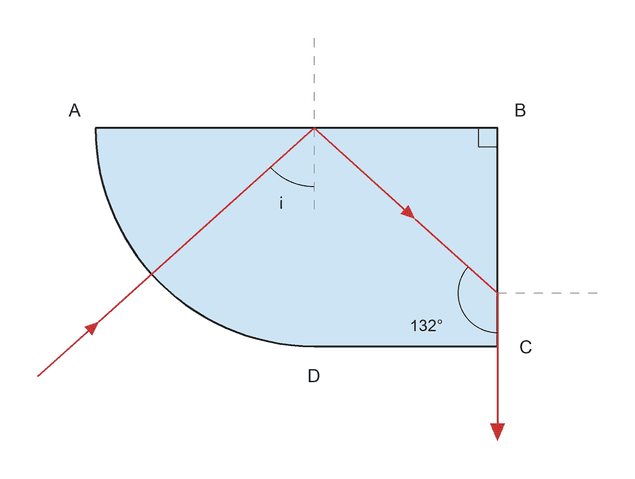
(a) What is the angle of incidence at the surface AB?
(b) What is the critical angle for the glass block BC?
(c) What would happen to the critical angle if the temperature of the glass block is increased?
- 104 marks
Question 10
Competency: Application & Evaluation

The above diagram shows a glass prism of a critical angle 42°.
(a) Redraw the diagram and complete the path of the light ray PQ till it emerges out of the prism.
(b) Also, calculate the net angle of deviation of the ray PQ when it emerges from the prism.
- 114 marks
Question 11
Competency: Understanding & Analysis
You are doing an experiment on the refraction of light in your Physics laboratory. ABCD is a rectangular block. A ray of light is incident obliquely on the surface AB.
(a) Draw the path of the ray of light through the glass block and also show how it emerges from the block. [The diagram should show the lateral displacement suffered by the ray.]
(b) Which two pairs of angles remain the same during the experiment?
(c) If the same experiment is performed first with red and then with blue light, which colour will suffer greater lateral displacement?
- 124 marks
Question 12
Competency: Understanding & Analysis
In the given diagram, two transparent optical media are shown. The rarer medium is air, while the denser medium is water. Redraw the diagram by showing the paths of the rays after striking the surface of separation AD for the incident rays OA, OB, OC and OD, respectively. (Critical angle for the denser medium = 48°)

- 134 marks
Question 13
Competency: Analysis & Evaluation
Case study: A group of students pours a liquid into a tall glass jar in steps. At each step they read the real depth of the liquid from a scale fixed along the jar and measure the apparent depth of a mark on the bottom of the jar, seen from vertically above. They repeat the work with a second liquid and plot the graph below for the two liquids P and Q.
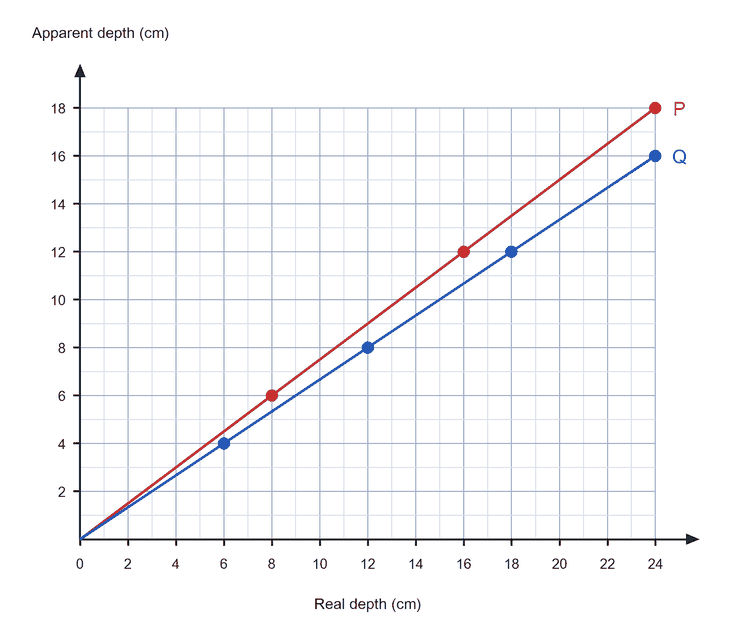
(a) What does a straight line through the origin tell about the real depth and the apparent depth ? Use the graph to find the refractive index of liquid P.
(b) Which of the two liquids is optically denser ? Justify your answer by finding the refractive index of liquid Q from the graph.
(c) A tank is filled with liquid Q to a depth of 24 cm. Find the apparent depth of a mark on its bottom, seen from vertically above, and the shift of the mark. Meena says, "If the tank is filled with liquid P to the same depth, the mark will appear raised by a larger amount, because the line of P is higher on the graph." Judge her statement.
- 144 marks
Question 14
Competency: Application & Evaluation
Case study: A company that makes lenses and prisms tests each transparent material by measuring the speed of yellow light in it. A part of its data sheet is given below. The speed of light in air may be taken as m s.
Material Speed of yellow light (m s) Water Crown glass Flint glass Diamond (a) Calculate the refractive index of crown glass and of diamond. Which material in the table is optically the densest ?
(b) The yellow light has a wavelength of 600 nm in air. Find its frequency, and its wavelength in crown glass.
(c) A ray of this light passes obliquely from water into crown glass. Find the refractive index of crown glass with respect to water, and state which way the ray bends. A trainee says, "The table shows that red light and violet light also travel at m s in crown glass." Judge his statement.
- 154 marks
Question 15
Competency: Analysis & Application
Case study: A jeweller shows a customer two stones cut in exactly the same shape, a diamond and a cheaper imitation made of glass. Under the same lamp the diamond sparkles far more than the imitation. The jeweller's chart gives the data below.
Stone Refractive index Critical angle (stone to air) Diamond 2.42 24° Glass imitation 1.50 42° (a) A ray of light travelling inside each stone meets a face at an angle of incidence of 30°. State, with a reason, what happens to this ray in the diamond and in the glass imitation.
(b) Inside a cut stone, rays meet the faces at many different angles of incidence between 0° and 90°. For each stone, find the range of angles of incidence over which a ray is totally reflected, and use it to explain why the diamond sparkles more.
(c) The diamond is now dipped in water of refractive index 1.33. Find the critical angle for light going from diamond to water, to the nearest degree (sin 33° = 0.545, sin 34° = 0.559). Will the diamond sparkle more or less in water than in air ? Give a reason.
- 164 marks
Question 16
Competency: Analysis & Creation
Riya traces a ray of light through a rectangular glass block for one angle of incidence and measures and . Her friend Kabir looks at the two numbers and says, "The refractive index of glass is simply , which comes to about 1.5." Riya has the glass block, a drawing board, sheets of white paper, four pins, a protractor, a scale and a table of sines.
(a) Show by calculation why this single pair of readings cannot decide whether Kabir is right.
(b) Design an experiment, using only the things Riya has, to test Kabir's statement. Describe the steps and the readings to be taken.
(c) State how the readings should be worked out to reach a conclusion and what result Riya should expect. Give two precautions that make the readings reliable.
- 171 mark
Question 17
Competency: Analysis & Application
A narrow ray of one colour of light passes down through three parallel layers P, Q and R of transparent media, as shown. The angles that the ray makes with the normal in the three layers are marked in the figure. (Hypothetical data.)
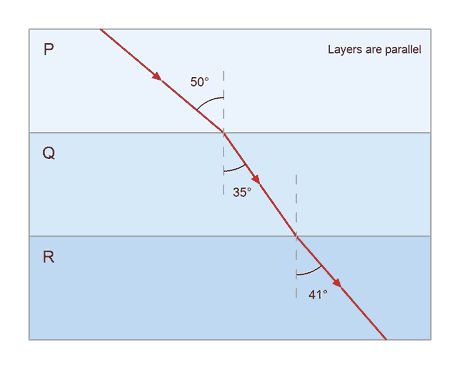
In which option are the layers arranged in the order of decreasing speed of light in them?
- 181 mark
Question 18
Competency: Analysis & Application
In a test on a sheet of transparent plastic, a laser beam travelling inside the plastic is turned slowly until the refracted beam in the air just grazes the surface. The angle of incidence in the plastic at this stage is . Take and the speed of light in air as . (Hypothetical data.)
Which option gives the refractive index of the plastic and the speed of light in it?
- 191 mark
Question 19
Competency: Analysis & Understanding
Sana has three prisms, each with a refracting angle of : a hollow prism made of thin glass plates and left empty (full of air), the same hollow prism filled with water (), and a solid glass prism (). She sends a ray of one colour on to each prism at the same angle of incidence, , and measures the angle of deviation. (Hypothetical data.)
Which option lists the three prisms in the order of increasing angle of deviation?
- 201 mark
Question 20
Competency: Analysis & Evaluation
Assertion (A): A ray of light travelling in water meets the water–air surface at an angle of incidence of . The ray is totally reflected back into the water.
Reason (R): The critical angle for water and air is about , and total internal reflection occurs only when the angle of incidence in the denser medium is greater than the critical angle.
- 211 mark
Question 21
Competency: Understanding & Analysis
Assertion (A): A beam of blue light does not change its colour when it passes from air into glass, although its speed decreases.
Reason (R): The frequency of light remains the same when it passes from one medium into another.
- 221 mark
Question 22
Competency: Understanding & Analysis
A doctor's endoscope carries light into the body along a bundle of thin glass fibres. A technician notices that the fibres carry the light well around gentle curves, but some light leaks out through the side of a fibre at a place where it is bent very sharply.
Which statement best explains the leak at the sharp bend?
- 231 mark
Question 23
Competency: Understanding
Ravi sees the Sun's upper edge at the horizon on a clear morning at a time when, if the Earth had no atmosphere, the Sun would still be a little below the horizon. The air near the ground is denser than the air higher up, so the refractive index of the atmosphere increases towards the ground.
Which statement explains what Ravi observes?
- 241 mark
Question 24
Competency: Understanding & Analysis
Meera lists four everyday observations in her notebook. Three of them are consequences of total internal reflection, and one is a consequence of ordinary refraction only.
Which observation is due to refraction only, and not to total internal reflection?
- 251 mark
Question 25
Competency: Analysis & Application
Arjun traces a ray of light through a rectangular glass block () kept in air, with an angle of incidence of . He then places the same block at the bottom of a glass tank full of water () and sends a ray through the water on to the block, again at . (Hypothetical data.)
Which statement correctly compares the ray through the block in water with the ray through the block in air?
- 261 mark
Question 26
Competency: Analysis & Application
A jeweller washes a cut diamond () in a dish of water () and notices that it sparkles less under water than in air. Inside the diamond, a ray of light meets a diamond–water face at gradually increasing angles of incidence. Take , , and . (Hypothetical data.)
At what angle of incidence will the ray just begin to be totally reflected at the diamond–water face?
- 272 marks
Question 27
Competency: Understanding & Analysis
Neha shines a thin torch beam from the air on to the surface of clear water in a glass tank, at to the normal. She notices two things. A faint beam is thrown back from the water surface into the air. The beam that enters the water bends at the surface and then goes on in a straight line to the bottom of the tank.
(a) Why is a faint beam thrown back, and why is the beam that enters the water less bright than the torch beam?
(b) Why does the beam bend only at the surface and not go on bending as it goes deeper into the water?
- 282 marks
Question 28
Competency: Application
An engineer compares two ways of sending a pulse of light over a distance of 30 cm. In the first way the light travels through air. In the second way it travels along a glass rod 30 cm long, of refractive index 1.5. The speed of light in air may be taken as . (Hypothetical data.)
(a) Find the time taken by the pulse to cover the 30 cm in air and in the glass rod.
(b) By how much longer does the pulse take in the glass rod, and why?
- 292 marks
Question 29
Competency: Application & Analysis
A small pebble lies at the bottom of a tall glass jar. The jar holds 12 cm of water (), with a 4.5 cm layer of a clear oil () floating on top. Seen from vertically above, each layer raises the image of the pebble by its own amount, so the apparent depth of the pebble below the top surface is . (Hypothetical data.)
(a) Find the apparent depth of the pebble below the top surface of the oil.
(b) By how much does the pebble appear to be raised, and which layer raises it more?
- 302 marks
Question 30
Competency: Creativity & Understanding
Rekha notices that when she looks at a distant electric pole through the air just above a burning stove, the pole seems to wave and shimmer, although it is not moving. Her teacher says that this is linked to the twinkling of a star at night.
(a) Suggest a simple, safe activity with a burning candle, a teacher or an adult present, that shows this effect, and say what you will observe.
(b) Explain why the pole shimmers, and how the same cause makes a star twinkle.
- 312 marks
Question 31
Competency: Evaluation & Analysis
In a laboratory, a laser beam travels upwards inside a glass tank of water and meets the water–air surface at an angle of incidence of . At 20 °C the refractive index of the water is 1.333 and its critical angle is , so the beam is totally reflected. The water is then warmed to 60 °C, and its refractive index falls to 1.327. Use . (Hypothetical data.)
A student says, "Warming the water makes no difference, because the angle of incidence is still ."
(a) Find the critical angle of the warm water for air.
(b) Judge the student's statement.
- 323 marks
Question 32
Competency: Evaluation & Analysis
A student traces a ray through a glass slab and measures the angle of incidence and the angle of refraction for four settings. One of her four readings is faulty. (Hypothetical data.)
Reading 1 2 3 4 Use , , , , , , , , , , .
(a) Work out for each reading.
(b) Which reading is faulty? Give a reason.
(c) Find the refractive index of the glass from the good readings, and say what the angle of refraction in reading 3 should have been (nearest degree).
- 333 marks
Question 33
Competency: Application & Analysis
Asha traces the path of a ray of light through a rectangular glass block ABCD, 4.0 cm thick, kept on a sheet of paper. The ray falls on the face AB at the point P at an angle of incidence of and leaves the face DC at the point Q. She draws the normal at P, which meets DC at N, and measures NQ = 3.0 cm, as shown in the figure. Take . (Hypothetical data.)
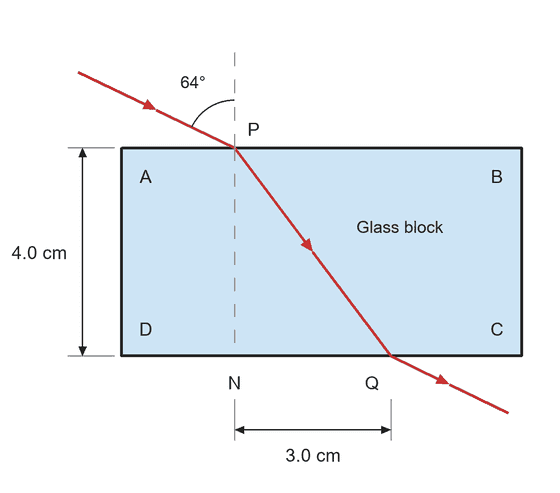
(a) Find the length PQ of the path of the ray inside the block.
(b) Use the triangle PNQ to find the sine of the angle of refraction at P, and hence find the refractive index of the glass.
(c) Asha repeats the tracing with a block of the same thickness made of a glass of larger refractive index, keeping the angle of incidence at . Will the distance NQ now be more than, equal to or less than 3.0 cm? Give a reason.
- 343 marks
Question 34
Competency: Analysis & Application
A thin glass prism has a refracting angle . For a prism with a small angle, the angle of deviation is . The refractive index of this glass is 1.51 for red light and 1.53 for violet light. (Hypothetical data.)
(a) Find the angle of deviation for red light and for violet light.
(b) Which colour is deviated more, and what is the angle between the emergent red and violet rays?
(c) A second prism of the same glass is to deviate red light by twice as much as the first prism does. Find its refracting angle.
- 353 marks
Question 35
Competency: Application & Evaluation
Mrs Kapoor runs a gift shop. She wants to display a small medal at the bottom of a tall glass jar filled with a clear liquid, so that the medal, seen from vertically above, appears to lie 7.5 cm below the surface of the liquid. The jar is 10.5 cm tall on the inside. She has two clear liquids: water () and a cooking oil (). Ignore the thickness of the glass bottom. (Hypothetical data.)
(a) Find the depth of water, and the depth of oil, that would make the medal appear 7.5 cm deep.
(b) Which liquid can she use in this jar? Give a reason.
(c) With the liquid she can use, by how much does the medal appear to be raised?
- 363 marks
Question 36
Competency: Analysis & Application
A long, straight rod of glass of refractive index 1.5 has flat polished ends and smooth sides. The critical angle of the glass for air is . A ray of light falls on one flat end at an angle of incidence of , as shown. Use . (Hypothetical data.)
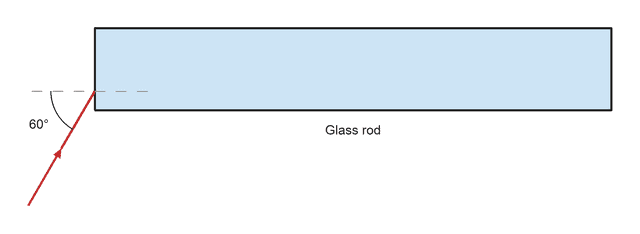
(a) Find the angle of refraction at the end of the rod.
(b) Find the angle of incidence at which the ray first meets a side of the rod, and say what happens to it there.
(c) Explain why the ray cannot escape through the sides even if the angle of incidence at the end is increased to .
- 374 marks
Question 37
Competency: Analysis & Application
Case study: In the school physics club, Tara has to find out which liquid is present in a sealed glass trough. She sends a thin ray of light from the air into the liquid at five different angles of incidence and measures the angle of refraction each time. Her readings are in the table below. The club's data sheet gives the refractive indices of three possible liquids: water 1.33, glycerine 1.47 and carbon disulphide 1.63. The speed of light in air is . (Hypothetical data.)
0.342 0.233 0.500 0.342 0.643 0.438 0.766 0.522 0.866 0.588 (a) Work out for the five readings. What do the values show?
(b) Find the refractive index of the liquid from the readings, name the liquid, and find the speed of light in it.
(c) Predict the angle of refraction for (use , and ). Explain why, for this liquid, the angle of refraction can never be larger than about , however large the angle of incidence.
- 384 marks
Question 38
Competency: Evaluation & Analysis
Case study: A small lamp is fixed at the middle of the floor of a decorative pool in a hotel garden. At night, a bright circle of light is seen on the surface above the lamp, and the surface outside it looks dark from above. A gardener measures the radius of the bright circle as 0.90 m. With a tape held straight from the lamp to the edge of the circle, he finds this distance to be 1.20 m, as shown in the figure. The edge of the circle is where rays from the lamp meet the surface at exactly the critical angle . (Hypothetical data.)
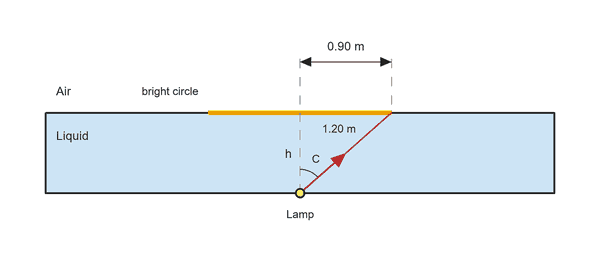
(a) Use the right-angled triangle in the figure to find , and hence the refractive index of the liquid in the pool. Is the pool filled with water ()?
(b) Find the depth of the pool.
(c) The hotel manager says, "If we fix the same lamp at the bottom of a pool twice as deep, filled with the same liquid, the bright circle will be twice as wide." Judge this statement.
- 394 marks
Question 39
Competency: Analysis & Evaluation
Case study: A class traces a ray through two rectangular blocks cut from the same glass. One block is 6 cm thick and the other is 9 cm thick. For several angles of incidence, they measure the lateral displacement of the emergent ray, that is, the sideways shift between the incident ray (extended straight) and the emergent ray. The readings are in the table. (Hypothetical data.)
Angle of incidence Displacement, 6 cm block (mm) 5.4 11.6 19.7 30.7 44.9 Displacement, 9 cm block (mm) 8.1 17.4 29.6 46.1 67.3 (a) Describe how the displacement changes as the angle of incidence increases. What would you expect at , and why?
(b) Compare the two blocks at the same angle of incidence. What conclusion can you draw about the effect of thickness?
(c) A student says, "Doubling the angle of incidence doubles the lateral displacement." Test this statement with the 6 cm block.
- 405 marks
Question 40
Competency: Analysis & Application
Case study: Zara sends a ray of light from inside a thick block of glass towards the glass–air surface. For each angle of incidence she measures the angle of refraction in the air, and plots her readings as dots on the graph below. She joins the dots with a smooth curve. She wants to use the graph to study the critical angle of the glass and to compare it with a diamond, whose refractive index is 2.42. Take , , and . (Hypothetical data.)
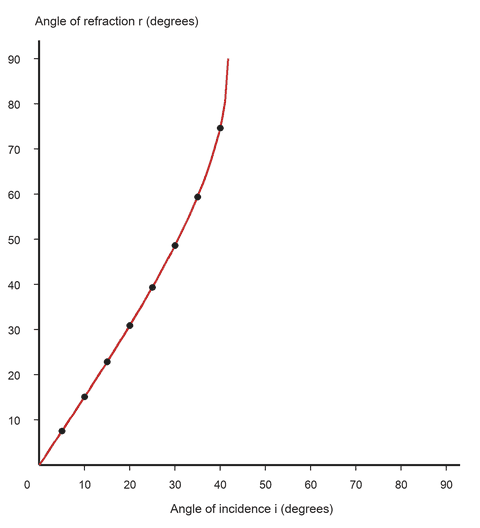
(a) Describe how changes as increases. From the graph, read the angle of incidence at which becomes , and name this angle.
(b) Use this value to find the refractive index of the glass. Read the value of for from the graph and check it by calculation.
(c) What happens to the ray when is larger than the angle found in (a)? For the diamond, find where the curve would end, and say whether it would lie above or below Zara's curve.