Solution:
Concept: Total internal reflection happens when light goes from a denser to a rarer medium and meets the surface at an angle of incidence greater than the critical angle. Then no light is refracted out: all of it is reflected back into the denser medium, obeying the laws of reflection. At each surface, find the angle of incidence from the normal and compare it with the critical angle, 42°.
Step 1 — At the curved surface.
The ray is aimed at O, the centre of the circular part, so it travels along a radius. It meets the curved surface normally (i = 0°) and enters without bending.
Step 2 — At O on face AB.
The ray makes 42° with the face OA, so its angle of incidence at O is
i=90∘−42∘=48∘
This is more than 42°, so the ray is totally internally reflected, leaving O at 48° on the other side of the normal.
Step 3 — At face BD.
The normal to BD is parallel to AB, so the reflected ray meets BD at
i=90∘−48∘=42∘
This is exactly the critical angle, so the ray refracts at 90° and emerges grazing along BD.
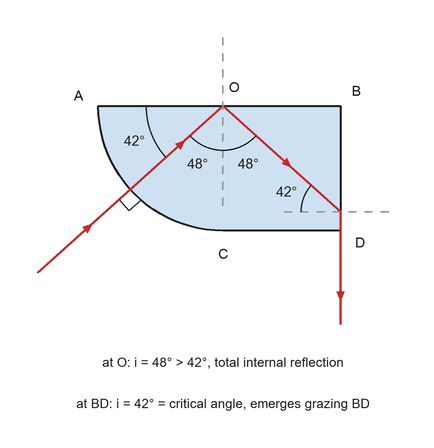
Watch out: The 42° marked at O is measured from the face, not from the normal.
Therefore, the ray enters undeviated, is totally reflected at O (i = 48°), and emerges grazing along BD (i = 42°).

