
Question 501 markMCQEasy
A ray of light suffers refraction through an equilateral prism. The deviation produced by the prism does not depend on the :
Confirming your payment
Sign up now and get 250 free tokens.
Refraction of Light at Plane Surfaces · Question 50 of 139
A ray of light suffers refraction through an equilateral prism. The deviation produced by the prism does not depend on the :
(A) angle of incidence
(B) colour of light
(C) material of prism
(D) size of prism
Answer: (D) size of prism
Concept: The angle of deviation of a prism depends on the angle of incidence, the colour (wavelength) of light, the material (refractive index) of the prism and its refracting angle. The size of the prism is not on this list.
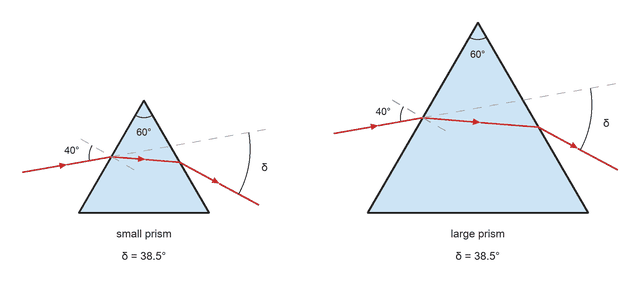
Step 1 — Look at an equilateral prism of any size.
Every equilateral prism has a refracting angle of 60°, whether it is small or large.
Step 2 — Compare a small and a large prism.
For the same glass, the same light and the same angle of incidence, the ray bends by the same amount at each face. For example, with i of 40° and μ of 1.5, δ is about 38.5° for both prisms; only the path inside is longer.
Why the other options are wrong:
Therefore, the deviation does not depend on the size of the prism, option (D).