
Question 491 markMCQEasy
In refraction of light through a prism, the light ray:
Confirming your payment
Sign up now and get 250 free tokens.
Refraction of Light at Plane Surfaces · Question 49 of 139
In refraction of light through a prism, the light ray:
(A) suffers refraction only at one face of the prism
(B) emerges out from the prism in a direction parallel to the incident ray
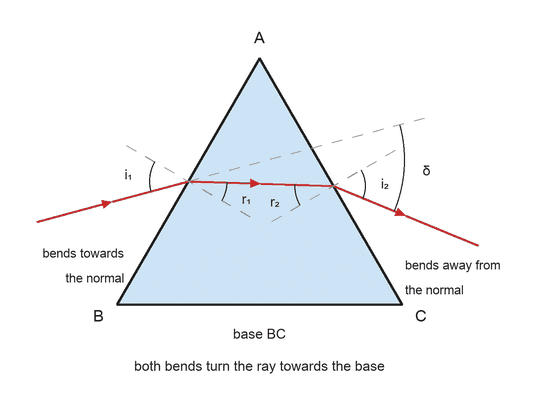
(C) bends at both the surfaces of the prism towards its base
(D) bends at both the surfaces of the prism opposite to its base.
Answer: (C) bends at both the surfaces of the prism towards its base
Concept: A prism refracts a ray twice, at two faces inclined at the angle of the prism A. Inside, the angles of refraction at the two faces add up to A (r₁ + r₂ = A); the total turning of the ray is the angle of deviation (δ = i₁ + i₂ − A), where i₁ is the angle of incidence and i₂ the angle of emergence. Both bends turn the ray towards the base of the prism.
Step 1 — At the first face.
The ray goes from air into glass, so it bends towards the normal of that face.
Step 2 — At the second face.
The ray goes from glass into air, so it bends away from the normal of that face.
Step 3 — Combine the two bends.
The faces are inclined to each other, so both bends turn the ray the same way: towards the base of the prism.
Why the other options are wrong:
Therefore, the ray bends at both surfaces towards the base, option (C).