
Question 52 marksAsked 2017Easy
State the conditions required for total internal reflection of light to take place.
Confirming your payment
Sign up now and get 250 free tokens.
Previous Year Questions · Question 5 of 57
State the conditions required for total internal reflection of light to take place.
Solution:
Concept: Critical angle (C): the angle of incidence in the denser medium for which the angle of refraction in the rarer medium is 90°. For glass or water to air, . Total internal reflection: it happens only when light goes from a denser to a rarer medium and the angle of incidence is greater than the critical angle. Then no light is refracted out; all of it is reflected back, obeying the laws of reflection (angle of reflection = angle of incidence).
Step 1 — Condition 1: the direction of travel.
Light must travel from an optically denser medium to an optically rarer medium, for example from glass to air or from water to air. Only then does the refracted ray bend away from the normal, so that it can reach 90°.
Step 2 — Condition 2: the angle of incidence.
The angle of incidence in the denser medium must be greater than the critical angle for that pair of media.
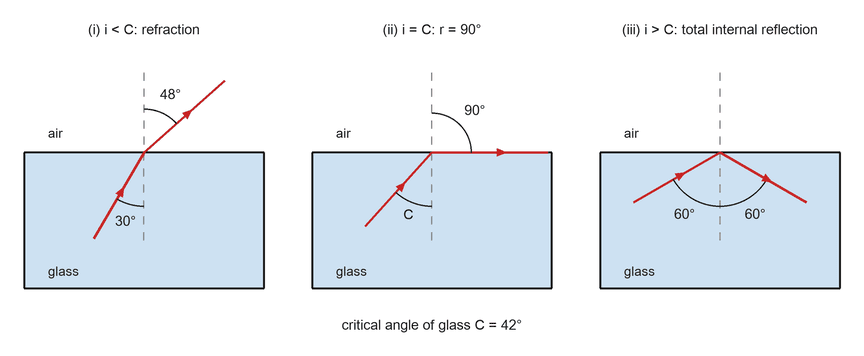
Step 3 — See how the ray changes as i grows.
When i is less than C, the ray refracts out (and a weak ray is reflected). When i equals C, the refracted ray grazes the surface (r = 90°). When i is greater than C, no refracted ray exists and all the light is reflected back into the denser medium: this is total internal reflection.
Watch out: Total internal reflection needs light going from the denser to the rarer medium; a large angle alone is not enough.
Therefore, (1) light must go from an optically denser to an optically rarer medium; (2) the angle of incidence in the denser medium must be greater than the critical angle.