
Opening your dashboard
Class 10 Physics Chapter 4 Refraction of Light at Plane Surfaces: Previous Year Questions
57 questions on Chapter 4, each solved step by step. Class 10 Physics, ICSE 2026-27.
57 questions with solutions
1–4 marks · Mixed difficulty
- 12 marks
Question 1
A boy uses blue colour of light to find the refractive index of glass. He then repeats the experiment using red colour of light. Will the refractive index be the same or different in the two cases? Give a reason to support your answer.
Solve with AIWritten solution
Solution:
Concept: Refractive index and speed: , where c is the speed of light in vacuum (or air) and v its speed in the medium. Light is slower in a medium of larger refractive index. Refractive index and colour: in glass or water, light of shorter wavelength travels more slowly, so the refractive index is larger for violet and blue light and smallest for red light (order: red < orange < yellow < green < blue < indigo < violet).
Step 1 — Compare the wavelengths.
Blue light has a shorter wavelength than red light.
Step 2 — Compare the speeds in glass.
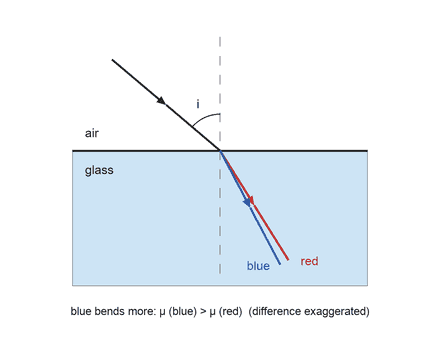
In glass, light of shorter wavelength travels more slowly. So blue light moves more slowly through the glass than red light.
Step 3 — Compare the refractive indices.
The refractive index is the speed of light in air divided by its speed in the glass:
A smaller speed v in the glass gives a larger μ. So the glass has a larger refractive index for blue light than for red light.
Step 4 — What the boy observes.
For the same angle of incidence, the blue ray bends more towards the normal, so its angle of refraction is smaller and comes out larger for blue light than for red light.
Watch out: The refractive index of a material is not one fixed number; it is always quoted for a particular colour of light.
Therefore, the refractive index will be different: it is greater for blue light than for red light, because blue light (shorter wavelength) travels more slowly in glass and bends more.
- 22 marks
Question 2
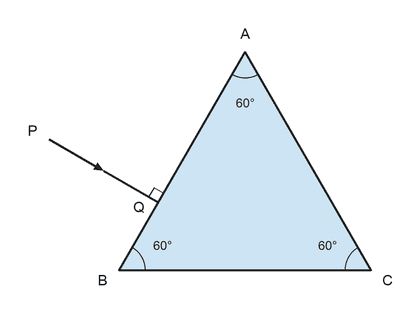
Copy the diagram given below and complete the path of light ray till it emerges out of the prism. The critical angle of glass is 42°. In your diagram mark the angles wherever necessary.
 Solve with AI
Written solution
Solution:
Concept: A ray that meets a surface along the normal (angle of incidence 0°) passes into the next medium without bending (angle of refraction 0°). Total internal reflection: it happens only when light goes from a denser to a rarer medium and the angle of incidence is greater than the critical angle. Then no light is refracted out; all of it is reflected back, obeying the laws of reflection (angle of reflection = angle of incidence).
Given: Equilateral prism ABC (each angle 60°), ray PQ normal to AB, critical angle of glass 42°.
Step 1 — At face AB (point Q).
The ray PQ falls normally on AB, so the angle of incidence is 0°. It enters the glass without bending, travelling perpendicular to AB.
Step 2 — Find the angle of incidence at the base BC.
The ray inside is perpendicular to AB, and the normal at R is perpendicular to BC. The angle between two lines equals the angle between their perpendiculars, so the angle of incidence at R equals the angle between AB and BC, which is ∠B:
Step 3 — Decide what happens at R.
The ray is going from glass to air, and its angle of incidence (60°) is greater than the critical angle (42°). So it suffers total internal reflection at R. The angle of reflection is also 60°, on the other side of the normal.
Step 4 — At face AC (point S).
The reflected ray makes 90° − 60° = 30° with BC. In triangle RSC, ∠SRC = 30° and ∠C = 60°, so the third angle is
The ray therefore meets AC along the normal (angle of incidence 0°) and passes out undeviated.

Watch out: Angles of incidence and refraction are measured from the normal; if a figure gives the angle with the surface, subtract it from 90°.
Therefore, the ray enters AB undeviated (i = 0°), is totally internally reflected at BC (i = 60°, more than 42°, reflected at 60°) and emerges normally through AC (i = 0°).
- 33 marks
Question 3
(i) Write a relationship between angle of incidence and angle of refraction for a given pair of media.
(ii) When a ray of light enters from one medium to another having different optical densities it bends. Why does this phenomenon occur?
(iii) Write one condition where it does not bend when entering a medium of different optical density.
Solve with AIWritten solution
Solution:
Concept: Refraction: light bends when it passes obliquely from one medium into another because its speed changes. Going into an optically denser medium it bends towards the normal; going into a rarer medium it bends away from the normal. Snell's law: is a constant (the refractive index) for a given pair of media and a given colour of light. All angles are measured from the normal, not from the surface.
Step 1 — Part (i): Snell's law.
For a given pair of media and light of a given colour, the ratio of the sine of the angle of incidence to the sine of the angle of refraction is a constant:
The constant is the refractive index of the second medium with respect to the first.
Step 2 — Part (ii): why the ray bends.
The speed of light is different in the two media: it is greater in the rarer medium and smaller in the denser medium. When a beam enters the new medium obliquely, one edge of it reaches the surface first and changes speed before the other edge, so the beam turns. It turns towards the normal on entering a denser medium and away from the normal on entering a rarer one.
Step 3 — Part (iii): when it does not bend.
If the ray falls normally on the surface (angle of incidence 0°), the whole beam reaches the surface at the same moment, so it goes straight on with angle of refraction 0°. Its speed still changes, but its direction does not.

Watch out: The ray still changes speed at normal incidence; only its direction stays the same.
Therefore, (i) sin i / sin r is a constant, the refractive index (Snell's law); (ii) the speed of light is different in the two media; (iii) when the ray is incident normally on the surface (i = 0°).
- 42 marks
Question 4
How is the refractive index of a material related to?
(i) real and apparent depth?
(ii) velocity of light in vacuum or air and the velocity of light in a given medium?
Solve with AIWritten solution
Solution:
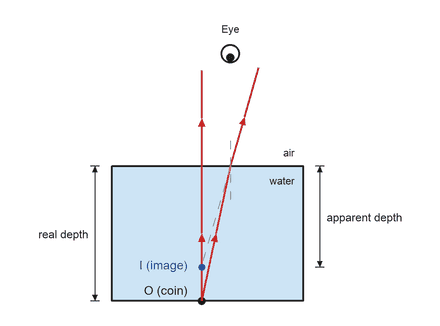
Concept: Real and apparent depth: an object inside a denser medium, seen from above (nearly along the normal), appears raised, because rays from it bend away from the normal on coming out. , and the shift (apparent rise) is real depth − apparent depth. Refractive index and speed: , where c is the speed of light in vacuum (or air) and v its speed in the medium. Light is slower in a medium of larger refractive index.
Step 1 — Part (i): real and apparent depth.
An object at the bottom of a medium appears raised, because rays from it bend away from the normal as they come out. The refractive index of the medium is the ratio of the real depth to the apparent depth:
Step 2 — Part (ii): speeds of light.
The refractive index is also the ratio of the speed of light in vacuum (or air) to its speed in the medium:
Here c is the speed of light in vacuum or air and v is its speed in the medium.
Watch out: Keep the larger quantity on top in both ratios (real depth, speed in air), so μ comes out greater than 1.
Therefore, (i) μ = real depth ÷ apparent depth; (ii) μ = speed of light in vacuum (or air) ÷ speed of light in the medium.
- 52 marks
Question 5
State the conditions required for total internal reflection of light to take place.
Solve with AIWritten solution
Solution:
Concept: Critical angle (C): the angle of incidence in the denser medium for which the angle of refraction in the rarer medium is 90°. For glass or water to air, . Total internal reflection: it happens only when light goes from a denser to a rarer medium and the angle of incidence is greater than the critical angle. Then no light is refracted out; all of it is reflected back, obeying the laws of reflection (angle of reflection = angle of incidence).
Step 1 — Condition 1: the direction of travel.
Light must travel from an optically denser medium to an optically rarer medium, for example from glass to air or from water to air. Only then does the refracted ray bend away from the normal, so that it can reach 90°.
Step 2 — Condition 2: the angle of incidence.
The angle of incidence in the denser medium must be greater than the critical angle for that pair of media.
Step 3 — See how the ray changes as i grows.
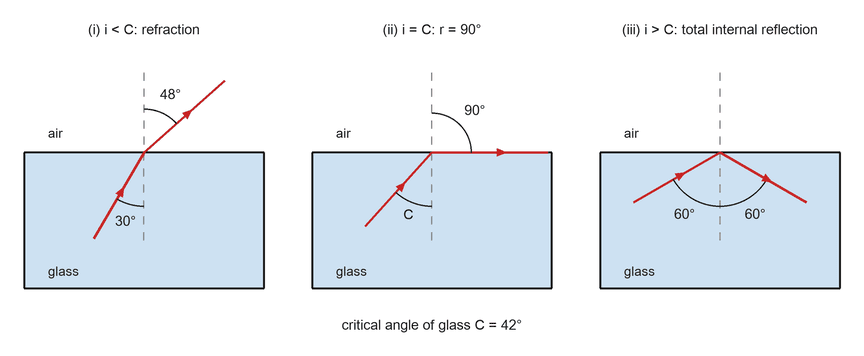
When i is less than C, the ray refracts out (and a weak ray is reflected). When i equals C, the refracted ray grazes the surface (r = 90°). When i is greater than C, no refracted ray exists and all the light is reflected back into the denser medium: this is total internal reflection.
Watch out: Total internal reflection needs light going from the denser to the rarer medium; a large angle alone is not enough.
Therefore, (1) light must go from an optically denser to an optically rarer medium; (2) the angle of incidence in the denser medium must be greater than the critical angle.
- 62 marks
Question 6
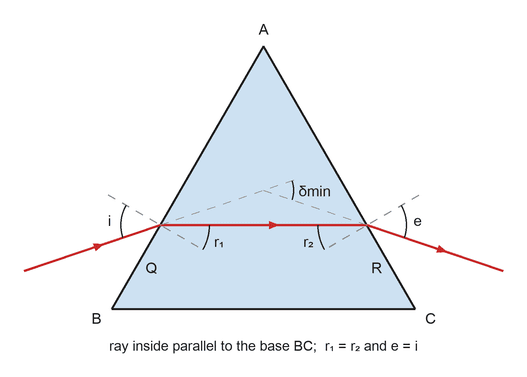
Draw a ray diagram to show the refraction of a monochromatic ray through a prism when it suffers minimum deviation.
Solve with AIWritten solution
Solution:
Concept: Minimum deviation: as the angle of incidence increases, the deviation first decreases, reaches a least value , then increases. At minimum deviation the ray passes symmetrically: the ray inside is parallel to the base, and are equal (each is ), and the angle of emergence equals the angle of incidence.
Step 1 — Draw the incident ray.
Draw the prism ABC and a monochromatic ray falling on face AB at an angle of incidence i. On entering the glass it bends towards the normal.
Step 2 — Draw the ray inside the prism.
For minimum deviation, draw the refracted ray QR parallel to the base BC. Then the angles of refraction at the two faces are equal, each being half the angle of the prism:
Step 3 — Draw the emergent ray.
At face AC the ray goes from glass into air and bends away from the normal. Because the path is symmetrical, it leaves at an angle of emergence equal to the angle of incidence:
Step 4 — Mark the angle of minimum deviation.
Produce the incident ray forward and the emergent ray backward (dashed). The angle between them is the angle of minimum deviation, . The ray is bent towards the base of the prism.
Step 5 — Check with numbers.
For example, take a 60° glass prism of refractive index 1.5. At minimum deviation the angle of refraction is 30°, and Snell's law at the first face gives the angle of incidence:
The minimum deviation is then
Watch out: The ray inside must be drawn parallel to the base; a ray sloping up or down inside the prism is not at minimum deviation.
Therefore, at minimum deviation the ray passes symmetrically: it travels parallel to the base inside the prism, r₁ and r₂ are each A/2, the angle of emergence equals the angle of incidence, and δmin is marked between the incident ray produced and the emergent ray.
- 73 marks
Question 7
A ray of light travels from water to air as shown in the diagram given below:
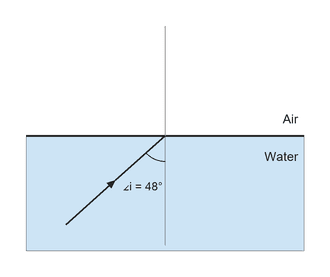
(i) Copy the diagram and complete the path of the ray. Given the critical angle for water is 48°.
(ii) State the condition so that total internal reflection occurs in the above diagram.
Solve with AIWritten solution
Solution:
Concept: Critical angle (C): the angle of incidence in the denser medium for which the angle of refraction in the rarer medium is 90°. For glass or water to air, . Total internal reflection: it happens only when light goes from a denser to a rarer medium and the angle of incidence is greater than the critical angle. Then no light is refracted out; all of it is reflected back, obeying the laws of reflection (angle of reflection = angle of incidence).
Given: A ray in water meets the surface at 48°; critical angle of water 48°.
Step 1 — Part (i): compare the angle with the critical angle.
The ray in water meets the surface at an angle of incidence of 48°, which is exactly the critical angle for water.
Step 2 — Part (i): complete the path.
At the critical angle the angle of refraction is 90°. So the refracted ray grazes along the water–air surface.
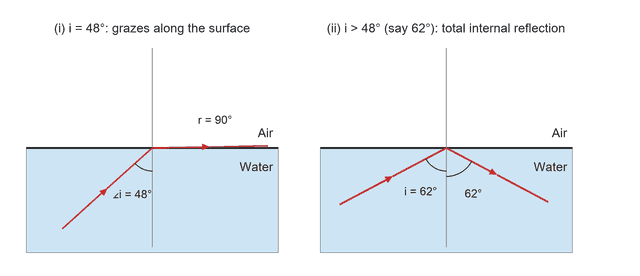
Step 3 — Part (ii): the condition for total internal reflection.
The light is already going from a denser medium (water) to a rarer medium (air). So the only further condition is that the angle of incidence in water must be greater than 48°. The ray then does not come out into air at all; it is totally reflected back into the water.
Watch out: At exactly the critical angle the ray grazes the surface; total internal reflection needs an angle greater than the critical angle.
Therefore, (i) the ray is refracted at 90° and grazes along the water surface; (ii) the angle of incidence in water must be greater than the critical angle, 48°.
- 84 marks
Question 8
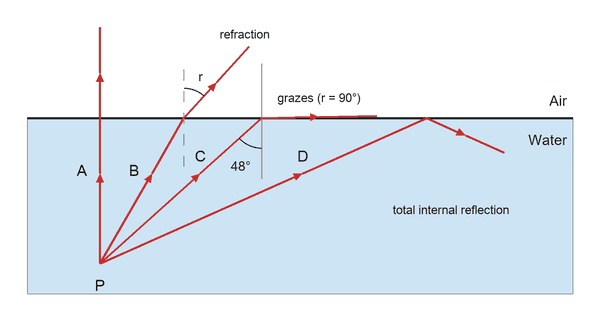
The diagram below shows a point source P inside a water container. Four rays A, B, C, D starting from the source P are shown up to the water surface.

(i) Show in the diagram the path of these rays after striking the water surface. The critical angle for water air surface is 48°.
(ii) Name the phenomenon which the rays B and D exhibit.
Solve with AIWritten solution
Solution:
Concept: Critical angle (C): the angle of incidence in the denser medium for which the angle of refraction in the rarer medium is 90°. For glass or water to air, . Total internal reflection: it happens only when light goes from a denser to a rarer medium and the angle of incidence is greater than the critical angle. Then no light is refracted out; all of it is reflected back, obeying the laws of reflection (angle of reflection = angle of incidence).
Given: Point source P in water; rays A, B, C, D; critical angle of water 48°.
Step 1 — Ray A.
Ray A meets the surface along the normal (i = 0°), so it passes into air without bending.
Step 2 — Ray B.
Ray B meets the surface at an angle of incidence less than 48°. It is refracted into air, bending away from the normal (its angle of refraction is greater than its angle of incidence). A weak reflected ray also returns into the water.
Step 3 — Ray C.
Ray C meets the surface at 48°, the critical angle. It is refracted at 90° and grazes along the water surface.
Step 4 — Ray D.
Ray D meets the surface at an angle greater than 48°. It cannot come out, so it suffers total internal reflection and returns into the water, with its angle of reflection equal to its angle of incidence.
Step 5 — Part (ii): name the phenomena.
Ray B shows refraction (from water into air). Ray D shows total internal reflection.
Watch out: Compare each ray's angle with the NORMAL at the surface (not with the surface) against 48°.
Therefore, (i) A goes straight out undeviated, B refracts out bending away from the normal, C grazes along the surface and D is totally reflected back into the water; (ii) B shows refraction and D shows total internal reflection.
- 92 marks
Question 9
(i) State the relation between the critical angle and the absolute refractive index of a medium.
(ii) Which colour of light has a higher critical angle? Red light or Green light.
Solve with AIWritten solution
Solution:
Concept: Critical angle (C): the angle of incidence in the denser medium for which the angle of refraction in the rarer medium is 90°. For glass or water to air, . Refractive index and colour: in glass or water, light of shorter wavelength travels more slowly, so the refractive index is larger for violet and blue light and smallest for red light (order: red < orange < yellow < green < blue < indigo < violet).
Step 1 — Part (i): write the relation.
At the critical angle the angle of refraction in air is 90°. Applying Snell's law for light going from the medium into air:
Since sin 90° = 1, this gives
So a medium with a larger refractive index has a smaller critical angle.
Step 2 — Part (ii): compare red and green light.
The refractive index of a medium is smaller for red light (longer wavelength) than for green light.
Step 3 — Part (ii): conclude.
A smaller μ gives a larger value of sin C = 1/μ, and so a larger critical angle. Therefore red light has the higher critical angle.
Watch out: A LARGER refractive index gives a SMALLER critical angle; the two change in opposite directions.
Therefore, (i) sin C = 1/μ (the sine of the critical angle is the reciprocal of the absolute refractive index); (ii) red light has the higher critical angle.
- 102 marks
Question 10
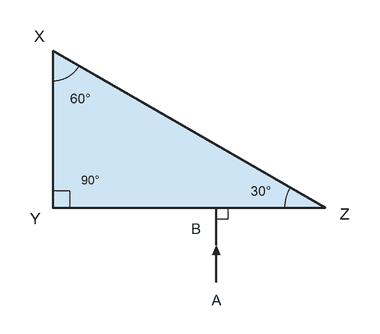
The following diagram shows a 60°, 30°, 90° glass prism of critical angle 42°. Copy the diagram and complete the path of incident ray AB emerging out of the prism marking the angle of incidence on each surface.
 Solve with AI
Written solution
Solution:
Concept: A ray that meets a surface along the normal (angle of incidence 0°) passes into the next medium without bending (angle of refraction 0°). Critical angle (C): the angle of incidence in the denser medium for which the angle of refraction in the rarer medium is 90°. For glass or water to air, . Total internal reflection: it happens only when light goes from a denser to a rarer medium and the angle of incidence is greater than the critical angle. Then no light is refracted out; all of it is reflected back, obeying the laws of reflection (angle of reflection = angle of incidence).
Given: 60°–30°–90° prism XYZ, ray AB normal to YZ, critical angle 42°.
Step 1 — At face YZ (point B).
The ray AB falls along the normal to YZ, so the angle of incidence is 0° and it goes straight up into the prism without bending.
Step 2 — Find the angle of incidence at XZ.
The ray inside is perpendicular to YZ, and the normal to XZ is perpendicular to XZ. So the angle between the ray and that normal equals the angle between YZ and XZ, which is ∠Z:
Step 3 — Decide what happens at XZ.
The angle of incidence, 30°, is less than the critical angle, 42°. So there is no total internal reflection: the ray refracts out into air, bending away from the normal.
Step 4 — Find the angle of emergence.
With a critical angle of 42°, the refractive index of the glass is
By Snell's law for light leaving the glass, sin e = μ sin i:

Watch out: Angles of incidence and refraction are measured from the normal; if a figure gives the angle with the surface, subtract it from 90°.
Therefore, the ray goes straight through YZ (i = 0°), meets XZ at i = 30° (less than 42°) and refracts out into air, bending away from the normal at about 48°.
- 113 marks
Question 11
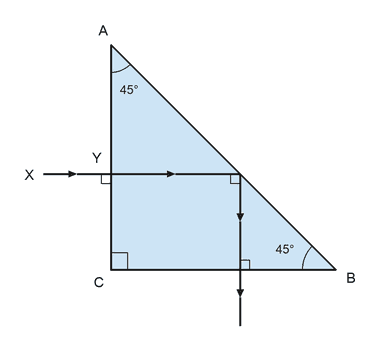
A ray of light XY passes through a right angled isosceles prism as shown below.
(i) What is the angle through which the incident ray deviates and emerges out of the prism?
(ii) Name the instrument where this action of prism is put into use.
(iii) Which prism surface will behave as a mirror?
Solve with AIWritten solution
Solution:
Concept: A right-angled isosceles prism (angles 90°, 45°, 45°) of glass (critical angle about 42°) can act as a perfect mirror: a ray entering a face normally meets the next face at 45°, which is more than 42°, so it is totally reflected.
Given: Right-angled isosceles prism, ray XY normal to face AC.
Step 1 — Follow the ray through the prism.
The ray XY enters face AC normally, so it goes straight in. It meets the hypotenuse AB at an angle of incidence of 45° (equal to ∠A). Since 45° is more than the critical angle of glass (about 42°), it is totally reflected, and it then leaves face CB normally.

Step 2 — Part (i): find the deviation.
A reflection with angle of incidence i turns a ray through 180° − 2i:
The ray was horizontal and leaves vertically, so it is deviated through 90°.
Step 3 — Part (ii): name the instrument.
This action is used in a periscope: two such prisms each turn the light through 90°, so an observer can see over an obstacle.
Step 4 — Part (iii): the surface acting as a mirror.
The hypotenuse face AB behaves as a mirror, because the light is totally reflected there.
Watch out: The turn on reflection is 180° − 2i, not 2i; here both give 90°, but they differ for other angles.
Therefore, (i) the ray is deviated through 90°; (ii) the periscope; (iii) the hypotenuse face AB acts as a mirror.
- 123 marks
Question 12
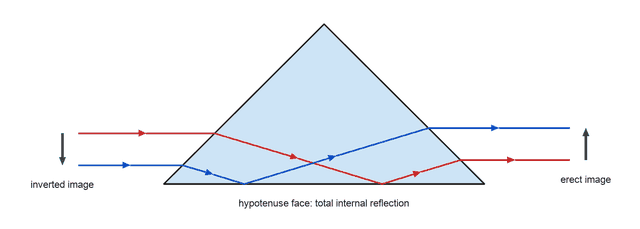
Draw the diagram of a right angled isosceles prism which is used to make an inverted image erect.
Solve with AIWritten solution
Solution:
Concept: A right-angled isosceles prism (angles 90°, 45°, 45°) of glass (critical angle about 42°) can act as a perfect mirror: a ray entering a face normally meets the next face at 45°, which is more than 42°, so it is totally reflected.
Step 1 — Place the prism.
Draw a right-angled isosceles prism with its hypotenuse face as the base. Draw two rays from the top and bottom of the inverted image falling on one short face, parallel to the base.
Step 2 — Refraction at the first face.
Each ray meets the slanting face at 45°, refracts into the glass bending towards the normal, and travels down towards the hypotenuse (for glass of μ = 1.5 it slopes down at about 17°).
Step 3 — Total internal reflection at the hypotenuse.
Each ray meets the hypotenuse at an angle of incidence of about 73°, which is greater than 42°, so it is totally reflected upwards.
Step 4 — Emergence from the second face.
The rays refract out of the other short face and travel parallel to their original direction, so there is no deviation.
Step 5 — See why the image becomes erect.
The ray that entered higher leaves lower, and the ray that entered lower leaves higher. The top and bottom are interchanged, so an inverted image becomes erect. A prism used in this way is called an erecting prism.
Watch out: The rays must fall parallel to the hypotenuse (base); entering a short face normally gives a 90° turn instead.
Therefore, a right-angled isosceles prism with its hypotenuse as the base and rays falling parallel to it: the rays are totally reflected at the hypotenuse and leave parallel to their original direction with top and bottom interchanged, so the inverted image becomes erect.
- 132 marks
Question 13
(i) Define critical angle.
(ii) State one important factor which affects the critical angle of a given medium.
Solve with AIWritten solution
Solution:
Concept: Critical angle (C): the angle of incidence in the denser medium for which the angle of refraction in the rarer medium is 90°. For glass or water to air, .
Step 1 — Part (i): define the critical angle.
The critical angle is the angle of incidence in the denser medium for which the angle of refraction in the rarer medium is 90°, so that the refracted ray just grazes the surface.
Step 2 — Part (i): see it in a figure.
In panel (ii) of the figure the ray inside glass meets the surface at the critical angle C and the refracted ray grazes along the surface. A smaller angle lets the ray out; a larger one gives total internal reflection.
Step 3 — Part (ii): one factor that affects it.
The colour (wavelength) of light. Since sin C = 1/μ and the refractive index is less for red light than for violet light, the critical angle is larger for red light than for violet light.
Step 4 — Part (ii): another factor.
The temperature of the medium also matters: a rise in temperature lowers the refractive index, so the critical angle increases.
Watch out: The critical angle is an angle of INCIDENCE in the denser medium, not an angle of refraction.
Therefore, (i) the critical angle is the angle of incidence in the denser medium for which the angle of refraction in the rarer medium is 90°; (ii) the colour (wavelength) of the light used (the temperature of the medium also affects it).
- 142 marks
Question 14
(i) What is the relation between the refractive index of water with respect to air () and the refractive index of air with respect to water ()
(ii) If the refractive index of water with respect to air () is . Calculate the refractive index of air with respect to water ().
Solve with AIWritten solution
Solution:
Concept: Principle of reversibility: a ray of light that is reversed retraces its path. So the refractive index of medium 1 with respect to medium 2 is the reciprocal of that of medium 2 with respect to medium 1: .
Given: .
Step 1 — Part (i): write the relation.
By the principle of reversibility, a ray going from water to air retraces the path of a ray going from air to water. So the two refractive indices are reciprocals:
Step 2 — Part (ii): rearrange for the unknown.
Dividing both sides by :
Step 3 — Part (ii): put in the value.
We substitute :
It is less than 1 because light travels faster in air than in water.
Watch out: A refractive index of air with respect to water is less than 1; that is correct, not a slip.
Therefore, (i) (each is the reciprocal of the other); (ii) (that is, 3/5).
- 152 marks
Question 15
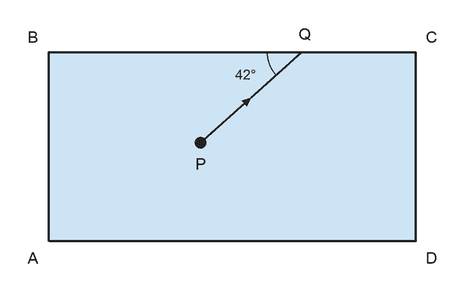
The diagram below shows a light source P embedded in a rectangular glass block ABCD of critical angle 42°. Complete the path of the ray PQ till it emerges out of the block. [Write necessary angles.]
 Solve with AI
Written solution
Solution:
Concept: Critical angle (C): the angle of incidence in the denser medium for which the angle of refraction in the rarer medium is 90°. For glass or water to air, . Total internal reflection: it happens only when light goes from a denser to a rarer medium and the angle of incidence is greater than the critical angle. Then no light is refracted out; all of it is reflected back, obeying the laws of reflection (angle of reflection = angle of incidence).
Given: Source P in a glass block ABCD; PQ makes 42° with BC; critical angle 42°.
Step 1 — Find the angle of incidence at Q.
PQ makes 42° with the surface BC. The normal is at 90° to the surface, so the angle of incidence is
Step 2 — Decide what happens at Q.
The ray goes from glass to air and 48° is greater than the critical angle, 42°. So the ray is totally internally reflected at Q, with an angle of reflection of 48°.
Step 3 — Follow the reflected ray.
The reflected ray travels down to the right, again making 42° with BC, and meets the face CD at R.
Step 4 — Find the angle of incidence at R.
The normal to CD is parallel to BC, so the reflected ray makes the same 42° with this normal (alternate angles):
Step 5 — Decide what happens at R.
This angle equals the critical angle, so the angle of refraction is 90° and the ray emerges grazing along the face CD.
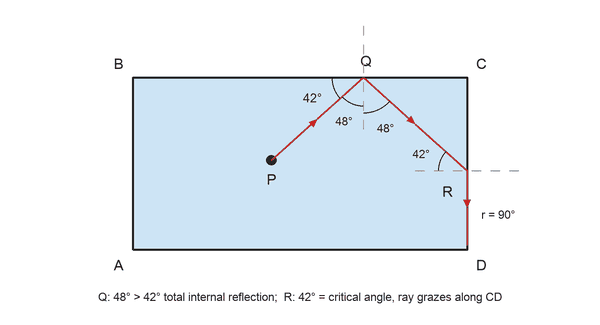
Watch out: Angles of incidence and refraction are measured from the normal; if a figure gives the angle with the surface, subtract it from 90°.
Therefore, the ray is totally reflected at Q (i = 48°, reflected at 48°) and comes out at R on CD grazing along the surface (i = 42°, the critical angle, r = 90°).
- 163 marks
Question 16
How does the angle of deviation formed by a prism change with the increase in the angle of incidence? Draw a graph showing the variation in the angle of deviation with the angle of incidence at a prism surface.
Solve with AIWritten solution
Solution:
Concept: Minimum deviation: as the angle of incidence increases, the deviation first decreases, reaches a least value , then increases. At minimum deviation the ray passes symmetrically: the ray inside is parallel to the base, and are equal (each is ), and the angle of emergence equals the angle of incidence.
Step 1 — Describe the change.
As the angle of incidence increases from a small value, the angle of deviation first decreases, becomes minimum () at one particular angle of incidence, and then increases again.
Step 2 — State the condition at the minimum.
At minimum deviation the angle of emergence equals the angle of incidence (i = e), and the ray inside the prism travels parallel to its base.
Step 3 — Draw the graph.
Plot the angle of deviation δ (y-axis) against the angle of incidence i (x-axis). The curve is U-shaped, but not symmetrical: it falls steeply, reaches its lowest point, and then rises more gently. The graph below is calculated for a 60° glass prism (μ = 1.5): δmin ≈ 37° at i ≈ 49°, and δ ≈ 58° at both ends of the curve.
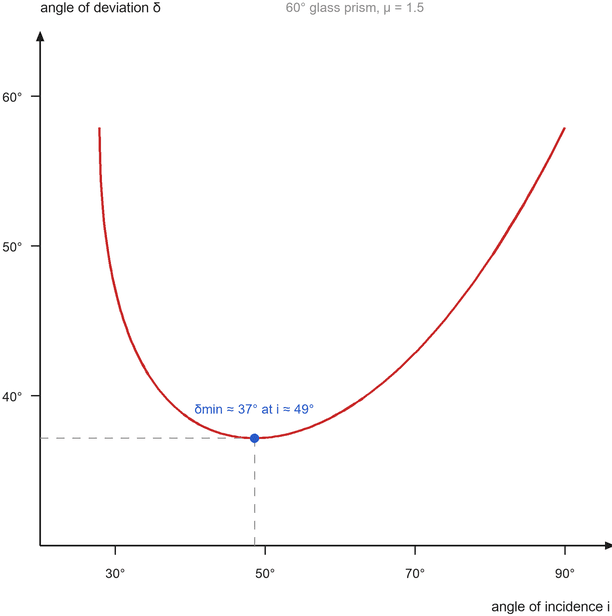
Watch out: The graph is not a straight line and not a symmetrical parabola; it has one lowest point, the angle of minimum deviation.
Therefore, the angle of deviation first decreases, reaches a minimum (δmin, where i = e) and then increases as the angle of incidence increases; the δ–i graph is a U-shaped curve with its lowest point at δmin.
- 172 marks
Question 17
A ray of light falls normally on a rectangular glass slab. Draw a ray diagram showing the path of the ray till it emerges out of the slab.
Solve with AIWritten solution
Solution:
Concept: A ray that meets a surface along the normal (angle of incidence 0°) passes into the next medium without bending (angle of refraction 0°).
Given: A ray falls normally on a rectangular glass slab.
Step 1 — At the first surface.
The ray falls along the normal, so the angle of incidence is 0°. By Snell's law, sin r is sin 0° divided by μ, which is zero, so the angle of refraction is also 0° and the ray enters the slab without bending.
Step 2 — At the second surface.
Inside, the ray again meets the opposite surface along the normal, so it comes out without bending.
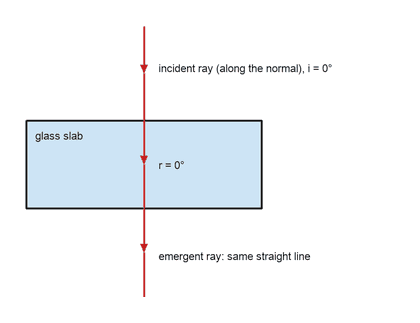
Step 3 — Describe the result.
The ray passes straight through the slab along the same line. There is no deviation and no lateral displacement; the light only travels more slowly while it is inside the glass.
Watch out: Do not draw any bend at normal incidence; the angle of incidence and the angle of refraction are both 0°.
Therefore, the ray passes straight through the slab without bending at either surface (the angles of incidence and refraction are 0° at both faces) and emerges along the same straight line.
- 182 marks
Question 18
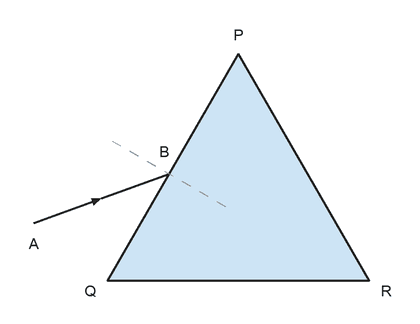
Complete the path of the monochromatic light ray AB incident on the surface PQ of the equilateral glass prism PQR till it emerges out of the prism due to refraction.
 Solve with AI
Written solution
Solution:
Concept: Refraction: light bends when it passes obliquely from one medium into another because its speed changes. Going into an optically denser medium it bends towards the normal; going into a rarer medium it bends away from the normal. Snell's law: is a constant (the refractive index) for a given pair of media and a given colour of light. All angles are measured from the normal, not from the surface. Prism: for a prism of angle A, the angle of deviation is , where is the angle of incidence and the angle of emergence. Inside, the angles of refraction at the two faces satisfy .
Given: Monochromatic ray AB incident on face PQ of an equilateral glass prism PQR.
Step 1 — At B on face PQ.
The ray goes from air into glass, so it bends towards the normal at B () and travels across the prism to face PR.
Step 2 — At C on face PR.
Now the ray goes from glass into air. Its angle of incidence is less than the critical angle, so it refracts out, bending away from the normal ().
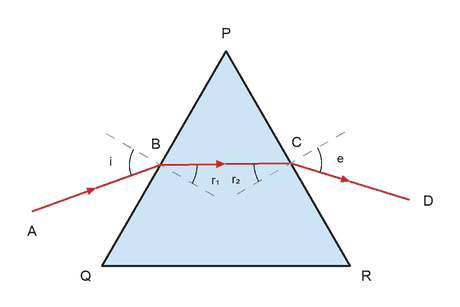
Step 3 — Describe the overall result.
Both bends turn the ray towards the base QR. So the emergent ray CD is deviated towards the base of the prism compared with the incident ray AB.
Watch out: In a prism both bends turn the ray towards the BASE; drawing the emergent ray bending towards the apex is the usual slip.
Therefore, the ray bends towards the normal at B, crosses the prism, bends away from the normal at C and emerges as CD, deviated towards the base QR.
- 192 marks
Question 19
A pond appears to be 2.7 m deep. If the refractive index of water is , find the actual depth of the pond.
Solve with AIWritten solution
Solution:
Concept: Real and apparent depth: an object inside a denser medium, seen from above (nearly along the normal), appears raised, because rays from it bend away from the normal on coming out. , and the shift (apparent rise) is real depth − apparent depth.
Given: Apparent depth 2.7 m; refractive index of water μ = 4/3.
Step 1 — Write the relation.
The refractive index of water is the real depth divided by the apparent depth:
Step 2 — Rearrange for the real depth.
Multiplying both sides by the apparent depth:
Step 3 — Put in the values.
We substitute μ = 4/3 and apparent depth = 2.7 m:
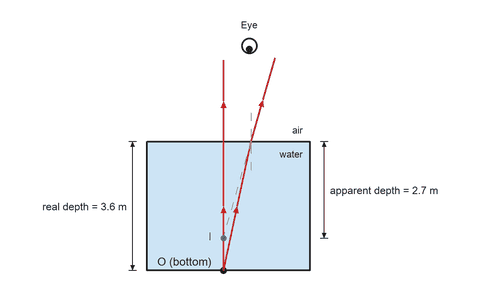
Step 4 — Check the answer.
The pond is 3.6 − 2.7 = 0.9 m deeper than it looks, as expected, because rays from the bottom bend away from the normal as they leave the water.
Watch out: The real depth is LARGER than the apparent depth, so multiply by μ; dividing would make the pond look deeper than it is.
Therefore, the actual depth of the pond is 3.6 m.
- 203 marks
Question 20
A diver in water looks obliquely at an object AB in air.
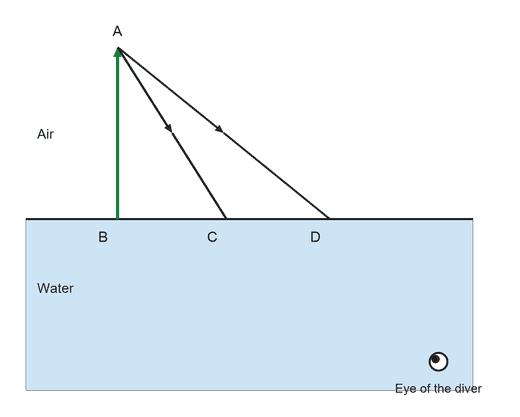
(i) Does the object appear taller, shorter or of the same size to the diver?
(ii) Show the path of two rays AC & AD starting from the tip of the object as it travels towards the diver in water and hence obtain the image of the object.
Solve with AIWritten solution
Solution:
Concept: Refraction: light bends when it passes obliquely from one medium into another because its speed changes. Going into an optically denser medium it bends towards the normal; going into a rarer medium it bends away from the normal. Snell's law: is a constant (the refractive index) for a given pair of media and a given colour of light. All angles are measured from the normal, not from the surface.
Given: A diver in water looks obliquely at an object AB standing in air.
Step 1 — Part (i): direction of the light.
Light from the object travels from air (rarer) into water (denser), so at the surface it bends towards the normal.
Step 2 — Part (ii): ray AC.
At C the ray AC enters the water and bends towards the normal, then goes on down into the water.
Step 3 — Part (ii): ray AD.
At D the ray AD also bends towards the normal. It meets the surface more obliquely than AC, so it is bent more.
Step 4 — Part (ii): locate the image.
The diver's eye receives the refracted rays. Produce them backwards (dashed lines): they meet at A′, which lies higher than A. The foot B is on the surface, so its image is B itself. A′B is the image: virtual, and taller than AB. (The figure is traced with μ = 4/3 for the two rays shown.)
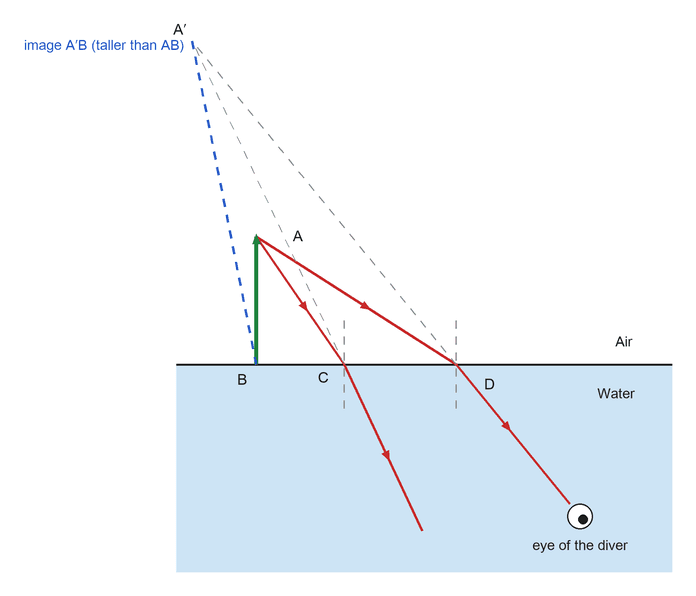
Step 5 — Part (i): conclude.
Since the image A′B reaches higher than the object, the object appears taller to the diver.
Watch out: Light here goes from AIR into WATER, so it bends towards the normal; the image of an object in air seen from water is raised, not lowered.
Therefore, (i) the object appears taller to the diver; (ii) the rays AC and AD bend towards the normal in water, and traced back they meet at A′ above A, so A′B is the (virtual) image.
- 213 marks
Question 21
Complete the path of the ray AB through the glass prism in PQR till it emerges out of the prism. Given the critical angle of the glass as 42°.
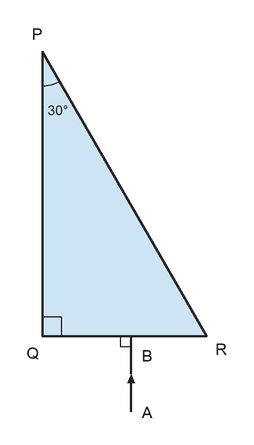 Solve with AI
Written solution
Solution:
Concept: A ray that meets a surface along the normal (angle of incidence 0°) passes into the next medium without bending (angle of refraction 0°). Critical angle (C): the angle of incidence in the denser medium for which the angle of refraction in the rarer medium is 90°. For glass or water to air, . Total internal reflection: it happens only when light goes from a denser to a rarer medium and the angle of incidence is greater than the critical angle. Then no light is refracted out; all of it is reflected back, obeying the laws of reflection (angle of reflection = angle of incidence).
Given: Right-angled prism PQR with ∠P = 30°, ray AB normal to QR, critical angle 42°.
Step 1 — At B on QR.
The ray AB falls normally on QR, so the angle of incidence is 0° and it goes straight up into the prism.
Step 2 — Find the angle of incidence at PR.
The ray is perpendicular to QR, and the normal to PR is perpendicular to PR. So the angle of incidence equals the angle between QR and PR, which is ∠R:
Step 3 — Decide what happens at PR.
Since 60° is greater than 42°, the ray is totally internally reflected at PR, with an angle of reflection of 60°.
Step 4 — Find the angle of incidence at PQ.
The reflected ray travels up to the left, making 30° with the horizontal. The normal to PQ is horizontal, so the angle of incidence at PQ is
Step 5 — Decide what happens at PQ.
Since 30° is less than 42°, the ray refracts out into air, bending away from the normal. With μ = 1/sin 42° ≈ 1.49:
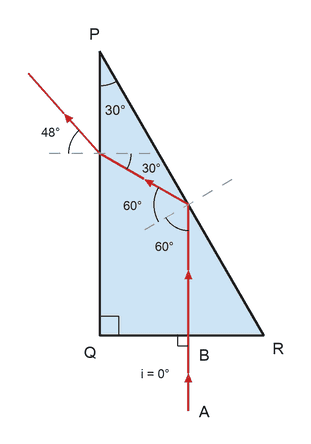
Watch out: Angles of incidence and refraction are measured from the normal; if a figure gives the angle with the surface, subtract it from 90°.
Therefore, the ray is totally reflected at PR (i = 60°) and then refracts out through PQ (i = 30°), bending away from the normal at about 48°.
- 221 mark
Question 22
When a ray of light travels normal to the given surface, then the angle of refraction is:
Solve with AIAnswer
(A) 180°
(B) 90°
- Correct
(C) 0°
(D) 45°
Answer: (C) 0°
Concept: A ray that meets a surface along the normal (angle of incidence 0°) passes into the next medium without bending (angle of refraction 0°).
Step 1 — Write the angle of incidence.
A ray travelling along the normal makes an angle of incidence of 0°.
Step 2 — Apply Snell's law.
Snell's law gives the sine of the angle of refraction as sin i ÷ μ. We put in i = 0°:
So the angle of refraction is 0°: the ray passes into the second medium without bending.
Watch out: An angle of 90° to the SURFACE is an angle of 0° to the NORMAL; the question asks for the angle from the normal.
Why the other options are wrong:
- (A) 180°: 180° would mean the ray turned straight back; a refracted ray goes on into the second medium.
- (B) 90°: 90° is the angle of refraction when light in the denser medium meets the surface at the critical angle (grazing emergence), not at normal incidence.
- (D) 45°: a ray along the normal is not bent at all, so its angle of refraction cannot be 45°.
Therefore, the angle of refraction is 0°, option (C).
- 231 mark
Question 23
Small air bubbles rising up a fish tank appear silvery when viewed from some particular angle is due to the:
Solve with AIAnswer
(A) reflection
(B) refraction
(C) dispersion
- Correct
(D) total internal reflection
Answer: (D) total internal reflection
Concept: Total internal reflection: it happens only when light goes from a denser to a rarer medium and the angle of incidence is greater than the critical angle. Then no light is refracted out; all of it is reflected back, obeying the laws of reflection (angle of reflection = angle of incidence).
Step 1 — Identify the two media.
An air bubble in water is a pocket of an optically rarer medium (air) inside a denser medium (water). Light in the water meets the bubble's surface going from denser to rarer.
Step 2 — Compare with the critical angle.
The critical angle for water is about 48.6° (sin C = 3/4). Light striking the bubble at an angle of incidence greater than this cannot enter the bubble; it is totally reflected.
Step 3 — Explain the silvery look.
All of that light is reflected towards the eye, so the bubble looks bright and silvery when seen from those directions.
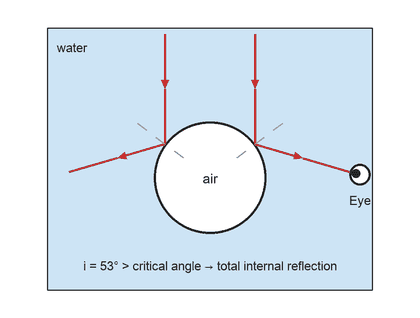
Watch out: The silvery shine is TOTAL reflection; ordinary reflection at a water–air surface returns only a few per cent of the light.
Why the other options are wrong:
- (A) reflection: ordinary (partial) reflection sends back only a small part of the light, too little to make the bubble shine like silver.
- (B) refraction: refraction carries light into the bubble; it does not make the bubble's surface shine.
- (C) dispersion: dispersion splits white light into colours, as in a prism; it does not explain a silvery shine.
Therefore, the bubbles look silvery because of total internal reflection, option (D).
- 243 marks
Question 24
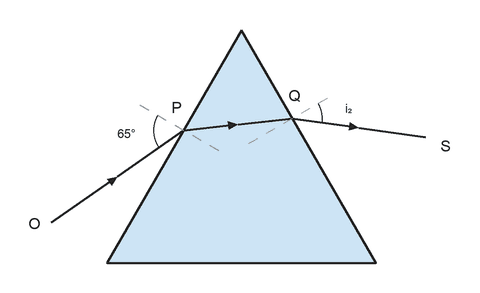
The diagram below shows the ray OP travelling through an equilateral prism of a certain material.
(a) Calculate the value of , if the angle of deviation is 43°.
(b) What is the ray QS called?
 Solve with AI
Written solution
Solution:
Concept: Prism: for a prism of angle A, the angle of deviation is , where is the angle of incidence and the angle of emergence. Inside, the angles of refraction at the two faces satisfy .
Given: Equilateral prism (A = 60°), angle of incidence = 65°, angle of deviation δ = 43°.
Step 1 — Part (a): write the deviation formula.
For a prism, the deviation equals the angle of incidence plus the angle of emergence minus the angle of the prism:
Step 2 — Part (a): rearrange for the angle of emergence.
Adding A and subtracting on both sides:
Step 3 — Part (a): put in the values.
The prism is equilateral, so A = 60°; the figure gives = 65° and the stem gives δ = 43°:
Step 4 — Check that the numbers fit a real prism.
With = 65° and = 38°, Snell's law at both faces with gives a refractive index of about 1.53, an ordinary glass value. The figure below is drawn with it.
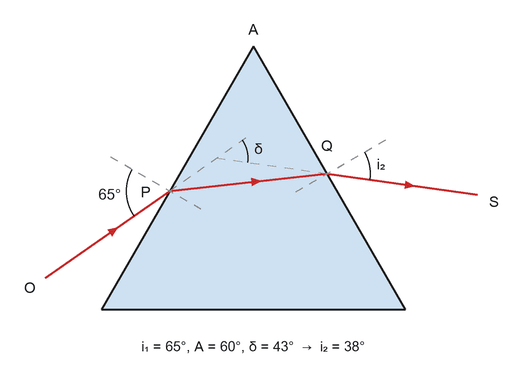
Step 5 — Part (b): name the ray QS.
QS is the ray that leaves the prism, so it is the emergent ray.
Watch out: Subtract the prism angle A (not add it) when you use δ = i₁ + i₂ − A.
Therefore, (a) = 38°; (b) QS is the emergent ray.
- 253 marks
Question 25
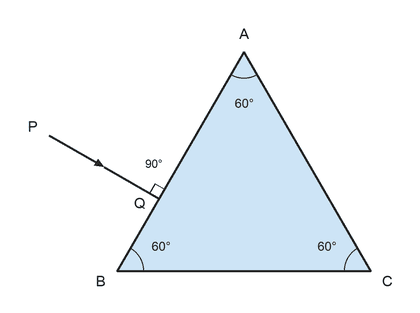
Copy the diagram given below and complete the path of the light ray PQ, as it emerges out of the prism by marking necessary angles. The critical angle of glass is 42°.
 Solve with AI
Written solution
Solution:
Concept: A ray that meets a surface along the normal (angle of incidence 0°) passes into the next medium without bending (angle of refraction 0°). Total internal reflection: it happens only when light goes from a denser to a rarer medium and the angle of incidence is greater than the critical angle. Then no light is refracted out; all of it is reflected back, obeying the laws of reflection (angle of reflection = angle of incidence).
Given: Equilateral prism ABC, ray PQ normal to AB, critical angle of glass 42°.
Step 1 — At Q on face AB.
The ray PQ meets AB at 90° to the face, that is along the normal, so the angle of incidence is 0° and it goes straight in, perpendicular to AB.
Step 2 — Find the angle of incidence at the base BC.
The ray is perpendicular to AB and the normal at R is perpendicular to BC, so the angle of incidence at R equals ∠B:
Step 3 — Decide what happens at R.
Since 60° is greater than the critical angle (42°), the ray suffers total internal reflection at R, with an angle of reflection of 60°.
Step 4 — At S on face AC.
The reflected ray makes 30° with BC, and ∠C is 60°. In the triangle formed with AC, the angle at which the ray meets AC is
So the ray meets AC along the normal (angle of incidence 0°) and passes out undeviated.
Watch out: Angles of incidence and refraction are measured from the normal; if a figure gives the angle with the surface, subtract it from 90°.
Therefore, the ray enters AB undeviated (i = 0°), is totally internally reflected at BC (i = 60°, reflected at 60°) and emerges normally through AC (i = 0°).
- 264 marks
Question 26
The diagram below shows two parallel rays A (Orange) & B (Blue) incident from air, on air-glass boundary.
(a) Copy and complete the path of the rays A and B.
(b) How do the speeds of these rays differ in glass?
(c) Are the two refracted rays in glass parallel? Give a reason.
 Solve with AI
Written solution
Solution:
Concept: Refraction: light bends when it passes obliquely from one medium into another because its speed changes. Going into an optically denser medium it bends towards the normal; going into a rarer medium it bends away from the normal. Snell's law: is a constant (the refractive index) for a given pair of media and a given colour of light. All angles are measured from the normal, not from the surface. Refractive index and colour: in glass or water, light of shorter wavelength travels more slowly, so the refractive index is larger for violet and blue light and smallest for red light (order: red < orange < yellow < green < blue < indigo < violet). Refractive index and speed: , where c is the speed of light in vacuum (or air) and v its speed in the medium. Light is slower in a medium of larger refractive index.
Given: Two parallel rays, A (orange) and B (blue), fall from air on a glass surface.
Step 1 — Part (a): complete the paths.
Both rays go from air into glass, so both bend towards the normal. Glass has a larger refractive index for blue light, so ray B (blue) bends more than ray A (orange): its angle of refraction is smaller than .

Step 2 — Part (b): compare the speeds.
Since μ = c/v, the colour with the larger refractive index travels more slowly. Blue has the larger μ, so the orange ray travels faster in glass than the blue ray.
Step 3 — Part (c): are the refracted rays parallel?
The answer is no. The two rays have the same angle of incidence, but different refractive indices, so their angles of refraction are different (). Two rays making different angles with the same normal direction cannot be parallel.
Watch out: The rays are parallel in air, but that does not make them parallel in glass; each colour has its own angle of refraction.
Therefore, (a) both rays bend towards the normal, the blue ray B more than the orange ray A; (b) the orange ray travels faster in glass than the blue ray; (c) no, because glass has a different refractive index for the two colours, so their angles of refraction are different.
- 273 marks
Question 27
(a) A coin kept inside water [] when viewed from air in a vertical direction appears to be raised by 3.0 mm. Find the depth of the coin in water.
(b) How is the critical angle related to the refractive index of a medium?
Solve with AIWritten solution
Solution:
Concept: Real and apparent depth: an object inside a denser medium, seen from above (nearly along the normal), appears raised, because rays from it bend away from the normal on coming out. , and the shift (apparent rise) is real depth − apparent depth. Critical angle (C): the angle of incidence in the denser medium for which the angle of refraction in the rarer medium is 90°. For glass or water to air, .
Given: Μ of water = 4/3; the coin appears raised by 3.0 mm.
Step 1 — Part (a): write the shift in terms of the real depth.
The apparent depth is the real depth divided by μ, so the shift (apparent rise) is
Step 2 — Part (a): work out the bracket.
For water, μ = 4/3, so 1/μ = 3/4:
Step 3 — Part (a): find the real depth.
The shift is 3.0 mm and it is one quarter of the real depth:
Step 4 — Part (a): check.
The apparent depth is 12 ÷ (4/3) = 9 mm, and 12 − 9 = 3 mm, which is the given shift.
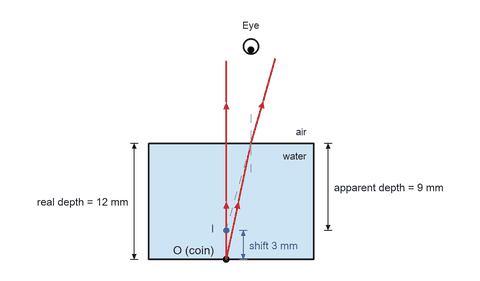
Step 5 — Part (b): the critical angle.
At the critical angle the refracted ray in air makes 90° with the normal, and Snell's law then gives
Watch out: The 3.0 mm is the SHIFT, not the apparent depth; the shift is only a quarter of the real depth for water.
Therefore, (a) the coin is 12 mm (1.2 cm) deep in the water; (b) sin C = 1/μ, so a larger refractive index means a smaller critical angle.
- 281 mark
Question 28
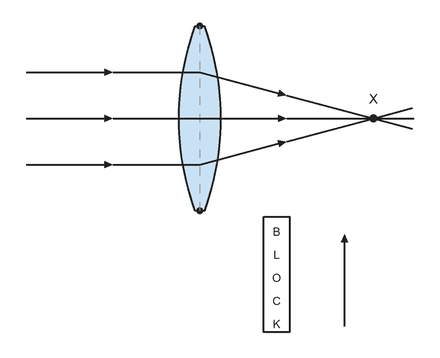
A block of glass is pushed into the path of the light as shown below. Then the converging point X will :
 Solve with AI
Answer
- Correct
(A) Move away from the slab
(B) Move towards the slab
(C) Not shift
(D) Move towards the left side of the lens
Answer: (A) Move away from the slab
Concept: A parallel-sided glass block does not change the direction of a ray; it only shifts it sideways (lateral displacement). For a converging beam this carries the meeting point farther along the beam.
Step 1 — What a parallel-sided block does to a ray.
Each converging ray bends towards the normal on entering the block and away from the normal on leaving it by the same amount, so it comes out parallel to its old path, shifted sideways.
Step 2 — Which way the rays are shifted.
Inside the block each ray is less steep, so it gets less close to the axis than it would have done. When it leaves, it is farther from the axis than before and still slopes the same way, so it reaches the axis later, at X′ beyond X.

Step 3 — How far the point moves.
For nearly axial rays the meeting point moves forward by about t(1 − 1/μ), where t is the thickness of the block; for a 1.2 cm block of μ = 1.5 that is about 0.4 cm. This is the same rule as the apparent rise of a coin seen through water.
Watch out: The block does not converge the light more; it leaves each ray parallel to its old path.
Why the other options are wrong:
- (B) Move towards the slab: the point would move towards the slab only if the block bent the rays more sharply towards the axis, but a parallel-sided block leaves every ray parallel to its old path.
- (C) Not shift: the sideways shift of each ray does move the crossing point; it stays at X only without the block.
- (D) Move towards the left side of the lens: the converging point stays on the far (right) side of the lens and moves farther to the right, not back across the lens.
Therefore, the converging point X moves away from the slab, option (A).
- 294 marks
Question 29
(a) Why do we use red colour as a danger signal on the top of a skyscraper?
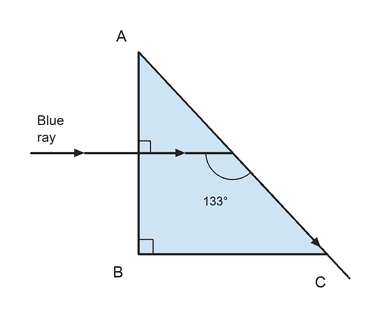
(b) The diagram below shows the path of a blue ray through the prism :
-
Calculate the critical angle of the material of the prism for blue colour.
-
What is the measure of the angle of this prism (A)?
-
Which colour should replace the blue ray, for the ray to undergo Total Internal Reflection?
Solve with AIWritten solution
Solution:
Concept: (a) The colour that is scattered least travels farthest through air. Critical angle (C): the angle of incidence in the denser medium for which the angle of refraction in the rarer medium is 90°. For glass or water to air, . Refractive index and colour: in glass or water, light of shorter wavelength travels more slowly, so the refractive index is larger for violet and blue light and smallest for red light (order: red < orange < yellow < green < blue < indigo < violet).
Given: A blue ray enters AB normally and emerges grazing along AC; the angle between the ray and AC is 133°.
Step 1 — Part (a): why red is used.
Red light has the longest wavelength in the visible spectrum, so it is scattered the least by air molecules, dust and fog. It travels farthest without fading and is seen from a long distance, so it is used as a danger signal.
Step 2 — Part (b) 1: find the angle of incidence at AC.
The figure shows 133° between the ray inside and the face AC (measured on the side of C). The normal to AC makes 90° with the face, so the angle between the ray and the normal is
Step 3 — Part (b) 1: recognise the critical angle.
The blue ray emerges grazing along AC (angle of refraction 90°), so this angle of incidence is the critical angle for blue light: C = 43°.

Step 4 — Part (b) 2: find the angle of the prism.
The ray inside is perpendicular to AB (it entered normally), and the normal at AC is perpendicular to AC. So the angle between the ray and the normal equals the angle between AB and AC, which is ∠A:
Step 5 — Part (b) 3: choose the colour for total internal reflection.
The angle of incidence stays 43°, so it must become greater than the critical angle. That needs a colour with a smaller critical angle, that is a larger refractive index than blue: violet (indigo would also do).
Watch out: 133° is the angle with the FACE; the angle of incidence is measured from the normal, so subtract 90°.
Therefore, (a) red light is scattered least, so it is seen from the farthest distance; (b) 1. the critical angle for blue light is 43°; 2. the angle of the prism A = 43°; 3. violet light (a colour with a larger refractive index than blue).
-
- 303 marks
Question 30
(a) Refractive index of glass with respect to water is . Find the refractive index of water with respect to glass.
(b) Name the principle used to find the value in part (a).
(c) If we change the temperature of water, then will the ratio remain the same? Write yes or no.
Solve with AIWritten solution
Solution:
Concept: Principle of reversibility: a ray of light that is reversed retraces its path. So the refractive index of medium 1 with respect to medium 2 is the reciprocal of that of medium 2 with respect to medium 1: .
Given: (glass with respect to water).
Step 1 — Part (a): use the reciprocal rule.
By the principle of reversibility, the refractive index of water with respect to glass is the reciprocal of that of glass with respect to water:
Step 2 — Part (a): put in the value.
We substitute :
Step 3 — Part (b): name the principle.
The principle of reversibility of the path of light: if a ray of light is reversed, it retraces its path.
Step 4 — Part (c): effect of temperature.
The answer is no. The refractive index of water depends on its temperature (it decreases as the water gets warmer), while that of glass changes very little. So changing the temperature of the water changes the ratio 9/8.
Watch out: The order of the subscripts matters: (glass with respect to water) and (water with respect to glass) are reciprocals.
Therefore, (a) the refractive index of water with respect to glass is 8/9 (about 0.89); (b) the principle of reversibility of light; (c) no.
- 313 marks
Question 31
Light travels a distance of ‘10x’ units in time ‘’ in vacuum and it travels a distance of ‘x’ units in time ‘’ in a denser medium. Using this information answer the question that follows :
(a) ‘Light covers a distance of ‘20x’ units in time ‘’ in diamond.’ State true or false.
(b) Calculate the refractive index of the medium in terms of ‘’ and ‘’.
Solve with AIWritten solution
Solution:
Concept: Refractive index and speed: , where c is the speed of light in vacuum (or air) and v its speed in the medium. Light is slower in a medium of larger refractive index.
Given: Light covers 10x in time in vacuum and x in time in a denser medium.
Step 1 — Write the two speeds.
Speed is distance divided by time. In vacuum light covers 10x in time ; in the medium it covers x in time :
Step 2 — Part (a): compare with diamond.
Light travels fastest in vacuum, covering 10x in time . In diamond (refractive index about 2.4) it travels more slowly, so in the same time it covers less than 10x, about 10x ÷ 2.4 ≈ 4x. It can never cover 20x. The statement is false.
Step 3 — Part (b): write the refractive index.
The refractive index is the speed in vacuum divided by the speed in the medium:
Step 4 — Part (b): substitute and simplify.
We put in the two speeds; dividing by a fraction means multiplying by its reciprocal, and x cancels:
Watch out: No material medium is faster than vacuum, so light can never cover MORE distance in a medium than in vacuum in the same time.
Therefore, (a) false; (b) .
- 324 marks
Question 32
A monochromatic ray of light is incident on an equilateral prism placed at minimum deviation position with an angle of incidence 45° as shown in the diagram.
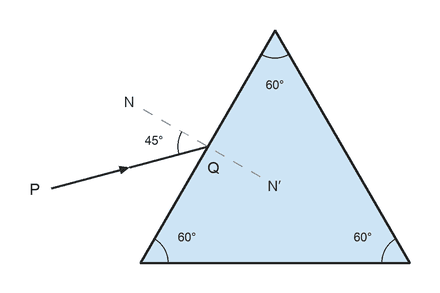
(a) Copy the diagram and complete the path of the ray PQ.
(b) State two factors on which the angle of deviation depends.
Solve with AIWritten solution
Solution:
Concept: Minimum deviation: as the angle of incidence increases, the deviation first decreases, reaches a least value , then increases. At minimum deviation the ray passes symmetrically: the ray inside is parallel to the base, and are equal (each is ), and the angle of emergence equals the angle of incidence. Prism: for a prism of angle A, the angle of deviation is , where is the angle of incidence and the angle of emergence. Inside, the angles of refraction at the two faces satisfy .
Given: Equilateral prism at minimum deviation; angle of incidence 45°.
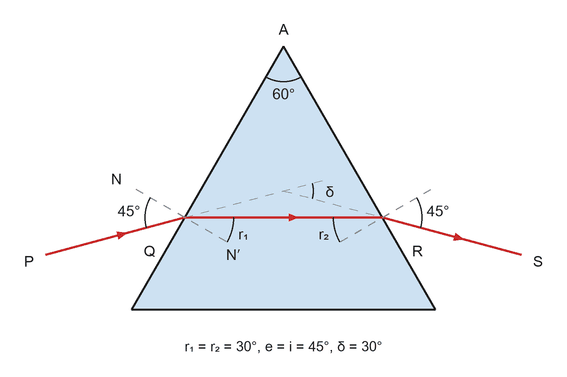
Step 1 — Part (a): the ray inside.
At minimum deviation the path is symmetrical. For an equilateral prism (A = 60°) the angle of refraction at Q is
So the ray bends towards the normal at Q and travels inside parallel to the base.
Step 2 — Part (a): the emergent ray.
At R the ray meets the second face at , bends away from the normal and emerges at an angle of emergence equal to the angle of incidence, 45°.
Step 3 — Part (a): the deviation.
The angle of (minimum) deviation is
For this to happen, the refractive index of the prism must be sin 45° ÷ sin 30° = √2 ≈ 1.41.
Step 4 — Part (b): factors on which the deviation depends.
The angle of deviation depends on: (1) the angle of incidence; (2) the material of the prism (its refractive index). It also depends on the angle of the prism and on the colour (wavelength) of the light.
Watch out: At minimum deviation the angle of emergence equals the angle of incidence (45°), not the angle of refraction (30°).
Therefore, (a) the ray refracts at Q to r₁ = 30°, travels parallel to the base, and emerges at R at e = 45° (deviation 30°); (b) the angle of incidence and the refractive index (material) of the prism.
- 331 mark
Question 33
When a ray of light passes from one optical medium to another, which of the following physical quantities does NOT change?
Solve with AIAnswer
(A) Amplitude of the wave
- Correct
(B) Frequency of the wave
(C) Wavelength of the wave
(D) Speed of the wave
Answer: (B) Frequency of the wave
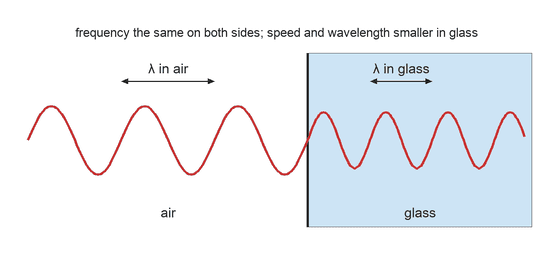
Concept: Speed, frequency and wavelength are linked by . On refraction the speed changes, the frequency stays the same (it is set by the source), so the wavelength changes.
Step 1 — What fixes the frequency.
The frequency of light is the number of waves the source sends out each second. The boundary cannot create or destroy waves, so the same number of waves per second passes into the second medium: the frequency does not change.
Step 2 — What the speed does.
On entering a denser medium, light slows down, so the speed v changes.
Step 3 — What the wavelength does.
Since v = fλ and f stays the same, the wavelength changes in the same ratio as the speed:
Watch out: The colour of light is fixed by its frequency, so it does not change in water or glass even though the wavelength does.
Why the other options are wrong:
- (A) Amplitude of the wave: part of the light is reflected at the boundary (and some may be absorbed), so the refracted wave carries less energy and its amplitude changes.
- (C) Wavelength of the wave: the wavelength changes with the speed (λ = v/f): it becomes shorter in a denser medium.
- (D) Speed of the wave: the change of speed is the very cause of refraction.
Therefore, the frequency of the wave does not change, option (B).
- 341 mark
Question 34
A ray of light is incident normally on a face of an equilateral prism.
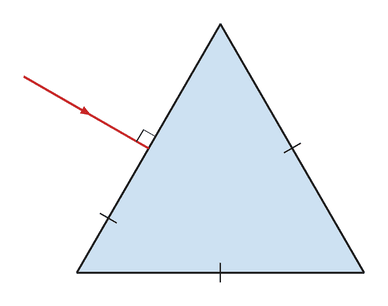
The ray gets totally reflected at the second refracting surface. The total deviation produced in the path of the ray is:
Solve with AIAnswer
(A) 30°
- Correct
(B) 60°
(C) 90°
(D) 120°
Answer: (B) 60°
Concept: A ray that meets a surface along the normal (angle of incidence 0°) passes into the next medium without bending (angle of refraction 0°). Total internal reflection: it happens only when light goes from a denser to a rarer medium and the angle of incidence is greater than the critical angle. Then no light is refracted out; all of it is reflected back, obeying the laws of reflection (angle of reflection = angle of incidence).
Step 1 — First face.
The ray enters normally (i = 0°), so it is not deviated there.
Step 2 — Angle of incidence at the second face.
The ray inside is perpendicular to the first face, and the normal at the second face is perpendicular to that face. So the angle of incidence equals the angle between the two faces, the prism angle, 60°. As 60° is more than the critical angle of glass (about 42°), the ray is totally reflected.
Step 3 — Deviation on reflection.
A reflection with angle of incidence i turns a ray through 180° − 2i:
Step 4 — Third face.
The reflected ray meets the third face along its normal (i = 0°) and leaves undeviated, so the total deviation stays 60°.
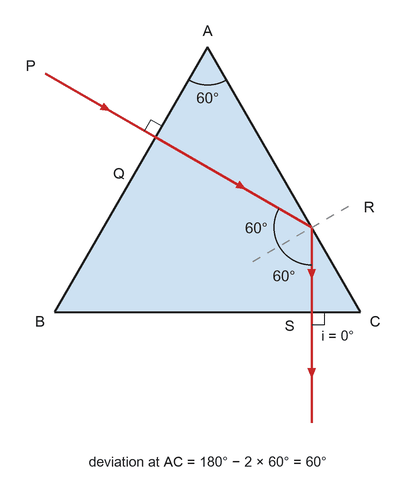
Watch out: The turn produced by a reflection is 180° − 2i, not 2i.
Why the other options are wrong:
- (A) 30°: 30° is the angle between the ray and the second face, not the turn of the ray.
- (C) 90°: a 90° turn needs reflection at 45°, as in a right-angled isosceles prism.
- (D) 120°: 120° is twice the angle of incidence (2 × 60°); the turn on reflection is 180° − 2i, not 2i.
Therefore, the total deviation is 60°, option (B).
- 351 mark
Question 35
Complete the following by choosing the correct answers from the bracket:
Refractive index of a medium is independent of ............... [temperature/angle of incidence/wavelength of light].
Solve with AIWritten solution
Solution:
Concept: Refraction: light bends when it passes obliquely from one medium into another because its speed changes. Going into an optically denser medium it bends towards the normal; going into a rarer medium it bends away from the normal. Snell's law: is a constant (the refractive index) for a given pair of media and a given colour of light. All angles are measured from the normal, not from the surface.
Step 1 — Recall what the refractive index depends on.
The refractive index depends on the material of the medium, its temperature, and the wavelength (colour) of the light.
Step 2 — Check the angle of incidence.
When the angle of incidence changes, the angle of refraction changes with it, but the ratio stays the same. So the refractive index does not depend on the angle of incidence.
Watch out: Temperature and wavelength DO change the refractive index; only the angle of incidence does not.
Therefore, the refractive index of a medium is independent of the angle of incidence.
- 362 marks
Question 36
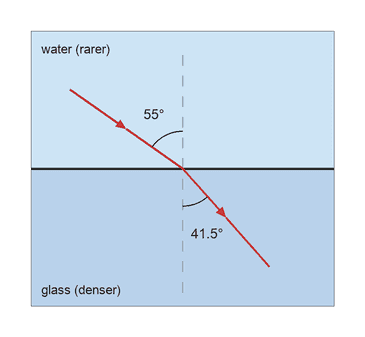
A ray of light enters a rectangular glass slab submerged in water at an angle of incidence 55°. Does this ray undergo total internal reflection when it moves from water to glass? Justify your answer. (The critical angle for glass–water interface is 54°)
Solve with AIWritten solution
Solution:
Concept: Total internal reflection: it happens only when light goes from a denser to a rarer medium and the angle of incidence is greater than the critical angle. Then no light is refracted out; all of it is reflected back, obeying the laws of reflection (angle of reflection = angle of incidence).
Given: A ray goes from water into glass at an angle of incidence of 55°; critical angle for glass–water 54°.
Step 1 — Identify the direction of travel.
The ray goes from water (rarer) into glass (denser). Glass is optically denser than water.
Step 2 — Apply the condition for total internal reflection.
Total internal reflection can happen only when light goes from a denser to a rarer medium. Going from water into glass, the ray bends towards the normal, so a refracted ray always exists, however large the angle of incidence.
Step 3 — Explain why 55° and 54° are not compared.
The critical angle of 54° applies to light going the other way, from glass into water. So comparing 55° with 54° does not apply here.
Step 4 — Find the actual angle of refraction.
For the glass–water pair, sin 54° = μ(water)/μ(glass). Going from water into glass, Snell's law gives sin r = sin 55° × sin 54°:
Watch out: Total internal reflection needs light going from the denser to the rarer medium; a large angle alone is not enough.
Therefore, no, the ray does not undergo total internal reflection: it is going from a rarer medium (water) into a denser medium (glass), so it simply refracts into the glass (at about 41.5°), bending towards the normal.
- 373 marks
Question 37
(a) Out of the three rays (I, J, H) shown in the diagram, which ray will suffer Total Internal Reflection while inside the prism? (Critical angle of the prism is 42°.)

(b) Copy the diagram to complete the path of the ray which you have named in (a) till it comes out of the prism.
Solve with AIWritten solution
Solution:
Concept: A ray that meets a surface along the normal (angle of incidence 0°) passes into the next medium without bending (angle of refraction 0°). Total internal reflection: it happens only when light goes from a denser to a rarer medium and the angle of incidence is greater than the critical angle. Then no light is refracted out; all of it is reflected back, obeying the laws of reflection (angle of reflection = angle of incidence).
Given: A 30°–60°–90° prism; rays I, J (normal to the slant face) and H (normal to the base); critical angle 42°.
Step 1 — Part (a): ray J.
J enters the slant face normally, so it goes straight in, perpendicular to the slant face. Near the top it reaches the vertical face first. The angle of incidence there equals the angle between the slant face and the vertical face, 60°, which is greater than 42°, so J is totally reflected.
Step 2 — Part (a): rays I and H.
Ray I (normal to the slant face) reaches the base, and ray H (normal to the base) reaches the slant face. In each case the angle of incidence equals the 30° angle between those two faces, which is less than 42°, so I and H simply refract out.
Step 3 — Part (b): path of J at the base.
After reflection at the vertical face (angle of reflection 60°), J travels down to the base and meets it at an angle of incidence of 30°. As 30° < 42°, it refracts out into air, bending away from the normal:
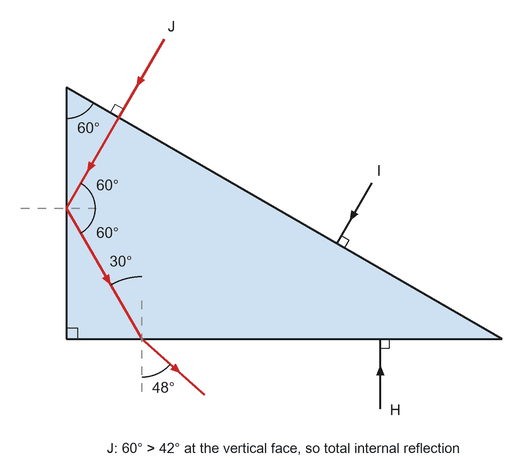
Watch out: Angles of incidence and refraction are measured from the normal; if a figure gives the angle with the surface, subtract it from 90°.
Therefore, (a) ray J suffers total internal reflection (at the vertical face, i = 60°); (b) J enters undeviated, is totally reflected at the vertical face and refracts out through the base (i = 30°), bending away from the normal at about 48°.
- 383 marks
Question 38
A rectangular glass block of refractive index 1.5 has an air bubble trapped inside it as shown in the diagram. When seen from the surface AB, it appears to be 4 cm deep.
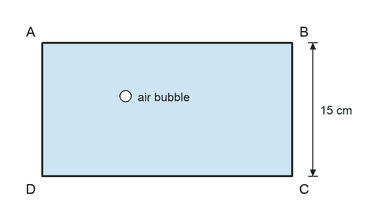
(a) Calculate the actual depth of the air bubble from the surface AB.
(b) For which colour of light, blue or yellow, the apparent depth will be greater?
(c) Turning the glass block upside down, DOES NOT change the apparent depth of the air bubble. State True or False.
Solve with AIWritten solution
Solution:
Concept: Real and apparent depth: an object inside a denser medium, seen from above (nearly along the normal), appears raised, because rays from it bend away from the normal on coming out. , and the shift (apparent rise) is real depth − apparent depth. Refractive index and colour: in glass or water, light of shorter wavelength travels more slowly, so the refractive index is larger for violet and blue light and smallest for red light (order: red < orange < yellow < green < blue < indigo < violet).
Given: Μ = 1.5; block 15 cm thick; seen from AB the bubble appears 4 cm deep.
Step 1 — Part (a): write the relation.
Seen from AB, μ = real depth ÷ apparent depth, so
Step 2 — Part (a): put in the values.
We substitute μ = 1.5 and apparent depth = 4 cm:
Step 3 — Part (b): blue or yellow.
The refractive index of glass is less for yellow light than for blue light. Since apparent depth = real depth ÷ μ, a smaller μ gives a greater apparent depth. So the apparent depth is greater for yellow light.
Step 4 — Part (c): turn the block over.
Seen from DC, the bubble's real depth is measured from DC instead:
This is 6 cm, not 4 cm, so the statement is false: the bubble is not at the middle of the block.
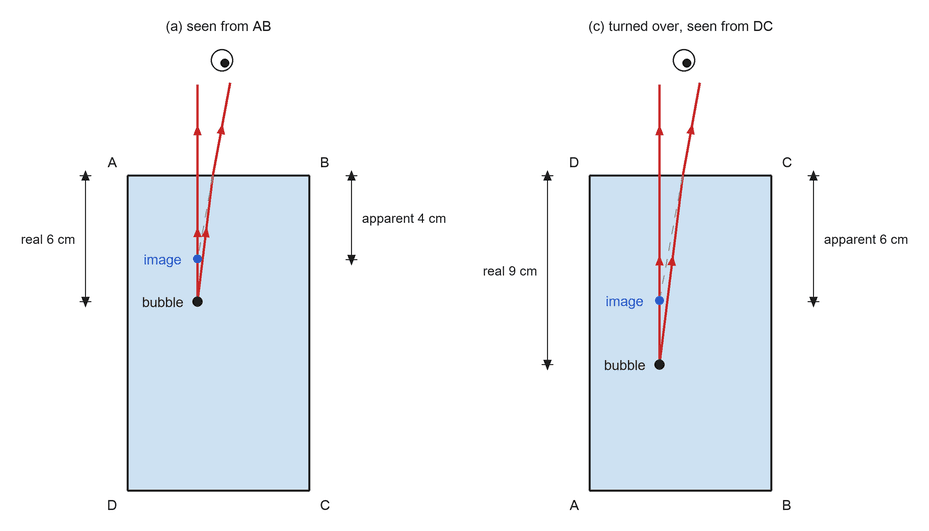
Watch out: After turning the block over, measure the real depth from the NEW top face DC (15 − 6 = 9 cm).
Therefore, (a) the bubble is 6 cm below AB; (b) yellow light; (c) false (from DC it appears 6 cm deep).
- 393 marks
Question 39
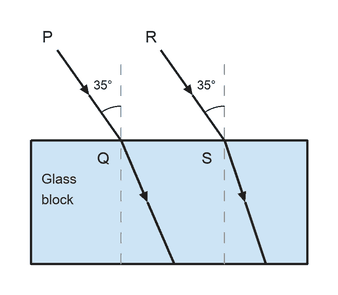
Two rays PQ and RS are incident on a rectangular glass block as shown in the diagram. Observe the diagram and answer the questions that follow.
Which of these two rays will :
(a) have greater lateral displacement on emerging out of the block?
(b) travel with greater speed in the block?
(c) scatter more in the atmosphere?
Solve with AIWritten solution
Solution:
Concept: Refraction: light bends when it passes obliquely from one medium into another because its speed changes. Going into an optically denser medium it bends towards the normal; going into a rarer medium it bends away from the normal. Snell's law: is a constant (the refractive index) for a given pair of media and a given colour of light. All angles are measured from the normal, not from the surface. Refractive index and colour: in glass or water, light of shorter wavelength travels more slowly, so the refractive index is larger for violet and blue light and smallest for red light (order: red < orange < yellow < green < blue < indigo < violet). Refractive index and speed: , where c is the speed of light in vacuum (or air) and v its speed in the medium. Light is slower in a medium of larger refractive index.
Given: Rays PQ and RS fall on a glass block at 35°; RS bends more inside.
Step 1 — Read the figure.
Both rays meet the block at the same angle of incidence, 35°, but RS bends closer to the normal inside the block (smaller angle of refraction). So the glass has a larger refractive index for RS: RS is light nearer the violet end, PQ nearer the red end.
Step 2 — Part (a): greater lateral displacement.
For the same block and the same angle of incidence, the ray that bends more is shifted sideways more. So RS has the greater lateral displacement (d₂ > d₁).
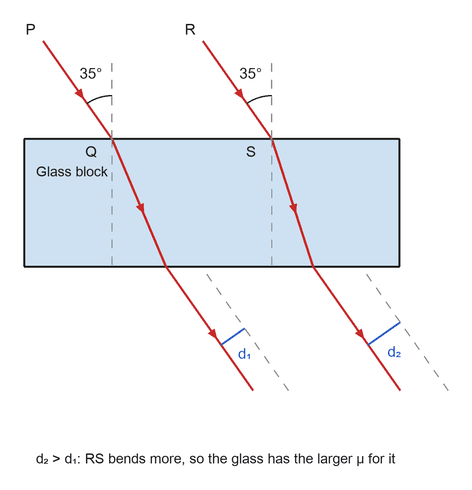
Step 3 — Part (b): greater speed in the block.
Since μ = c/v, the smaller refractive index goes with the larger speed. PQ bends less, so PQ travels faster in the block.
Step 4 — Part (c): more scattering in the atmosphere.
A larger refractive index means a shorter wavelength (towards blue–violet), and shorter wavelengths are scattered more. So RS scatters more.
Watch out: Judge each ray by how much it bends at the SAME angle of incidence; the ray that bends more has the larger μ.
Therefore, (a) RS; (b) PQ; (c) RS.
- 401 mark
Question 40
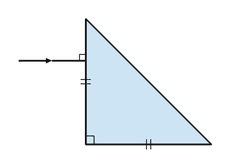
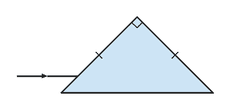
Which of the following figures will depict deviation of a ray of light through 90° when it emerges out of the prism.
Solve with AIAnswer
- Correct
(A)
(B)
(C)

(D)

Answer: (A)
Concept: A right-angled isosceles prism (angles 90°, 45°, 45°) of glass (critical angle about 42°) can act as a perfect mirror: a ray entering a face normally meets the next face at 45°, which is more than 42°, so it is totally reflected.
Step 1 — Figure (A).
The ray enters a short face of the right-angled isosceles prism normally and goes straight on. It meets the hypotenuse at 45°, more than the critical angle of glass (about 42°), so it is totally reflected and turned through 180° − 2 × 45° = 90°. It leaves the other short face normally.
Step 2 — Check the other figures.
Tracing each of the other three figures (below) gives deviations of 0°, 180° and about 19°, so only (A) turns the ray through 90°.
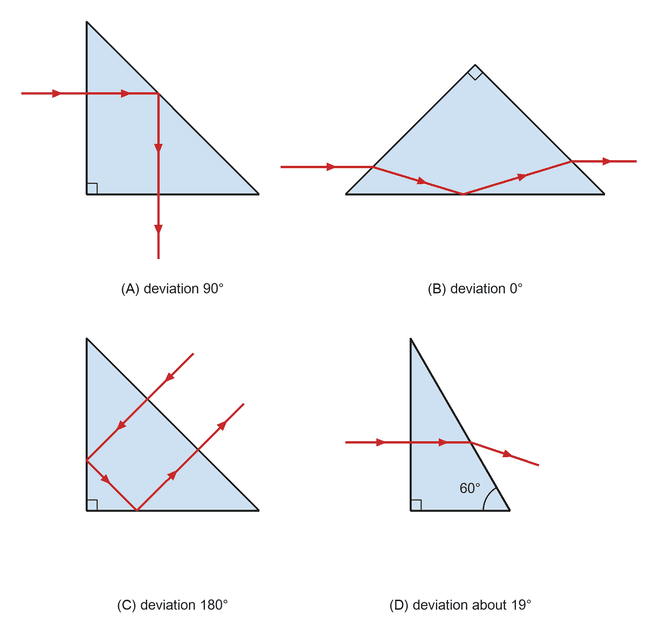
Watch out: A 90° turn needs the ray to meet the hypotenuse at 45° after entering a short face normally.
Why the other options are wrong:
- (B): the ray falls on a short face parallel to the hypotenuse (the erecting-prism position); after total reflection at the hypotenuse it leaves parallel to its original direction, so the deviation is 0°.
- (C): the ray enters the hypotenuse normally and is totally reflected at both short faces, so it comes back the way it came: deviation 180°.
- (D): the ray meets the slant face at only 30° (less than 42°), so it refracts out with a small deviation of about 19°, not 90°.
Therefore, figure (A) shows the ray deviated through 90°, option (A).
- 411 mark
Question 41
Complete the following by choosing the correct answers from the bracket:
If different colours of light strike a rectangular glass block at same angle of incidence, then maximum lateral displacement will be shown by ............... [Red / Green / Blue] colour.
Solve with AIWritten solution
Solution:
Concept: Refractive index and colour: in glass or water, light of shorter wavelength travels more slowly, so the refractive index is larger for violet and blue light and smallest for red light (order: red < orange < yellow < green < blue < indigo < violet).
Step 1 — Link the displacement to the bending.
For a block of given thickness and a given angle of incidence, the lateral displacement is larger when the ray bends more, that is, when the refractive index is larger.
Step 2 — Compare the colours.
Of red, green and blue, blue has the shortest wavelength, so glass has the largest refractive index for blue light. Blue bends the most inside the block and is shifted the most sideways.
Watch out: The colour with the largest wavelength (red) bends LEAST and so has the smallest lateral displacement.
Therefore, maximum lateral displacement will be shown by blue colour.
- 422 marks
Question 42
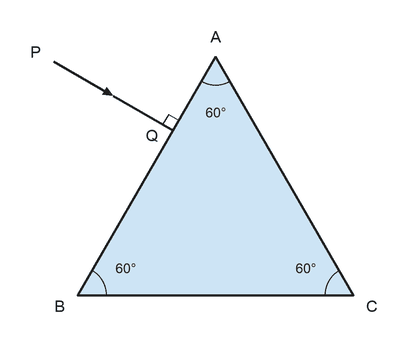
A ray of light PQ is incident normally on the face AB of an equilateral prism. The ray gets totally reflected from the surface AC.
Calculate:
(a) the angle of deviation at AC.
(b) the angle of incidence at BC.
Solve with AIWritten solution
Solution:
Concept: A ray that meets a surface along the normal (angle of incidence 0°) passes into the next medium without bending (angle of refraction 0°). Total internal reflection: it happens only when light goes from a denser to a rarer medium and the angle of incidence is greater than the critical angle. Then no light is refracted out; all of it is reflected back, obeying the laws of reflection (angle of reflection = angle of incidence).
Given: Equilateral prism ABC; PQ normal to AB; the ray is totally reflected at AC.
Step 1 — Part (a): angle of incidence at AC.
PQ enters AB normally, so it is not bent. The ray inside is perpendicular to AB, and the normal at AC is perpendicular to AC, so the angle of incidence at AC equals the angle between AB and AC, the prism angle:
Step 2 — Part (a): deviation at AC.
On total reflection the ray turns through 180° − 2i:
Step 3 — Part (b): angle of incidence at BC.
The ray was travelling at 30° below the horizontal; turning it through 60° makes it travel straight down, perpendicular to BC. So it meets BC along the normal: the angle of incidence at BC is 0°, and it leaves BC undeviated.
Watch out: The deviation on reflection is 180° − 2i (= 60°), not the angle of incidence itself (also 60° here, by coincidence).
Therefore, (a) the angle of deviation at AC is 60°; (b) the angle of incidence at BC is 0°.
- 433 marks
Question 43
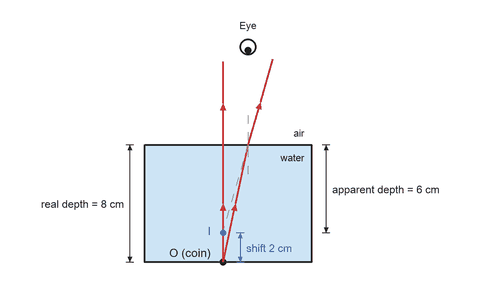
(a) A coin lies at the bottom of a beaker. Water is poured into the beaker upto a height of 8 cm. Calculate the shift seen in the position of the coin.
(The refractive index of water is 4/3. The width of the glass wall of the beaker is negligible.)
(b) How will the apparent depth be affected if the temperature of water is increased?
Solve with AIWritten solution
Solution:
Concept: Real and apparent depth: an object inside a denser medium, seen from above (nearly along the normal), appears raised, because rays from it bend away from the normal on coming out. , and the shift (apparent rise) is real depth − apparent depth.
Given: Water 8 cm deep; μ = 4/3; glass wall negligible.
Step 1 — Part (a): write the shift.
The thin glass wall can be ignored, so only the 8 cm of water matters. The apparent depth is real depth ÷ μ, so the shift is
Step 2 — Part (a): put in the values.
With μ = 4/3, the bracket is 1 − 3/4 = 1/4:
The coin appears 8 − 2 = 6 cm deep instead of 8 cm.
Step 3 — Part (b): effect of warming the water.
Warming lowers the refractive index of water. Since apparent depth = real depth ÷ μ, a smaller μ gives a larger apparent depth: the coin appears less raised.
Watch out: The shift is real depth × (1 − 1/μ), not real depth ÷ μ (that is the apparent depth).
Therefore, (a) the coin appears raised by 2 cm (it looks 6 cm deep); (b) the apparent depth increases.
- 443 marks
Question 44
Draw a ray diagram to invert the image without deviation of light using right angle isosceles prism.
Solve with AIWritten solution
Solution:
Concept: A right-angled isosceles prism (angles 90°, 45°, 45°) of glass (critical angle about 42°) can act as a perfect mirror: a ray entering a face normally meets the next face at 45°, which is more than 42°, so it is totally reflected.
Step 1 — Place the prism.
Draw a right-angled isosceles prism with its hypotenuse as the base. Draw two rays from the top and bottom of the object falling on one short face, parallel to the base.
Step 2 — Refraction at the first face.
The rays refract into the glass, bending towards the normal, and travel down towards the hypotenuse.
Step 3 — Total internal reflection at the hypotenuse.
They meet the hypotenuse at an angle of incidence greater than 42° (about 73° for glass of μ = 1.5), so they are totally reflected upwards.
Step 4 — Emergence.
They refract out of the other short face and travel parallel to their original direction: there is no deviation.

Step 5 — See the inversion.
The ray from the top of the object comes out at the bottom, and the ray from the bottom comes out at the top. So the image is inverted, while the light carries on in its original direction.
Watch out: The rays must fall parallel to the hypotenuse; entering a short face normally would turn them through 90° instead.
Therefore, rays falling parallel to the hypotenuse of a right-angled isosceles prism are totally reflected at the hypotenuse and leave parallel to their original direction with top and bottom interchanged, so the image is inverted without deviation.
- 453 marks
Question 45
The diagram given below shows a triangular prism of a certain material with fluorescent screen placed adjacent to it. The yellow light ray striking the surface ST of the prism shows a fluorescent spot at point X.
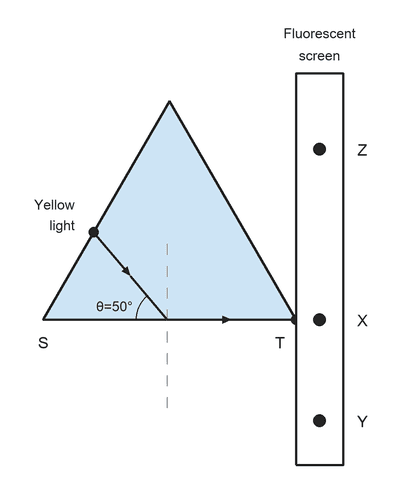
(a) Calculate the critical angle of the material of the prism for yellow colour.
(b) To move the fluorescent spot towards Y, the value of θ should be ............... [> 50, < 50 or = 50].
(c) Which direction will the fluorescent spot move if yellow light is replaced with indigo light? (towards Y or towards Z)
Solve with AIWritten solution
Solution:
Concept: Critical angle (C): the angle of incidence in the denser medium for which the angle of refraction in the rarer medium is 90°. For glass or water to air, . Refractive index and colour: in glass or water, light of shorter wavelength travels more slowly, so the refractive index is larger for violet and blue light and smallest for red light (order: red < orange < yellow < green < blue < indigo < violet).
Given: Yellow ray inside the prism makes θ = 50° with ST and emerges along ST to X.
Step 1 — Part (a): find the angle of incidence at ST.
The yellow ray reaches X by travelling along ST, so at the base it is refracted at 90°. The ray inside makes θ = 50° with the surface ST; the angle of incidence is measured from the normal:
Step 2 — Part (a): recognise the critical angle.
An angle of refraction of 90° means this angle of incidence is the critical angle: C = 40° for yellow light (a refractive index of 1/sin 40° ≈ 1.56).
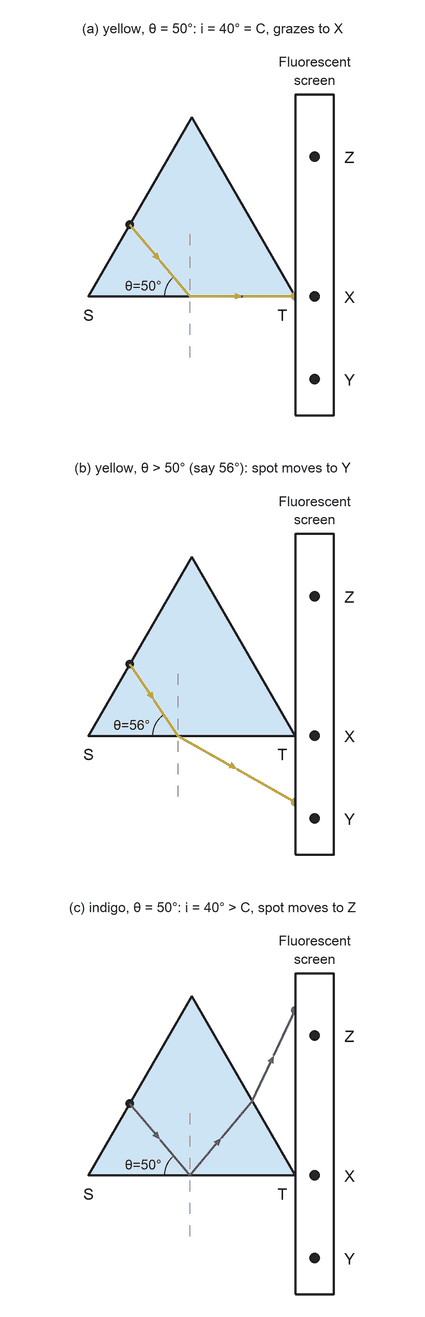
Step 3 — Part (b): move the spot towards Y.
To reach Y (below X), the ray must come out through ST and go downwards, so its angle of incidence must be less than 40°. Since i = 90° − θ, a smaller i needs a larger θ: θ > 50°.
Step 4 — Part (c): indigo light.
The prism's refractive index is greater for indigo than for yellow, so its critical angle for indigo is less than 40°. The ray still meets ST at 40°, now greater than the critical angle, so it is totally reflected upwards, leaves through the other face and strikes the screen above X. The spot moves towards Z.
Watch out: Θ is measured from the SURFACE; the angle of incidence is 90° − θ.
Therefore, (a) the critical angle for yellow light is 40°; (b) θ should be > 50; (c) the spot moves towards Z.
- 461 mark
Question 46
From the figure given below, the refractive index of medium B with respect to medium A () is:
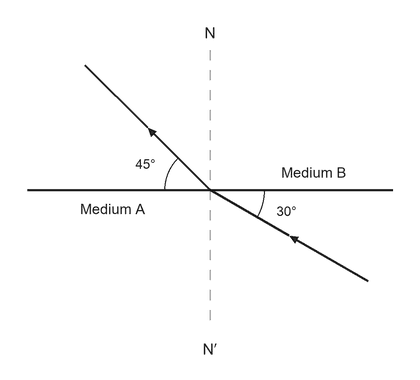 Solve with AI
Answer
(A)
(B)
(C)
- Correct
(D)
Answer: (D)
Concept: Refraction: light bends when it passes obliquely from one medium into another because its speed changes. Going into an optically denser medium it bends towards the normal; going into a rarer medium it bends away from the normal. Snell's law: is a constant (the refractive index) for a given pair of media and a given colour of light. All angles are measured from the normal, not from the surface.
Step 1 — Find the direction of the light.
The arrows show the light going from medium A into medium B. So the angle in A is the angle of incidence and the angle in B is the angle of refraction.
Step 2 — Angle of incidence (in A).
The ray in A makes 30° with the surface, so with the normal it makes
Step 3 — Angle of refraction (in B).
The ray in B makes 45° with the surface, so with the normal it makes
Step 4 — Write the refractive index.
The refractive index of B with respect to A is sin i ÷ sin r:
Its value is about 1.22, more than 1: the ray bends towards the normal in B, so B is the denser medium.
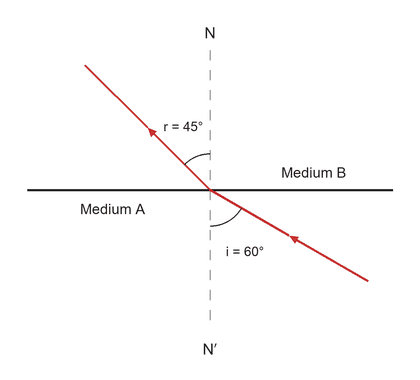
Watch out: Angles of incidence and refraction are measured from the normal; if a figure gives the angle with the surface, subtract it from 90°.
Why the other options are wrong:
- (A): it puts the angle in B on top and uses the 30° angle with the surface for A instead of the 60° angle of incidence.
- (B): it uses the angles with the surface (30° and 45°); those are not the angles of incidence and refraction.
- (C): it is the ratio upside down, sin r ÷ sin i, which is the refractive index of A with respect to B.
Therefore, , option (D).
- 471 mark
Question 47
Complete the following by choosing the correct answers from the bracket:
When a ray of light passes from a denser to a rarer medium, its wavelength ............... [decreases / increases].
Solve with AIWritten solution
Solution:
Concept: The frequency of light is fixed by its source and does not change on refraction; speed = frequency × wavelength.
Step 1 — Compare the speeds.
Light travels faster in the rarer medium than in the denser medium.
Step 2 — Use the wave equation.
The frequency does not change on refraction, and the wavelength is speed divided by frequency:
A larger speed v with the same f gives a larger wavelength.
Watch out: The frequency stays the same; it is the speed and the wavelength that change together.
Therefore, when a ray of light passes from a denser to a rarer medium, its wavelength increases.
- 483 marks
Question 48
A monochromatic ray strikes the surface of identical prisms (A, B and C) at different angles of incidence. The diagram below shows their refracted rays. Study the path of these refracted rays and identify in which of the diagrams:
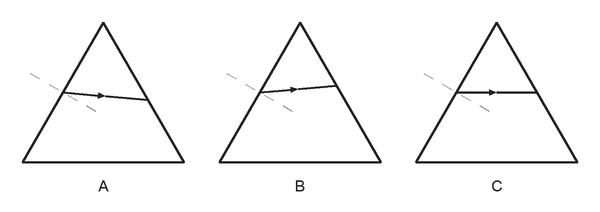
(a) the angle of incidence is maximum.
(b) the angle of incidence is minimum.
(c) the angle of incidence is equal to the angle of emergence.
Solve with AIWritten solution
Solution:
Concept: Refraction: light bends when it passes obliquely from one medium into another because its speed changes. Going into an optically denser medium it bends towards the normal; going into a rarer medium it bends away from the normal. Snell's law: is a constant (the refractive index) for a given pair of media and a given colour of light. All angles are measured from the normal, not from the surface. Minimum deviation: as the angle of incidence increases, the deviation first decreases, reaches a least value , then increases. At minimum deviation the ray passes symmetrically: the ray inside is parallel to the base, and are equal (each is ), and the angle of emergence equals the angle of incidence.
Given: Identical prisms A, B, C; the same monochromatic ray at different angles of incidence.
Step 1 — Relate the angle of incidence to the ray inside.
At the first face sin i = μ sin r, so the larger the angle of incidence, the larger the angle of refraction: the refracted ray turns farther from the normal, that is, more upwards towards the apex.
Step 2 — Read the three diagrams.
The ray enters at the same point with the same normal in all three. In A the refracted ray slopes down (closest to the normal, smallest r). In C it is parallel to the base. In B it slopes up (farthest from the normal, largest r).
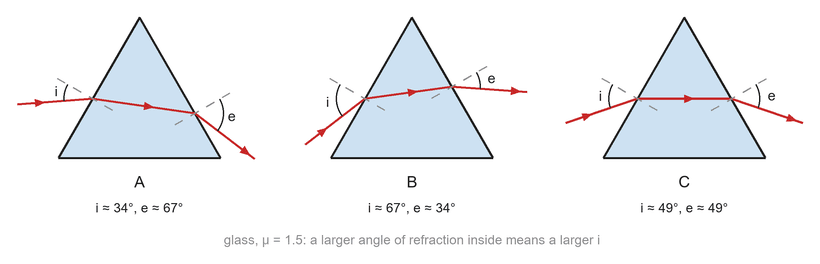
Step 3 — Parts (a) and (b).
The largest angle of refraction goes with the largest angle of incidence: B. The smallest goes with the smallest: A.
Step 4 — Part (c).
When the ray inside is parallel to the base, it passes symmetrically through the prism, so i = e (minimum deviation): C.
Watch out: A refracted ray sloping UP inside the prism has the LARGER angle of refraction (it is farther from the inward normal, which points down).
Therefore, (a) prism B; (b) prism A; (c) prism C.
- 493 marks
Question 49
A ray of light enters a glass block from air and comes out from the opposite surface. If the angle of refraction at the first surface is not the same as the angle of incidence at the second surface, then:
(a) What is the product of the ratio at the first surface and at the second surface?
(b) State whether the opposite surfaces are parallel or not parallel.
(c) How did you reach the conclusion in (b) above?
Solve with AIWritten solution
Solution:
Concept: Refraction: light bends when it passes obliquely from one medium into another because its speed changes. Going into an optically denser medium it bends towards the normal; going into a rarer medium it bends away from the normal. Snell's law: is a constant (the refractive index) for a given pair of media and a given colour of light. All angles are measured from the normal, not from the surface. Principle of reversibility: a ray of light that is reversed retraces its path. So the refractive index of medium 1 with respect to medium 2 is the reciprocal of that of medium 2 with respect to medium 1: .
Step 1 — Part (a): the ratio at the first surface.
Going from air into glass, Snell's law gives
Step 2 — Part (a): the ratio at the second surface.
Going from glass back into air, the ratio is the reciprocal:
Step 3 — Part (a): multiply.
The product of the two ratios is
This holds whether or not the surfaces are parallel.
Step 4 — Part (b): decide.
The opposite surfaces are not parallel.
Step 5 — Part (c): give the reason.
If the surfaces were parallel, their normals would be parallel too. The ray inside would then cut the two parallel normals at equal alternate angles, so the angle of refraction at the first surface would equal the angle of incidence at the second. Here these angles are not equal, so the normals, and therefore the surfaces, are not parallel.
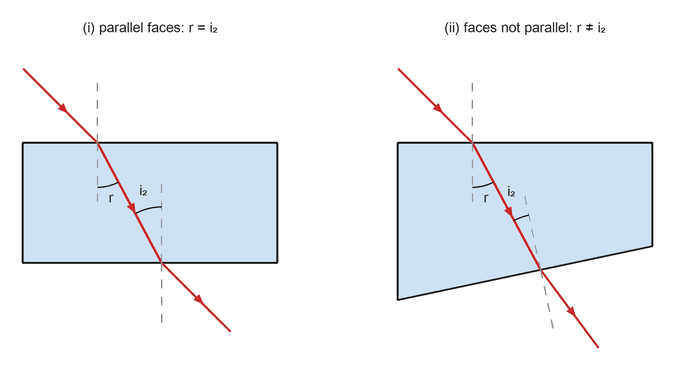
Watch out: The product of the two ratios is 1 for ANY block; it is the equality r₁ = i₂ that needs parallel faces.
Therefore, (a) the product is 1; (b) the surfaces are not parallel; (c) for parallel surfaces the normals are parallel, so r at the first surface would equal i at the second (alternate angles); they are unequal here.
- 503 marks
Question 50
A type of glass block has a refractive index of 1.8.
(a) Calculate the speed of light in this glass. (Given speed of light in air )
(b) If the width of this block is doubled, then what will be the speed of light in the block?
Solve with AIWritten solution
Solution:
Concept: Refractive index and speed: , where c is the speed of light in vacuum (or air) and v its speed in the medium. Light is slower in a medium of larger refractive index.
Given: Μ = 1.8; c = m s⁻¹.
Step 1 — Part (a): write the formula.
The refractive index is the speed of light in air divided by its speed in the glass, so
Step 2 — Part (a): put in the values.
We substitute c = m s⁻¹ and μ = 1.8:
Light travels a little more than half as fast in this glass as in air.
Step 3 — Part (b): width doubled.
The speed of light in a medium depends on the material (its refractive index), not on the size of the block. So the speed stays m s⁻¹; a wider block only makes the light take longer to cross it.
Watch out: Divide c by μ; multiplying would give a speed faster than light in vacuum, which is impossible.
Therefore, (a) the speed of light in the glass is about m s⁻¹; (b) it stays m s⁻¹.
- 514 marks
Question 51
(a) Name the electromagnetic radiation used to detect fake currency.
(b) Redraw the diagram given below and complete the path of the light ray AB through the glass prism till it emerges out of the prism. Critical angle of the glass is 42°.
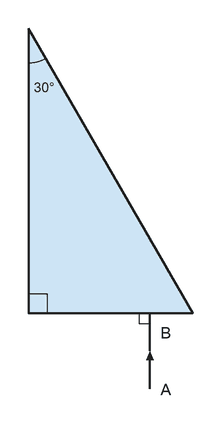 Solve with AI
Written solution
Solution:
Concept: (a) Some substances fluoresce (glow) under ultraviolet light. (b) A ray that meets a surface along the normal (angle of incidence 0°) passes into the next medium without bending (angle of refraction 0°). Total internal reflection: it happens only when light goes from a denser to a rarer medium and the angle of incidence is greater than the critical angle. Then no light is refracted out; all of it is reflected back, obeying the laws of reflection (angle of reflection = angle of incidence).
Given: 30°–60°–90° prism with 30° at the top; AB enters the base normally; critical angle 42°.
Step 1 — Part (a): fake currency.
The radiation used is ultraviolet (U.V.) radiation. Security marks printed on genuine notes glow (fluoresce) under ultraviolet light; a fake note lacks them.
Step 2 — Part (b): at B on the base.
AB falls normally on the base, so i = 0° and the ray goes straight up into the prism.
Step 3 — Part (b): angle of incidence at the slant face.
The angle between the base and the slant face is 90° − 30° = 60°, and the ray is perpendicular to the base, so it meets the slant face at an angle of incidence of 60°. Since 60° > 42°, it is totally internally reflected.
Step 4 — Part (b): at the vertical face.
The reflected ray travels up to the left and meets the vertical face at an angle of incidence of 30°. Since 30° < 42°, it refracts out into air, bending away from the normal:

Watch out: Angles of incidence and refraction are measured from the normal; if a figure gives the angle with the surface, subtract it from 90°.
Therefore, (a) ultraviolet radiation; (b) the ray is totally reflected at the slant face (i = 60°) and emerges through the vertical face (i = 30°), bending away from the normal at about 48°.
- 521 mark
Question 52
The net angle of deviation produced by the prism in the diagram shown below is ...............
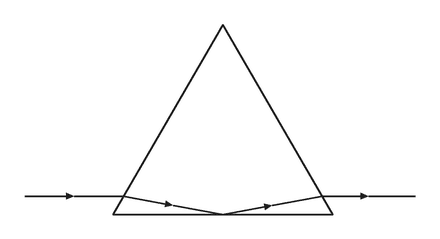 Solve with AI
Answer
- Correct
(A) 0°
(B) 60°
(C) 90°
(D) 180°
Answer: (A) 0°
Concept: Net deviation is the angle between the incident ray and the final emergent ray. If they are parallel and point the same way, the net deviation is zero.
Step 1 — First face.
The incident ray is parallel to the base. It meets the first face at 30° and bends towards the base on entering the glass.
Step 2 — At the base.
It meets the base at an angle of incidence of about 79°, far more than 42°, so it is totally reflected.
Step 3 — Second face.
The two faces slope equally on either side, so after the reflection the ray meets the second face at the same angle at which it left the first face. It therefore comes out parallel to the base, travelling in the same direction as the incident ray.
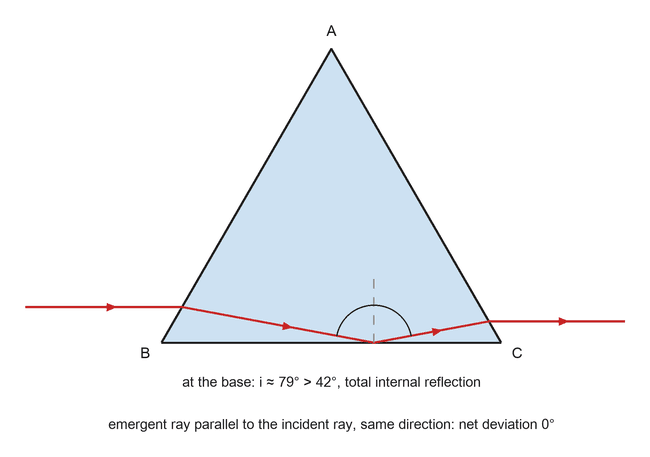
Step 4 — Net deviation.
Net deviation is the angle between the incident ray and the final emergent ray. They are parallel and point the same way, so the net deviation is 0°: the bends at the faces and the reflection at the base cancel out overall.
Watch out: The 60° angle of the prism is not a deviation; look at the directions of the rays only.
Why the other options are wrong:
- (B) 60°: 60° is the angle of the prism, not the deviation of the ray.
- (C) 90°: a 90° turn would make the ray leave perpendicular to its original direction, as in a right-angled isosceles prism entered normally.
- (D) 180°: 180° would send the ray back the way it came; here it goes on in the same direction.
Therefore, the net angle of deviation is 0°, option (A).
- 531 mark
Question 53
A crack in a glass vessel often shines, like a mirror, in sunlight. Which of the following phenomenon of light is responsible for this?
Solve with AIAnswer
(A) reflection
(B) refraction
(C) dispersion
- Correct
(D) total internal reflection
Answer: (D) total internal reflection
Concept: Total internal reflection: it happens only when light goes from a denser to a rarer medium and the angle of incidence is greater than the critical angle. Then no light is refracted out; all of it is reflected back, obeying the laws of reflection (angle of reflection = angle of incidence).
Step 1 — Identify the two media.
A crack in glass is a thin layer of air (rarer) inside glass (denser).
Step 2 — Compare with the critical angle.
Sunlight inside the glass meets the surface of the crack, going from glass to air. Where it strikes at an angle greater than the critical angle of glass (about 42°), all of it is totally reflected.
Step 3 — Explain the shine.
This bright reflected light reaches the eye, so the crack shines like a mirror.
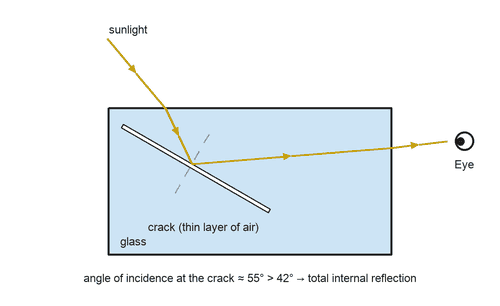
Watch out: Ordinary reflection at a glass–air surface returns only a few per cent of the light; the mirror-like shine needs TOTAL reflection.
Why the other options are wrong:
- (A) reflection: ordinary (partial) reflection at glass sends back only a small fraction of the light, not enough for a mirror-like shine.
- (B) refraction: refraction lets light pass through the crack; it does not make the crack shine.
- (C) dispersion: dispersion splits white light into colours; it does not cause a mirror-like shine.
Therefore, the crack shines because of total internal reflection, option (D).
- 541 mark
Question 54
Complete the following by choosing the correct answers from the bracket:
Out of multiple images of an object, formed by a thick plane glass mirror, the ............... [first / second] image is the brightest.
Solve with AIWritten solution
Solution:
Concept: A thick plane glass mirror reflects light at two surfaces: weakly at the front glass surface and strongly at the silvered back surface. Repeated reflections inside the glass give several images.
Step 1 — First image.
The front (unsilvered) glass surface reflects only a small part of the light, so the first image I₁ is faint.
Step 2 — Second image.
Most of the light enters the glass, is reflected strongly by the silvered back surface and comes out again. This gives the second image I₂, which is the brightest.
Step 3 — Further images.
Light reflected again inside the glass gives further images I₃, … which become fainter and fainter.
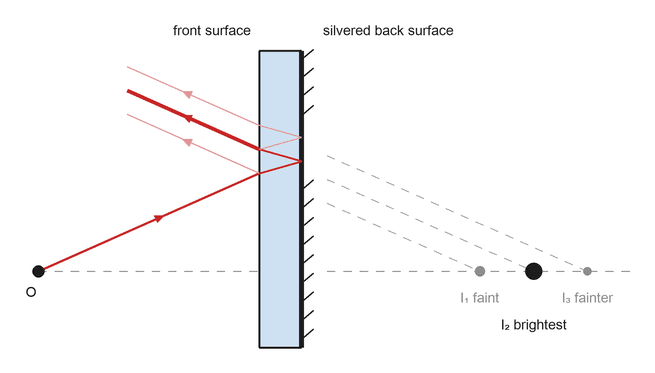
Watch out: The FIRST image is formed by the front glass surface, not by the silvering, so it is faint.
Therefore, the second image is the brightest.
- 553 marks
Question 55
Two beakers A and B contain kerosene oil and water respectively. The speed of light in water is and in kerosene oil .
(a) In which liquid will the angle of refraction be more, when light ray strikes the surface of both liquids at the same angle of incidence?
(b) Calculate the ratio of refractive indices of water to kerosene oil.
(c) If liquid A is heated, what change will you expect in the path of the refracted ray?
Solve with AIWritten solution
Solution:
Concept: Refractive index and speed: , where c is the speed of light in vacuum (or air) and v its speed in the medium. Light is slower in a medium of larger refractive index. Refraction: light bends when it passes obliquely from one medium into another because its speed changes. Going into an optically denser medium it bends towards the normal; going into a rarer medium it bends away from the normal. Snell's law: is a constant (the refractive index) for a given pair of media and a given colour of light. All angles are measured from the normal, not from the surface.
Given: Speed of light in water m s⁻¹, in kerosene oil m s⁻¹.
Step 1 — Part (a): compare the speeds.
Light is faster in water ( m s⁻¹) than in kerosene oil ( m s⁻¹). By μ = c/v, water has the smaller refractive index, so it bends light less and the angle of refraction is more in water (beaker B).
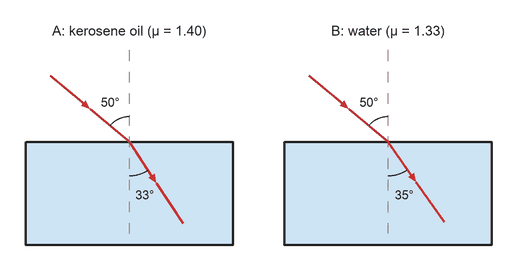
Step 2 — Part (b): write the ratio.
Since μ = c/v, the ratio of refractive indices is the inverse ratio of the speeds:
Step 3 — Part (b): put in the values.
We substitute the two speeds; the powers of ten cancel:
Step 4 — Part (c): heating the kerosene.
Heating lowers the refractive index of kerosene. The ray then bends less towards the normal, so the angle of refraction increases: the refracted ray moves away from the normal.
Watch out: The liquid in which light is FASTER has the smaller μ and the LARGER angle of refraction.
Therefore, (a) in water (beaker B); (b) μ(water) : μ(kerosene) = 43 : 45, about 0.96; (c) the angle of refraction increases (the refracted ray moves away from the normal).
- 563 marks
Question 56
Rohit is travelling by a car through a highway on a hot summer afternoon. The road in front of him appears momentarily wet as shown in the picture below.
(a) Name and define the phenomenon responsible for this.
(b) Provide another example that demonstrates the same phenomenon.
Solve with AIWritten solution
Solution:
Concept: Total internal reflection: it happens only when light goes from a denser to a rarer medium and the angle of incidence is greater than the critical angle. Then no light is refracted out; all of it is reflected back, obeying the laws of reflection (angle of reflection = angle of incidence).
Step 1 — Part (a): name the phenomenon.
The phenomenon is mirage.
Step 2 — Part (a): define it.
A mirage is an optical illusion in which a distant object (a vehicle, a tree, the sky) is seen together with its inverted image below it, as if reflected from a pool of water, so the road ahead looks wet. It is caused by total internal reflection of light at the hot, rarer layers of air near the ground.
Step 3 — Part (a): explain how it happens.
On a hot afternoon the air just above the road is much hotter, and so optically rarer, than the air above it. A ray from the top of an object going downwards passes into hotter and hotter layers and bends away from the normal at each one. Near the road its angle of incidence becomes greater than the critical angle, so it is totally reflected and travels up into the driver's eye. The eye sees the light as coming from below the road.

Step 4 — Part (b): another example.
The mirage seen in a desert: on a hot sunny day a traveller sees what looks like a pool of water with inverted images of distant trees.
Watch out: A mirage is not a reflection from real water; the 'water' is an image of the sky formed by total internal reflection in hot air.
Therefore, (a) mirage: an illusion of water with inverted images of distant objects, caused by total internal reflection of light in the hot, rarer air near the ground; (b) the mirage seen in a desert.
- 574 marks
Question 57
(a) In an experiment to find the refractive index of glass, if yellow light is replaced by green light, then how will the refractive index of the glass change? Give a reason in support of your answer.
(b) What is the value of angle of deviation, when light ray falls normally on the surface during refraction?
(c) Is it possible to have a critical angle of water with respect to glass? (Write YES or NO)
Solve with AIWritten solution
Solution:
Concept: Refractive index and colour: in glass or water, light of shorter wavelength travels more slowly, so the refractive index is larger for violet and blue light and smallest for red light (order: red < orange < yellow < green < blue < indigo < violet). Critical angle (C): the angle of incidence in the denser medium for which the angle of refraction in the rarer medium is 90°. For glass or water to air, .
Step 1 — Part (a): yellow replaced by green.
Green light has a shorter wavelength than yellow light. Glass slows down light of shorter wavelength more, so its refractive index is greater for green light: the refractive index will increase.
Step 2 — Part (b): normal incidence.
A ray falling along the normal (angle of incidence 0°) is refracted at an angle of 0° and goes straight on. Its direction does not change, so the angle of deviation is 0°.
Step 3 — Part (c): critical angle of water with respect to glass.
The answer is NO. A critical angle exists only for light going from a denser into a rarer medium. Water is optically rarer than glass, so light going from water into glass bends towards the normal and can never be totally reflected.
Step 4 — Part (c): the other direction.
For light going the other way, from glass into water, there is a critical angle: sin C = μ(water) ÷ μ(glass), about 63° for ordinary glass (μ = 1.5) and water (μ = 4/3).
Watch out: Total internal reflection needs light going from the denser to the rarer medium; a large angle alone is not enough.
Therefore, (a) the refractive index increases, because green light has a shorter wavelength and travels more slowly in glass; (b) 0°; (c) NO.