
Question 182 marksAsked 2020Medium
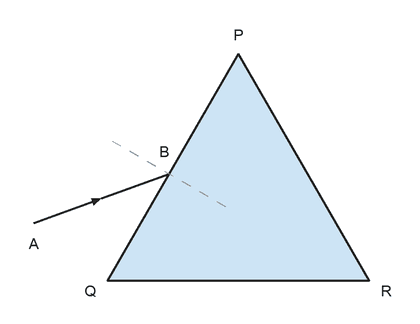
Complete the path of the monochromatic light ray AB incident on the surface PQ of the equilateral glass prism PQR till it emerges out of the prism due to refraction.
Confirming your payment
Sign up now and get 250 free tokens.
Previous Year Questions · Question 18 of 57
Complete the path of the monochromatic light ray AB incident on the surface PQ of the equilateral glass prism PQR till it emerges out of the prism due to refraction.
Solution:
Concept: Refraction: light bends when it passes obliquely from one medium into another because its speed changes. Going into an optically denser medium it bends towards the normal; going into a rarer medium it bends away from the normal. Snell's law: is a constant (the refractive index) for a given pair of media and a given colour of light. All angles are measured from the normal, not from the surface. Prism: for a prism of angle A, the angle of deviation is , where is the angle of incidence and the angle of emergence. Inside, the angles of refraction at the two faces satisfy .
Given: Monochromatic ray AB incident on face PQ of an equilateral glass prism PQR.
Step 1 — At B on face PQ.
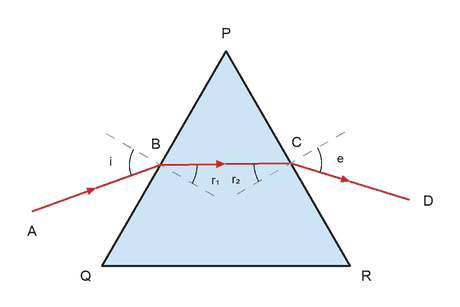
The ray goes from air into glass, so it bends towards the normal at B () and travels across the prism to face PR.
Step 2 — At C on face PR.
Now the ray goes from glass into air. Its angle of incidence is less than the critical angle, so it refracts out, bending away from the normal ().
Step 3 — Describe the overall result.
Both bends turn the ray towards the base QR. So the emergent ray CD is deviated towards the base of the prism compared with the incident ray AB.
Watch out: In a prism both bends turn the ray towards the BASE; drawing the emergent ray bending towards the apex is the usual slip.
Therefore, the ray bends towards the normal at B, crosses the prism, bends away from the normal at C and emerges as CD, deviated towards the base QR.