
Question 172 marksAsked 2020Easy
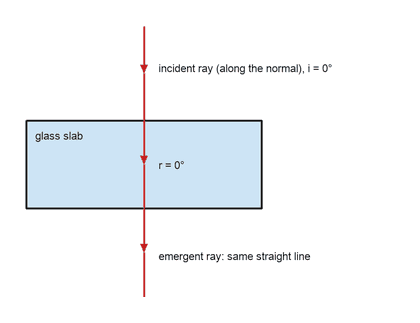
A ray of light falls normally on a rectangular glass slab. Draw a ray diagram showing the path of the ray till it emerges out of the slab.
Confirming your payment
Sign up now and get 250 free tokens.
Previous Year Questions · Question 17 of 57
A ray of light falls normally on a rectangular glass slab. Draw a ray diagram showing the path of the ray till it emerges out of the slab.
Solution:
Concept: A ray that meets a surface along the normal (angle of incidence 0°) passes into the next medium without bending (angle of refraction 0°).
Given: A ray falls normally on a rectangular glass slab.
Step 1 — At the first surface.
The ray falls along the normal, so the angle of incidence is 0°. By Snell's law, sin r is sin 0° divided by μ, which is zero, so the angle of refraction is also 0° and the ray enters the slab without bending.
Step 2 — At the second surface.
Inside, the ray again meets the opposite surface along the normal, so it comes out without bending.
Step 3 — Describe the result.
The ray passes straight through the slab along the same line. There is no deviation and no lateral displacement; the light only travels more slowly while it is inside the glass.
Watch out: Do not draw any bend at normal incidence; the angle of incidence and the angle of refraction are both 0°.
Therefore, the ray passes straight through the slab without bending at either surface (the angles of incidence and refraction are 0° at both faces) and emerges along the same straight line.