
Question 163 marksAsked 2019Medium
How does the angle of deviation formed by a prism change with the increase in the angle of incidence? Draw a graph showing the variation in the angle of deviation with the angle of incidence at a prism surface.
Confirming your payment
Sign up now and get 250 free tokens.
Previous Year Questions · Question 16 of 57
How does the angle of deviation formed by a prism change with the increase in the angle of incidence? Draw a graph showing the variation in the angle of deviation with the angle of incidence at a prism surface.
Solution:
Concept: Minimum deviation: as the angle of incidence increases, the deviation first decreases, reaches a least value , then increases. At minimum deviation the ray passes symmetrically: the ray inside is parallel to the base, and are equal (each is ), and the angle of emergence equals the angle of incidence.
Step 1 — Describe the change.
As the angle of incidence increases from a small value, the angle of deviation first decreases, becomes minimum () at one particular angle of incidence, and then increases again.
Step 2 — State the condition at the minimum.
At minimum deviation the angle of emergence equals the angle of incidence (i = e), and the ray inside the prism travels parallel to its base.
Step 3 — Draw the graph.
Plot the angle of deviation δ (y-axis) against the angle of incidence i (x-axis). The curve is U-shaped, but not symmetrical: it falls steeply, reaches its lowest point, and then rises more gently. The graph below is calculated for a 60° glass prism (μ = 1.5): δmin ≈ 37° at i ≈ 49°, and δ ≈ 58° at both ends of the curve.
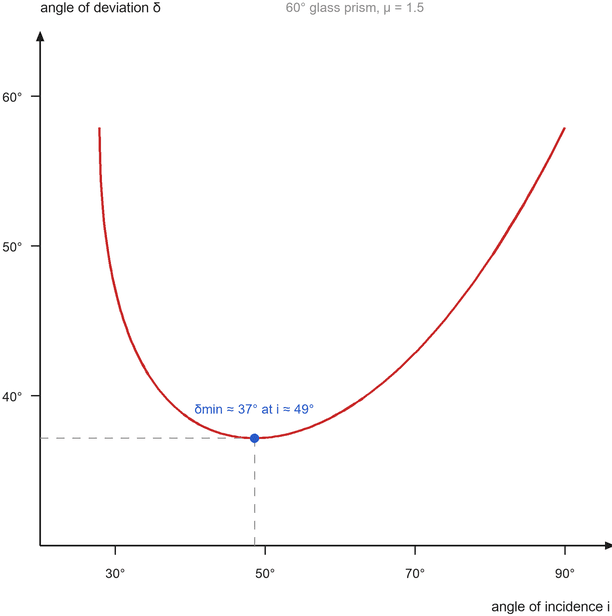
Watch out: The graph is not a straight line and not a symmetrical parabola; it has one lowest point, the angle of minimum deviation.
Therefore, the angle of deviation first decreases, reaches a minimum (δmin, where i = e) and then increases as the angle of incidence increases; the δ–i graph is a U-shaped curve with its lowest point at δmin.