
Question 152 marksAsked 2019Medium
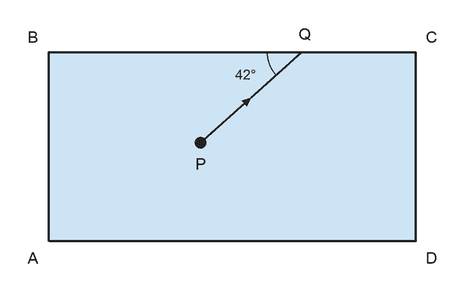
The diagram below shows a light source P embedded in a rectangular glass block ABCD of critical angle 42°. Complete the path of the ray PQ till it emerges out of the block. [Write necessary angles.]
Confirming your payment
Sign up now and get 250 free tokens.
Previous Year Questions · Question 15 of 57
The diagram below shows a light source P embedded in a rectangular glass block ABCD of critical angle 42°. Complete the path of the ray PQ till it emerges out of the block. [Write necessary angles.]
Solution:
Concept: Critical angle (C): the angle of incidence in the denser medium for which the angle of refraction in the rarer medium is 90°. For glass or water to air, . Total internal reflection: it happens only when light goes from a denser to a rarer medium and the angle of incidence is greater than the critical angle. Then no light is refracted out; all of it is reflected back, obeying the laws of reflection (angle of reflection = angle of incidence).
Given: Source P in a glass block ABCD; PQ makes 42° with BC; critical angle 42°.
Step 1 — Find the angle of incidence at Q.
PQ makes 42° with the surface BC. The normal is at 90° to the surface, so the angle of incidence is
Step 2 — Decide what happens at Q.
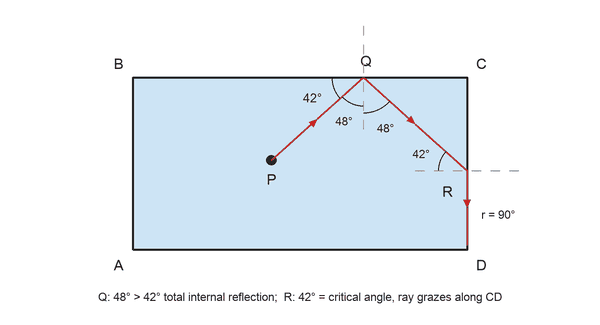
The ray goes from glass to air and 48° is greater than the critical angle, 42°. So the ray is totally internally reflected at Q, with an angle of reflection of 48°.
Step 3 — Follow the reflected ray.
The reflected ray travels down to the right, again making 42° with BC, and meets the face CD at R.
Step 4 — Find the angle of incidence at R.
The normal to CD is parallel to BC, so the reflected ray makes the same 42° with this normal (alternate angles):
Step 5 — Decide what happens at R.
This angle equals the critical angle, so the angle of refraction is 90° and the ray emerges grazing along the face CD.
Watch out: Angles of incidence and refraction are measured from the normal; if a figure gives the angle with the surface, subtract it from 90°.
Therefore, the ray is totally reflected at Q (i = 48°, reflected at 48°) and comes out at R on CD grazing along the surface (i = 42°, the critical angle, r = 90°).